Self Drive Amboseli National Park
How to plan, pay for, drive, and enjoy Amboseli in your own vehicle: gates, rules, elephants, mud, loops, itineraries, and what to do when the track disappears.
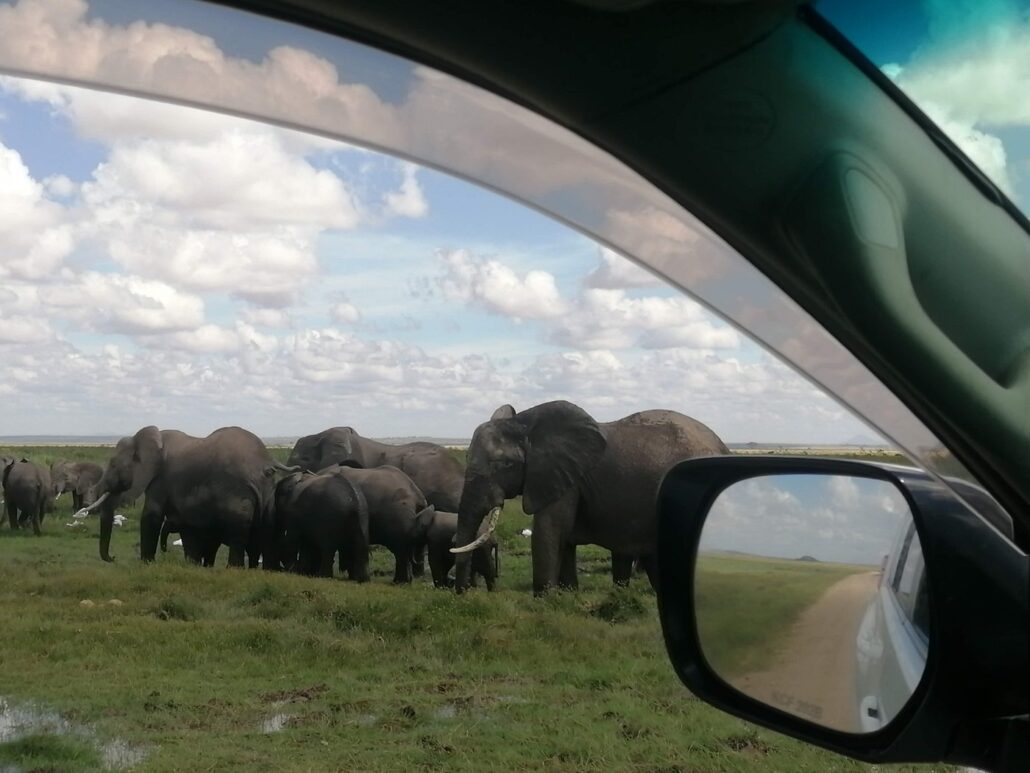 Yes, you can self-drive in Amboseli National Park. Amboseli is managed by the Kenya Wildlife Service (KWS), and visitors may drive their own or a rented 4×4 inside the park, provided they obey the park rules: stay on the tracks, keep to the speed limit, and be out of the park by closing time. Car Rental 4×4 hires safari-ready Land Cruisers from Nairobi to Amboseli National Park, with pop-up roofs, rooftop tents and full camping kits, unlimited mileage and 24/7 roadside assistance.
There is a particular kind of silence that belongs to Amboseli. You will meet it at about half past six in the morning, on a dusty track beside the swamp, after you have switched off the engine. A bull elephant, enormous and unhurried, steps out of the reeds twenty meters from your window. Behind him, as if arranged by a stage designer with a taste for the dramatic, Kilimanjaro lifts out of the cloud.
No guide is needed to experience that moment, though the right preparation helps. Amboseli is compact, open, and legible, which makes it one of the most rewarding national parks in Africa for a self-driver. It is also dusty, rutted, and, after rain, genuinely treacherous. This guide is written for the person who will be behind the wheel: it explains how to pay your fees, which gate to use, how to read the tracks, how to behave around elephants, how to recover from mud, and how to build a trip that works. If you are looking for rental details, vehicles, and pick-up points, see our companion page, Car Rental Amboseli National Park.
Self-Drive Amboseli at a Glance
• Is self-drive allowed? Yes. You pay the daily person fee and a vehicle fee and drive on designated tracks. No guide is compulsory. • Vehicle: a high-clearance 4×4. Tracks are dusty, rutted, and sometimes boggy. • Size: the park is small, about 390 square kilometers; a full day of game driving may cover 60 to 100 km. • Park Gates: Kimana (east), Meshanani (north-west), and Iremito (north-east) are the main entrances. • Fees (from 1 October 2025): about USD 90 per non-resident adult per day and USD 45 per child; vehicle fee is additional. Payment is cashless and best arranged in advance. • Hours: dawn to dusk. Be through a gate at opening time and out by closing time. • Best time: June to October and January to February; sunrise for Kilimanjaro. • Distances: Nairobi about 240 km (4 to 5 hours); Emali about 65 to 110 km depending on the gate and track. • Rules to remember: stay on tracks, 40 km/h, stay in the vehicle, keep about 100 m from elephants, and no night driving. |
Can You Self-Drive in Amboseli National Park?
Yes. Amboseli is a national park run by the country’s wildlife authority, and private vehicles are welcome. You don’t need a ranger or guide to enter, but you can hire one at the gate if you want. You pay a daily entry fee for each person, a fee for your vehicle, and any campsite or activity charges.
Is Self-Drive in Amboseli Easy?
Easier than most. The terrain is open and flat, so you can see across it, and the network of tracks is compact. Wildlife is concentrated around the swamps, which makes sightings reliable. The difficulties are practical: dust in the dry season, mud in the wet, corrugated approach roads, and the discipline needed to stay on the track.
Is It Right for You? A Quick Self-Check
Question | If yes | If no |
Are you comfortable driving a 4×4 on dusty, rutted tracks? | Self-drive suits you. | Consider a driver guide. |
Can you follow a map and note junctions as you go? | Self-drive suits you. | Add a guide for park days. |
Are you happy to wait quietly at a sighting for 30 to 60 minutes? | You will love it. | A guide helps find action. |
Is this your first safari? | Possible, with preparation | Self-drive is an excellent second safari |
Are you travelling in the rain? | Take extra care or choose a guide. | Dry season is easier |
Before You Go: Fees, Payment, and Paperwork
How Park Fees Are Paid
Kenya’s national parks are cashless. Entry is paid electronically, through the wildlife authority’s online portal or an authorized payment channel, and loading funds in advance saves time at the gate. At busy times, gate formalities can take an hour or more, so arrive early and pay ahead. Methods change, so verify the current process before you travel.
What You Will Pay
Item | Approximate cost |
Non-resident adult entry | About USD 90 per day |
Non-resident child (9 to 17) | About USD 45 per day |
Tsavo West and Amboseli combined package | About USD 150 for an adult and USD 80 for a child |
Vehicle entry fee | Charged per day by vehicle size; confirm at booking |
Campsites | Per person per night, on top of park entry |
Kenyan resident and East African citizen | Lower rates; confirm current figures |
What to Bring to the Gate
- Passport and a copy of your payment confirmation.
- Your vehicle’s registration and rental papers.
- A means of payment as advised by the authority.
- You will also need offline maps and a paper map of the park.
You will also need a rental vehicle, a license, a passport, and insurance. We summarize the essentials in the rental section below, and you can find them in full on our car rental Amboseli page.
The Right Vehicle for Self-Drive Amboseli
Amboseli rewards a vehicle with ground clearance, durable tires, and reliable four-wheel drive. A Land Cruiser or Hilux is ideal; a pop-up roof makes photography easier, and a rooftop tent enables camping. A RAV4 can reach the park on the main roads in dry weather but struggles on rutted tracks and in mud.
Vehicle | Best for | Watch out for |
Land Cruiser (LX, V8, Prado, GX) | All-round Amboseli driving, camping, luggage | Larger turning circle on narrow tracks |
Hilux Double Cab | Capable, simple, gear in the load bed | Dust enters the open bed; cover luggage. |
Extended Land Cruiser (pop-up roof) | Photography and viewing over reeds | Close the roof to dust and rain. |
RAV4/Nissan Xtrail | Dry-season travel and the paved approach | Low clearance; avoid wet swamp edges. |
See 4×4 Fleets, Car Rental with Pop-Up Roof in Kenya and Car Rental with Rooftop Tent in Kenya
Why a 4×4 matters in Amboseli
- The dry bed of Lake Amboseli and surrounding flats throw up fine, alkaline dust. A pop-up roof helps with viewing and photography, but keep windows and camera gear protected.
- Tracks near the gates can be washboard. Good suspension makes a real difference over a few days.
- Soft ground. Swamp margins and seasonal wet areas can trap a vehicle. A 4×4 with good tires gives you margin, but not immunity.
- Carry a full-size spare, jack, and tools, all supplied with our vehicles. Know how to change a wheel.
Car Rental 4×4 costs
Item | Cost or term |
Vehicle daily rate | Speak to an expert |
Driver-guide | From about $40 per day; park fees are separate |
Rooftop tent, ground tent, fridge | Rooftop tent = $20 per day, Ground tent at $5 and fridge = $10 |
Mileage and roadside assistance | Unlimited mileage; 24/7 roadside assistance |
Security deposit | $500, refundable at the end of the trip if the vehicle returns without offenses |
Insurance | Covers collision and theft; excess USD 1,500 to 2,000 depending on the vehicle. Punctures, underbody damage, water damage, and negligence are not covered. |
Replacement after a breakdown | Within 24 hours in Kenya |
Additional driver | Can be added at no extra charge; must be named on the agreement |
Driving hours | 6:00 am to 7:00 pm. Outside those hours: liable for damage and a USD 1,200 fine |
Cross-border (COMESA) | USD 50 for up to 20 days; |
Amboseli park fees
Amboseli is classified by KWS as a premium park, and its non-resident adult fee has recently changed. Reports put the adult non-resident rate at around $80 to $100 per day, with a lower rate for children; a 2025 tariff increase was reported to have been challenged in court, so the figure you pay may depend on the ruling in force. Kenyan citizens and residents pay lower rates. KWS daily fees are valid for a single entry and for no longer than 24 hours, and KWS is moving to cashless payment.
Requirements to drive
- A valid driving licence from your country of origin. An International Driving Permit is recommended if your licence is not in English.
- Passport, booking confirmation and the signed rental agreement.
- Minimum age and licence-held period as set in the rental agreement. [CONFIRM]
- We ask about your experience on gravel, mud and manual gearboxes, because it shapes the vehicle and route we recommend.
Getting to Amboseli National Park: Which Gate and Which Road?
Gate | Side | Comes from | Notes |
Kimana | East | Emali and the Mombasa Road; Tsavo; the community lands | Often the first choice for road travelers, this route offers a quieter approach. |
Meshanani | North-west | Nairobi via Namanga road | It is closest to the central plains and Observation Hill. |
Iremito | North-east | Emali side and the Loitokitok road | Useful for coast routes. |
Choosing Your Amboseli National Park Route
From | Route | Distance and time | Road |
Nairobi | Via Kajiado and Namanga roads to Meshanani | About 240 km; 4 to 5 hours | Paved to near the park, then rough gravel and potholes |
Nairobi | Via Emali and the Loitokitok road | About 230 to 250 km; 4.5 to 5 hours | Paved to the Loitokitok road, then dirt |
Emali | Loitokitok road to Kimana or Iremito | About 65 to 110 km depending on the gate; about 2 hours | Mixed paved and dirt |
Mombasa | Mombasa Road via Voi and Emali | About 430 to 440 km; about 7 hours | Paved highway, then dirt |
Tsavo West | Connecting tracks via the community lands | Conditions vary; please check current conditions. | Mixed; 4×4 needed |
Arusha | Via the Namanga border | About 180 km plus border; 3 to 4 hours | Paved, then gravel |
The Amboseli circuit. A neat way to see the country is to enter by one road and leave by another: in via Namanga and out via Emali, or the reverse, with a one-way rental that you collect in Nairobi and return at Emali, Voi, or the coast. See the one-way section below.
Fuel up before you enter. Fill your tank in Kajiado, Namanga, Emali, or Loitokitok. Do not rely on fuel at the park gates.
Amboseli Park Rules Every Self-Driver Must Follow
- Stay on the tracks. Off-track driving damages fragile soils and is not allowed. Our agreement sets a penalty of USD 150 per person in the vehicle.
- Speed limit: 40 km/h under our contract; follow posted signs.
- Stay in your vehicle except at designated points such as Observation Hill and picnic sites. Sitting on top of the vehicle carries a USD 100
- Keep about 100 m from elephants whenever possible, and never get between a mother and her calf. Give animals the right of way. Elephants have priority on every road. Stop, turn off the engine, and wait. Do not reverse or squeeze past.
- Allow animals the right of way. Never block a path; surround an animal or corner it.
- No driving at night. Be at the gate before closing time and at your camp before dark.
- No feeding, calling, or harassing wildlife.
- Keep your distance. Never approach, feed, call, or chase wildlife.
- Take all litter with you. No single-use plastic. Amboseli prohibits it. Pack water in reusable containers.
- Respect local communities and ask before photographing people.
- Drones are prohibited without authorization.
- Be out by closing time. Gates are reported to close at 7:00 pm; our rental agreement limits driving to 6:00 am to 7:00 pm and prohibits game drives after 7:00 pm.
- Our insurance does not cover damage inside national parks, including collisions with wildlife, and excludes off-track driving.
Elephant etiquette from the driver’s seat
Amboseli’s elephants are used to vehicles, which is precisely why you should be careful. Keep to a calm speed, leave a gap, and never position your vehicle between a mother and a calf. If an elephant lifts its head, spreads its ears or shakes its head, ease back quietly and give it room.
Amboseli Gates and Which One to Use
Gate | Where it is | Good for |
Kimana (Olkelunyiet) Gate | North-east of the park | The usual choice if you come via Emali and Kimana town or from Tsavo West through the Chyulu Hills. Handy for lodges and camps near Kimana |
Meshanani Gate | Northern side, close to Ol Tukai Lodge | The common approach is from the Namanga road. Convenient for the central lodges |
Iremito Gate | Western side, close to Kilima Safari Camp | Travellers staying in the west and coming from the Namanga side |
How to Behave Around Amboseli's Elephants
For decades, researchers have watched Amboseli’s elephants, and they remain relaxed around vehicles that behave well. They are also immensely powerful, and a misjudged approach can end a trip. Treat them as you would a large and thoughtful neighbor.
Situation | What to do |
A herd is crossing the track ahead. | Stop well back, switch off the engine, and wait. Do not nose through the line; let them finish. |
A mother with a small calf | Give them extra room and keep still. This is the situation most likely to provoke a warning. |
An elephant flaps its ears, shakes its head, or stamps. | These are warnings. Back away slowly, without revving. |
A mock charge | Stay calm. Do not accelerate toward the animal. Reverse steadily and let it settle. |
A solitary bull with swollen temporal glands (in musth) | Keep a long distance; males in musth are unpredictable. |
Elephants surround the vehicle. | Stay still and quiet. Do not start the engine abruptly. They will move on. |
Elephants on the road at dusk | Give them time. Do not push through to beat closing time. |
Never get out of the vehicle to photograph elephants. A zoom lens and a beanbag are your best tools.
Reading the Terrain: Tracks, Dust, and Mud
Dust
In the dry season Amboseli’s fine volcanic soil becomes a powder that finds its way into everything. Keep windows and vents closed when other vehicles are ahead, give vehicles ahead extra space, and protect cameras with covers.
The Dry Lakebed
The pale flats of the old lakebed look inviting and can be deceptively soft. Keep to the designated tracks across them, and never improvise a shortcut.
Swamp Edges and Black Cotton Ground
Near the swamps, the ground can be damp even during the dry season. After rain, it turns into sticky, slick mud that grips wheels and refuses to let go. Avoid soft margins, avoid following deep wheel ruts, and keep your momentum steady.
Corrugations and Rocks
Many tracks are corrugated. A steady, moderate speed rides over them better than very slow crawling. Watch for rocks and washouts in the approach roads.
Water Crossings
Never enter water you cannot see the bottom of. Our contract treats engine damage from deep water as the hirer’s responsibility.
If You Get Stuck: A Step-by-Step Recovery Guide
Step | What to do |
1. Stop | Stop spinning the wheels immediately. Spinning digs you in. |
2. Check surroundings. | Look for animals before you step out. Stay in the vehicle if any are near. |
3. Engage low range | Select four-wheel drive and low range, then use the lowest suitable gear. |
4. Reverse gently. | Try reversing along your tracks with light throttle. |
5. Clear and prepare | If safe, clear mud from the front of the tires and lay traction boards or branches ahead of the wheels. |
6. Try again. | Use steady, gentle throttle. Avoid sudden power. |
7. Call for help | If still stuck, call us and the nearest rangers. Do not attempt a risky pull with improvised ropes. |
Carry traction boards, a shovel, and a tow strap on every Amboseli trip. We will add them to your vehicle on request.
What to See in Amboseli and How to Drive It
Amboseli rewards a plan: the right place at the right hour.
Place | What you will find | Driving notes |
The swamps (Ol Tukai and Enkongo Narok) | Elephants, buffalo, hippos, and birds gathering around permanent water | Soft margins. Keep to established tracks and give animals room. |
Observation Hill | A viewpoint over the park and the swamps | A short, rough climb. Stay in the designated area and watch for animals. |
Lake Amboseli (dry bed) | Open pan with dust devils and mirage; zebra and wildebeest on the margins. | Dusty and exposed. Floods in wet years |
The plains | Elephants, giraffes, zebras, wildebeests, lions, and cheetahs | Open sightlines. Drive slowly and scan. |
Kilimanjaro | The summit across the border in Tanzania, often clearest early and late | Plan dawn and sunset drives. Clouds often build later in the day |
The Amboseli day clock
Time | What to do |
6:00 to 9:00 am | Best light and the best chance of a clear Kilimanjaro. Drive the swamps and plains. |
9:00 am to 3:00 pm | Heat and haze. Rest at camp or lodge, or follow the shade of the swamps. |
3:00 to 6:30 pm | The second window. Elephants return to water; light turns gold. |
By 7:00 pm | Be out of the park or at your camp. |
The Best Self-Drive Loops in Amboseli
Track numbers and names change, so collect or photograph the map at the gate and treat these as areas rather than fixed routes. All distances are approximate.
Loop | Where | Time | What you will see |
Swamp loop | Along the main permanent swamps | 2 to 3 hours | Elephants, wading, buffalo, hippos, pelicans, and other water birds. The park’s heart. |
Observation Hill | A short drive to the hill, the only place you may step out in the central area | 1 to 2 hours | A sweeping view of the plains, swamps, and mountains. Good for orientation and a break. |
Central plains | Open grassland between the swamps | 2 to 3 hours | Zebra, wildebeest, giraffe, gazelle, and, with luck, cheetah or lion. |
Lakebed edge | Designated tracks around the dry lakebed | 1 to 2 hours | Mirages, dust devils, ostriches, and open skies. Early morning is best. |
Woodland and springs | Acacia woodland near the springs | 1 to 2 hours | Birds, monkeys, giraffes, and shade for a rest. |
The Best Self-Drive Loops in Amboseli
Track numbers and names change, so collect or photograph the map at the gate and treat these as areas rather than fixed routes. All distances are approximate.
Loop | Where | Time | What you will see |
Swamp loop | Along the main permanent swamps | 2 to 3 hours | Elephants, wading, buffalo, hippos, pelicans, and other water birds. The park’s heart. |
Observation Hill | A short drive to the hill, the only place you may step out in the central area | 1 to 2 hours | A sweeping view of the plains, swamps, and mountains. Good for orientation and a break. |
Central plains | Open grassland between the swamps | 2 to 3 hours | Zebra, wildebeest, giraffe, gazelle, and, with luck, cheetah or lion. |
Lakebed edge | Designated tracks around the dry lakebed | 1 to 2 hours | Mirages, dust devils, ostriches, and open skies. Early morning is best. |
Woodland and springs | Acacia woodland near the springs | 1 to 2 hours | Birds, monkeys, giraffes, and shade for a rest. |
How to Plan Your Day in Amboseli
Time | What to do |
5:30 to 6:00 am | Wake, check the vehicle, and be at the gate when it opens. The mountain is clearest now. |
6:00 to 10:00 am | Swamp loop and central plains. Predators and elephants are most active in the cool light. |
10:00 am to 1:00 pm | Observation Hill, a picnic or rest. Cloud often gathers around the summit. |
1:00 to 3:30 pm | Rest at your lodge or camp. The heat is intense, and wildlife is quiet. |
3:30 to 6:00 pm | A second drive in the warm light, with the mountain re-emerging. Be out by closing time. |
Photography Tips for Self-Drivers
- Use a beanbag on the window frame; it steadies a long lens better than a tripod.
- Position your vehicle so the mountain sits behind the elephants, then wait for the light.
- Switch off the engine to remove vibration.
- Shoot early and late for soft light and clear mountain views.
- Keep a cloth ready for dust and wipe the lenses often.
Is Self Drive in Amboseli Safe?
No journey in the wild is without risk. These are the main hazards and how to manage them.
Risk | How to manage it |
Elephants and other wildlife | Stay in the vehicle, keep your distance, and follow the elephant guidance above. |
Mud and getting stuck | Avoid soft ground, carry a recovery kit, and follow the recovery steps. |
Dust | Close vents, protect cameras, and keep a safe following distance. |
Navigation | Photograph the gate map, use offline maps, and note junctions. |
Heat and dehydration | Carry plenty of water and rest in the afternoon. |
Breakdowns | Our rental includes 24/7 roadside assistance. Call us first; do not arrange your own repairs. |
Emergency contacts | Kenya’s emergency numbers are 999 and 112. Save our WhatsApp number and your camp’s number. |
Communication | Coverage is generally adequate at gates and settlements but patchy on the plain. |
Closing time | Leave early enough to reach the gate before it closes. |
Theft | Lock the vehicle and keep valuables out of sight. |
Health | Take malaria advice and carry a first-aid kit. |
Camping and Where to Stay in Amboseli
Camping with Car Rental 4×4
Our camper vehicles carry a rooftop tent or ground tent, a fridge, a gas bottle and cooker, pots and pans, crockery and cutlery, a camp table and chairs, a water container, battery lamps, mattresses, and sleeping bags. Rooftop tents are fitted to Land Cruisers only. (a rooftop tent at $20/day, ground tent at $5 per day, and fridge at $10/day; and camping gear at $10 per day.]
KWS and the neighboring community areas offer camping in and around Amboseli. Facilities and rules vary, so we confirm which sites suit your dates when you book.
Lodges and camps
Where | Examples | Notes |
Inside the park | Amboseli Serena Safari Lodge, Ol Tukai Lodge, Sopa Amboseli, Sentrim Amboseli Lodge (about 3 km from Kimana Gate) | Close to the action; park fees apply for each day you are inside. |
Just outside | Tented camps near Kimana and Iremito, such as Kibo Safari Camp and Kilima Safari Camp | Often better value; check the gate you will use |
Camping | KWS and community campsites | Confirm facilities and booking |
Camp rules of thumb
- Be settled before dusk. Elephants and hyenas move through camps at night.
- Keep food sealed and the vehicle close. Stay by your vehicle after dark.
- Bring warm clothes for early mornings and dust protection for gear.
See our camping gear and rooftop tent pages.
Is Self Drive in Amboseli Safe?
No journey in the wild is without risk. These are the main hazards and how to manage them.
Risk | How to manage it |
Elephants and other wildlife | Stay in the vehicle, keep your distance, and follow the elephant guidance above. |
Mud and getting stuck | Avoid soft ground, carry a recovery kit, and follow the recovery steps. |
Dust | Close vents, protect cameras, and keep a safe following distance. |
Navigation | Photograph the gate map, use offline maps, and note junctions. |
Heat and dehydration | Carry plenty of water and rest in the afternoon. |
Breakdowns | Our rental includes 24/7 roadside assistance. Call us first; do not arrange your own repairs. |
Emergency contacts | Kenya’s emergency numbers are 999 and 112. Save our WhatsApp number and your camp’s number. |
Communication | Coverage is generally adequate at gates and settlements but patchy on the plain. |
Closing time | Leave early enough to reach the gate before it closes. |
Theft | Lock the vehicle and keep valuables out of sight. |
Health | Take malaria advice and carry a first-aid kit. |
Camping and Where to Stay in Amboseli
Camping with Car Rental 4×4
Our camper vehicles carry a rooftop tent or ground tent, a fridge, a gas bottle and cooker, pots and pans, crockery and cutlery, a camp table and chairs, a water container, battery lamps, mattresses, and sleeping bags. Rooftop tents are fitted to Land Cruisers only. (a rooftop tent at $20/day, ground tent at $5 per day, and fridge at $10/day; and camping gear at $10 per day.]
KWS and the neighboring community areas offer camping in and around Amboseli. Facilities and rules vary, so we confirm which sites suit your dates when you book.
Lodges and camps
Where | Examples | Notes |
Inside the park | Amboseli Serena Safari Lodge, Ol Tukai Lodge, Sopa Amboseli, Sentrim Amboseli Lodge (about 3 km from Kimana Gate) | Close to the action; park fees apply for each day you are inside. |
Just outside | Tented camps near Kimana and Iremito, such as Kibo Safari Camp and Kilima Safari Camp | Often better value; check the gate you will use |
Camping | KWS and community campsites | Confirm facilities and booking |
Camp rules of thumb
- Be settled before dusk. Elephants and hyenas move through camps at night.
- Keep food sealed and the vehicle close. Stay by your vehicle after dark.
- Bring warm clothes for early mornings and dust protection for gear.
See our camping gear and rooftop tent pages.
Safety, Navigation, and Road Conditions
Amboseli is a gentle park for a self-driver, provided you respect its conditions.
- Dust: keep windows closed when other vehicles pass, protect cameras, and carry plenty of drinking water.
- Soft ground and rain: avoid swamp edges and low areas after rain. If wheels begin to sink, stop; do not spin.
- Elephants and other animals: they have right of way. Never block their path or drive between a mother and calf.
- Livestock and people: the park is surrounded by Maasai community land, so expect cattle, goats, and people on the roads outside the gates.
- Navigation: download offline maps before you leave Nairobi and take a park map at the gate. Mobile signal can be patchy.
- No night driving: Our agreement limits driving to 6:00 am to 7:00 pm. Plan to arrive in daylight.
- Breakdowns: call our 24/7 line at once, and do not arrange repairs without our authorisation. We arrange repairs or a replacement within 24 hours in Kenya.
- Emergencies: keep Kenya’s emergency number (999 or 112) and our number saved offline. Take travel insurance with medical evacuation cover.
Tickets, Payments and Booking with Car Rental 4×4
Park tickets
KWS issues Amboseli tickets and is moving to cashless payment. Pay through the official KWS channel before you arrive, if possible, and carry proof of payment. Fees are generally non-refundable, so confirm your dates first.
How booking works
- Tell us your plan: dates, party size, route, and whether you want a driver or camping gear.
- We recommend a vehicle and send a written quotation with every cost listed.
- Confirm and pay by the agreed method.
- Collect in Nairobi, with a walk-around inspection and a briefing.
- Return to the agreed place and time with all equipment. Extensions are subject to availability and our consent.
Cancellation, amendment, and refund terms are in your agreement.
What Does a Self-Drive Trip to Amboseli Cost?
Self-drive is often cheaper than a fully guided safari, but not always. The vehicle, fuel, park fees, and accommodation all add up. Here is how to think about the budget.
Cost | Notes |
Vehicle rental | Quoted per model, season, and length of hire in your written quotation. |
Fuel | Paid by you. Planning figures: about 8 to 10 L/100 km (RAV4); 12 to 15 L/100 km (Land Cruiser), more on rough tracks. Nairobi to Amboseli and back is roughly 500 km. |
Park entry | About USD 90 per non-resident adult per day, USD 45 per child, plus a vehicle fee. |
Camping or lodging | Campsite fees per person per night, or lodge rates. |
Add-ons | Rooftop tent $20/day, ground tent $5/day, fridge $10/day, driver-guide from $40/day. |
One-way fee | Route-specific, disclosed at booking. |
Food and water | Bring supplies; options near the park are limited and costly. |
Insurance | Vehicle cover is included subject to excess; arrange your own travel and medical cover. |
Renting a Vehicle for Self-Drive Amboseli: The Essentials
The full details are on our car rental page. In brief:
Topic | What to know |
Documents | Passport, valid driving licence (international permit also accepted), booking confirmation, your own travel and medical insurance. |
Age | Stated in your written quotation; tell us your age and years of licence when you enquire. |
Deposit | $500 where requested, refundable at the end of the trip. |
Insurance | Collision and theft cover, subject to excess: RAV4 $700, Prado TX/TZ $1,700, LX, V8 and GX $2,200. |
Not covered | Damage inside national parks, including wildlife collisions; off-track driving; tyres; underbody; deep-water damage; night driving; tents and gear. |
Mileage | Unlimited. |
Fuel policy | You pay for fuel; no credit for unused fuel. |
Additional drivers | Only named drivers may drive. |
Pick-up and drop-off | Nairobi, Emali, Voi, Mombasa International Airport, Diani Beach, and Watamu, by arrangement. |
Daylight rule | Vehicles are on the road between 6:00 am and 7:00 pm. |
Support | 24/7 roadside assistance; mechanic targeted within 12 hours; replacement vehicle or compensation if repair is not possible. |
Related: Long Term Car Rental Kenya, Car with Driver in Kenya and the full terms.
One-Way Self Drive to and From Amboseli
Collect at one point and return at another, by arrangement. Popular combinations include Nairobi to Emali, Nairobi to Mombasa Airport (with Amboseli and Tsavo on the way), and Emali to Diani Beach. A route-specific one-way fee applies, disclosed in full at booking. Rooftop tents and camping gear are available on one-way hires.
From Amboseli to Tanzania
Many guests continue from Amboseli to Arusha and the Northern Circuit. By prior arrangement you can drive our vehicles across the border at Namanga.
- Authorization: prior written consent from us, with advance notice.
- Insurance: COMESA cross-border cover, arranged by us, at $100 for 20 days or fewer.
- Proof of exit: required on return. Without it, a $400 surcharge applies.
- Documents: prepared by us and checked at handover.
See Cross-Border Tanzania Car Rental and Car Rental Tanzania.
What to Pack for a Self-Drive Trip to Amboseli
Category | Bring |
Documents | Passport, license, international permit if needed, booking confirmation, payment confirmation, and insurance papers. |
Clothing | Neutral colors, layers for cool dawns, hat, sunglasses, scarf for dust and closed shoes. |
Navigation | Offline maps, paper maps, and our contact numbers. |
Electronics | Phone, vehicle charger, power bank, camera with spare batteries, and a dust cover. |
Food and water | Plenty of drinking water, snacks, and a cool box. |
Safari equipment | Binoculars, a field guide, a long lens, and a beanbag. |
Camping equipment | Head torch, sleeping liner, warm layers, and towel. |
Recovery items | Traction boards, shovel and tow strap (ask us to add). |
Personal items | Medication, malaria prophylaxis, insect repellent, sun cream, lip balm and small notes of cash. |
Self-Driver’s Checklist
- Park fees are paid or loaded, and I know my gate and its opening hours.
- I have a 4×4 with a full tank, a spare tire, and a recovery kit.
- I have offline maps and a photograph of the park map.
- I know the elephant rules and the 100 m guideline.
- I will be at my camp or lodge before dark.
- I have saved the emergency contacts and our WhatsApp number.
- I have read the rental terms, excess and deposit.
Frequently Asked Questions About Self Drive Amboseli National Park
Can you self-drive in Amboseli National Park?
Yes. Private vehicles are allowed on payment of the daily person fee and a vehicle fee. A guide is not compulsory.
Do I need a 4×4 in Amboseli?
Yes, strongly recommended. Tracks are dusty, rutted and boggy after rain. A saloon car is not suitable.
How much does it cost to enter Amboseli?
The entry fee is about USD 90 per non-resident adult per day and USD 45 per child since 1 October 2025, plus a vehicle fee.
Can I pay at the gate?
Parks are cashless. Pay through the authority’s approved channels, ideally in advance. Verify the current process before travel.
Which gate should I use?
Kimana from Emali and the east, Meshanani from Nairobi via Namanga, and Iremito from the northeast. Please confirm the conditions before you go.
How far is Amboseli from Nairobi?
About 240 km, roughly four to five hours by road.
How big is Amboseli?
About 390 square kilometers, small enough to see well in two days.
What is the best time to go?
June to October and January to February; sunrise for the clearest Kilimanjaro views.
Can I leave the track to get closer to elephants?
No. Off-road driving is prohibited and attracts fines. Insurance does not cover off-track damage.
Can I get out of my vehicle?
Only at designated points such as Observation Hill and picnic sites.
How close can I get to elephants?
Keep about 100 m where you can, and never come between a mother and her calf.
What if I get stuck in mud?
Stop spinning, engage low range, reverse gently, use traction boards, and call us and the rangers if needed.
Can I camp in Amboseli?
Yes, at designated campsites only. Bush camping is not permitted.
Can I use a rooftop tent?
Yes, at $20 per day for two people.
Can I drive at night?
No. Our contract prohibits it, and gates close around dusk.
Is insurance included?
Yes, for collision and theft of the vehicle, subject to excess. It does not cover damage inside national parks, wildlife collisions, or tents or gear.
How much is the deposit?
$500 where requested, refunded at the end of the trip less any deductions.
Can I combine Amboseli with Tsavo?
Yes. Many self-drive itineraries pair Amboseli with Tsavo West and Tsavo East.
Can I return the vehicle somewhere different?
Yes, you can return the vehicle at a different location for a route-specific fee, but this requires a one-way arrangement.
Is self-drive better than a guided safari?
It depends. Self-drive offers freedom and value; a guide brings expertise and less stress. Many guests combine both.
What are the park hours?
Gates are reported to open from 6:00 am to 7:00 pm. Our rental agreement also limits driving to 6:00 am to 7:00 pm.
Can I see Kilimanjaro from Amboseli?
Often, especially early in the morning and late in the day, and most reliably during the dry season. Clouds can hide the summit later in the day.
Is a driver guide worth it?
For first-timers or those who want help finding cats and reading tracks, yes. A driver guide costs from about $40 a day.
Can I combine Amboseli with the Maasai Mara or Tsavo?
Yes. Many travelers pair Amboseli with Tsavo West or the Maasai Mara. See our combined routes above.
Can I take the vehicle to Tanzania?
Yes, with our prior consent and COMESA insurance. Namanga is the usual crossing to Arusha and Moshi.
Frequently Asked Questions About Self Drive Amboseli National Park
You have, by now, pictured it. The first light turned the snow on Kilimanjaro rose and gold. An old bull elephant walking out of the dust as if the plain were his alone. The quiet at the end of the day, when the herds drift back to the swamps and the engine ticks as it cools, is a moment of peace.
This is the part we take care of so that you do not have to.
Your Land Cruiser will be waiting in Nairobi, serviced and equipped. We will tell you plainly which gate suits your plan, what the roads are doing, and what the rules are. The deposit will be explained, the excess written down, the camp kit packed. And if the unexpected happens on a long, dusty track, someone will answer.
Every detail is considered. No decision is left to chance. All that remains is the part only you can do: to go.
Begin planning your self-drive Amboseli
Send us your dates, party size, route, and whether you want camping gear or a driver-guide. Write to rent@carrental4x4.com or use the contact page.