Lake Nakuru National Park Travel Guide: Wildlife, Gates, Game Drive Routes and Where to Stay
Lake Nakuru National Park is a compact, fenced wildlife park of about 188 square kilometers on the floor of the Rift Valley, roughly 156 km northwest of Nairobi and a few kilometers south of Nakuru city. It is best known for its black and white rhinos, Rothschild’s giraffe, lions, leopards, birdlife, and, when conditions allow, flamingos. Allow a half day at minimum, a full day for a relaxed visit, and one night inside or beside the park if you want sunrise and sunset drives. It suits first-time safari visitors, photographers, bird enthusiasts, and self-drivers.
There is a moment on the Baboon Cliff viewpoint, about the time the morning mist lifts off the lake, when the whole park is laid out beneath you: the pale shoreline, the dark green of the yellow-barked acacia woodland, the rocky ridges standing guard on either side, and the wide silver of the water. Lake Nakuru National Park is not the biggest or wildest park in Kenya, but it may be the most satisfying for its size, a place where you can see rhinos, giraffes, and a long list of birds in a single day without leaving a compact loop.
This guide explains what the park is, what you can see and do there, how it is laid out, when to go, how long to stay, and how to plan your visit. For the town of Nakuru and the attractions around it, see our Nakuru travel guide, and if you are planning to drive yourself, our page on self-drive Lake Nakuru National Park explains the practical details.
Lake Nakuru National Park at a Glance
Quick fact | What to know |
Location | Nakuru County, Great Rift Valley, immediately south of Nakuru City |
Size | About 188 square kilometers, mostly enclosed by a wildlife fence |
Altitude | Roughly 1,750 to 1,900 meters, so mornings and evenings are cool. |
Protected since | It began as a bird sanctuary in 1961 and later became a national park and a Ramsar wetland of international importance. |
Famous for | A rhino sanctuary, Rothschild’s giraffe, over 400 recorded bird species, and a soda lake that has hosted vast flamingo flocks |
Not found here | Elephants, because the fenced area does not support them |
Distance from Nairobi | About 156 km, typically three to four hours by road |
Gates | Main Gate, Lanet Gate, and Nderit Gates are the ones visitors use most. Confirm current gate names and hours before you travel |
Best for | First safaris, rhino viewing, birdwatching, photography, camping, and short breaks |
Is Lake Nakuru National Park Worth Visiting?
Yes, provided you arrive with the right expectations. The park delivers dependable rhino sightings, a good chance of Rothschild’s giraffe, abundant buffalo, zebra, and waterbuck, and some of the finest birdwatching within reach of Nairobi. It also offers a compactness that larger parks cannot match, with short distances between viewpoints, forest, grassland, and lakeshore. For many visitors, that makes it the most efficient safari in Kenya, since you can see several habitats in a single day.
What has changed is the flamingo spectacle. For decades, the lake was synonymous with immense pink flocks, but it has expanded, its chemistry has shifted, and the birds have become smaller in number and more mobile. Visitors who come only for flamingos can be disappointed, while those who come for rhinos, giraffes, forests, and birds usually leave delighted. Treat flamingos as a pleasant extra and plan around the animals that live here all year.
History and Conservation
Lake Nakuru National Park was first protected in the early 1960s, largely to safeguard the lake’s remarkable birdlife, and it was later upgraded to a national park. Over the years, it has grown in importance as a refuge for rhinos, and a fence around the park helps protect the animals from conflict with people. The lake and its surroundings are recognized internationally for their ecological value, and the lake forms part of a group of Rift Valley lakes recognized as a World Heritage site.
The park’s story is one of both success and change. Rhino numbers have been supported by dedicated protection efforts, and Rothschild’s giraffes, a rarer subspecies, have been moved to the park as part of conservation programs. At the same time, the lake itself has changed. Water levels have risen and fallen over the years, affecting the shoreline, the food supply for flamingos, and the areas visitors can reach, which is why information about the park can date quickly.
Landscape and Habitats
The park’s centerpiece is a shallow, alkaline lake whose chemistry supports algae, the food of flamingos and other water birds. Around the lake, open grassland gives way to woodland dominated by yellow-barked acacia, sometimes called fever trees, which form some of the park’s most atmospheric stretches. On the ridges, rocky outcrops and euphorbia trees add texture, and the Rift Valley escarpment rises along the western edge.
This variety is part of what makes the park rewarding to drive. In a short time you can pass through lakeshore, woodland, grassland, and rocky hillside, each with its wildlife and its own light.
Flamingos, Water Levels, and What to Expect Now
Lake Nakuru is a shallow soda lake with no outlet, which means its level and its alkalinity respond quickly to rainfall and inflow. Over roughly the last fifteen years the lake has grown considerably, with its surface area reported to have risen from about 43 square kilometers to well over 60 and, in some estimates, around 80. The rise flooded parts of the shore, covered some low-lying tracks, and drowned stands of acacia, and it diluted the water that supports the algae lesser flamingos feed on.
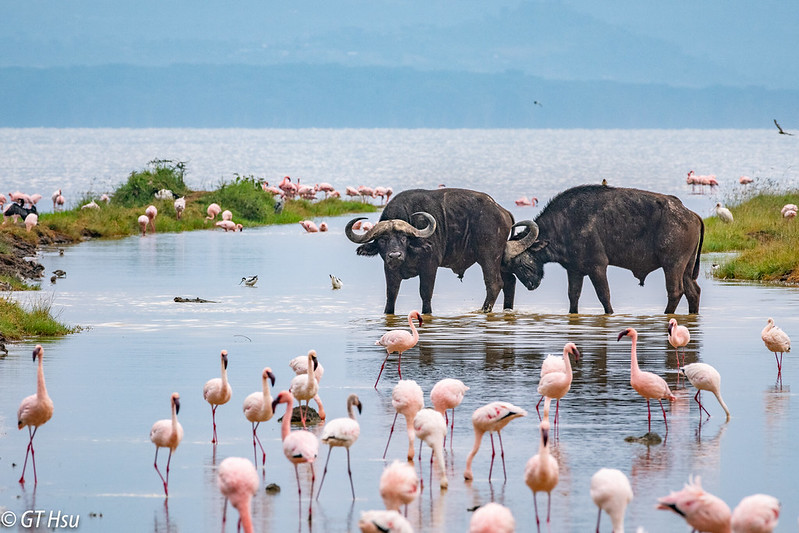
As a result, flamingos have been moving among Rift Valley lakes, including Bogoria and Elmenteita, and sometimes gather in shallower areas such as the southern mudflats. Reports from recent years range from a few hundred birds to tens of thousands, depending on the season and the observer. Pelicans, storks, herons, and many other waterbirds have been more consistent. Before you plan a visit around flamingos, ask the park or an operator about recent sightings, and keep a second objective, such as rhinos or birdlife, in mind.
What stays reliable all year
- Black and white rhinos in the sanctuary.
- Rothschild’s giraffe on the grassland and in the woodland.
- Buffalo, zebra, waterbuck, impala, warthog, and hippo.
- Pelicans, eagles, kingfishers, and a long list of forest and savanna birds.
- Dramatic scenery at Baboon Cliff and the other viewpoints.
Wildlife in Lake Nakuru National Park
Rhinos
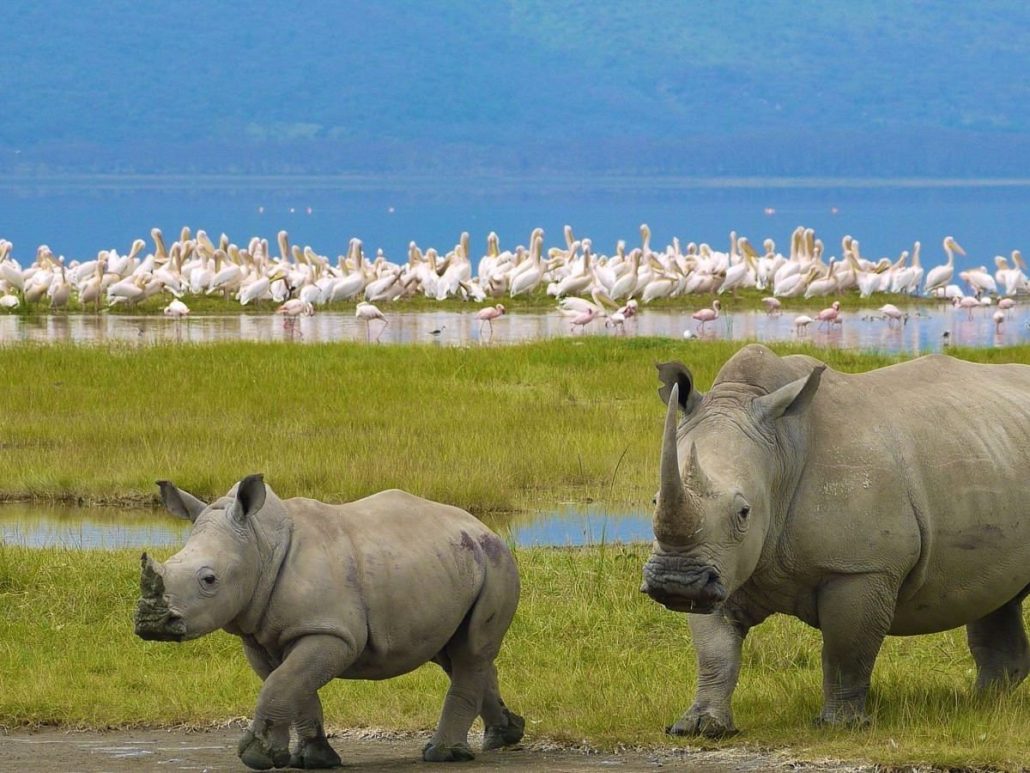
The park’s rhino sanctuary is among the best in Kenya and gives visitors a realistic chance of seeing both species in one drive. White rhinos are the more numerous and are usually found grazing on open grassland, while black rhinos prefer thicker cover and are harder to find, so a sighting of one feels like a reward. Rhinos are most active in the cool of early morning and late afternoon. Keep a respectful distance, stay inside your vehicle, and never approach on foot.
Rothschild’s giraffe
Rothschild’s giraffe is a rare subspecies that was brought to Nakuru from western Kenya beginning in 1977, and the park now supports a healthy herd. You can recognize it by its pale lower legs, which lack the dark patches of other giraffes. They often browse around the fever-tree woodland and open plains, and they make superb photographic subjects against the lake and the cliffs.
Lions, leopards, and other predators
Lions live in the park, and some of them are known to rest in trees, particularly around Lion Hill, which gives the area its name. Leopards also live in the fever-tree forest but are shy and best looked for at dawn and dusk. Hyenas and jackals are present, and occasional cheetah sightings have been reported. Predators are harder to guarantee than rhinos, so a patient drive and a guide who knows recent movements make a real difference.
Buffalo, hippos, primates, and reptiles
Large herds of buffalo, zebra, and waterbuck are easy to find, along with Defassa waterbuck, Grant’s gazelle, impala, and bushbuck. Hippos wallow near the lake and river mouths, and olive baboons are almost always present at Baboon Cliff. Vervet monkeys and black-and-white colobus live in the forest, and large rock pythons sometimes drape themselves in acacia branches.
Birds
Well over four hundred bird species have been recorded, including pelicans, flamingos, storks, ibises, cormorants, kingfishers, and raptors. The migrant season, roughly from November to April, adds northern visitors to the resident birds, and the wetter months often bring breeding activity. Bring binoculars, because many of the best birds sit on distant shorelines.
The Best Places Inside the Park
Place | What you get | Best time |
Baboon Cliff | The park’s classic panorama over the lake and the Rift Valley, a picnic site, and constant baboon activity | Late afternoon for light and cooler air |
Out of Africa Lookout | A second elevated view, with a quieter picnic area | Midday break or late afternoon |
Lion Hill | Ridge and woodland where lions are sometimes seen resting in trees | Early morning or late afternoon |
Makalia Falls | A waterfall of about ten meters in the south, with picnic and camping areas, strongest after the rains | Midday, after rain |
Eastern forest and rhino areas | Thick fever-tree and euphorbia woodland with rhinos, buffalo, and predators | First light |
The lakeshore | Pelicans, waders, and, when present, flamingos, with giraffes and buffalo on the margins | Mid-morning |
Southern grasslands and mudflats | Open plains with giraffes, buffalo, and rhinos, and shallow flats where flamingos sometimes gather | Morning or late afternoon |
Game Drive Circuits: How to Plan Your Day in the Park
The park is small enough that you can cover most of it in a day, but a plan helps you reach the best areas when the animals are active. These circuits are based on how the park is commonly laid out. Park tracks change, and some lakeside sections have flooded or been rerouted as the lake has grown, so ask at the gate which tracks are open.
Morning circuit: forest and rhinos
Enter at first light and head for the eastern forest and the rhino areas, where white rhinos graze and predators may still be moving. Continue through the fever-tree woodland and finish with a stop at Baboon Cliff or Out of Africa for breakfast or an early picnic.
Midday circuit: the lakeshore
As the heat builds, the lakeshore is the most rewarding area. Birds are active, hippos and buffalo gather near the water, and the light is excellent for photographing pelicans and waders. This is also the time to check for flamingos, if conditions allow.
Afternoon circuit: southern plains and ridges
Late in the day, drive through the southern grassland for giraffes and buffalo, stop at Makalia Falls if you have time, and finish on the ridges around Lion Hill and Baboon Cliff for golden-hour views. Leave enough time to reach a gate before closing.
Gates, Opening Hours, and Entry
The park is typically entered through one of several gates, with the Main Gate near Nakuru town being the most commonly used and other gates on different sides of the park. Which gate is best depends on where you are coming from and where you want to start your drive, and gate arrangements can change, so confirm the options and opening hours before you go.
Inside, a network of roads loops around much of the lake, linking the viewpoints, woodland, and grassland. Distances are modest, but speeds are low and stops are frequent, so a full circuit takes several hours.
Gate | Where it is | Best for |
Main Gate | About 4 km from Nakuru city center on the park’s northern side | Visitors staying in town, and those who want to combine park and city stops |
Lanet Gate | Reached from the Nairobi–Nakuru highway at Lanet, on the eastern side | Most visitors arriving from Nairobi |
Nderit Gate | On the southern side, accessed from the Elmenteita direction | Visitors coming from Naivasha or Elmenteita, and those staying at nearby lodges |
Southern entrances near Naishi and Makalia | On the southern edge, near the waterfall and some campsites | Campers and visitors based in the south. Tracks are less maintained. |
- Hours: gates typically open at around dawn and close at dusk, and visitors usually have to exit before closing unless they are staying overnight. Confirm the current times before you travel.
- Tickets: the Kenya Wildlife Service typically uses a cashless online system for park fees, so book or pay through the official channel and carry identification.
- Fees: park fees vary by visitor category and change over time, and vehicles are charged separately. Confirm the current tariff before you travel instead of relying on older guides.
- Guides and rangers: guides can usually be arranged at the gate or in advance. They are particularly useful if it is your first visit.
- Leave early enough: it can take time to buy tickets and pass the gate, and last-minute arrivals lose valuable game-viewing time.
Best Time to Visit Lake Nakuru National Park
The park is open all year, and each season has its character. The dry months from about June to October and from January to February offer firm tracks, concentrated wildlife, and easy driving. The long rains from March to May turn the park green and fill Makalia Falls, but tracks become slippery and some lodges are quiet. The short rains from November to December bring migratory birds, fewer visitors and cool, atmospheric light.
- For rhinos and predators: dry months, especially early mornings.
- For birds: November to April, when migrants arrive and many residents breed.
- For Makalia Falls and green scenery: shortly after the rains.
- For flamingos: no fixed season. Ask about recent sightings before you go.
- For photography: early morning and late afternoon, when the light is soft and animals are active.
- For fewer vehicles: weekdays outside school holidays.
How Long Should You Spend in the Park?
Time available | What you can do | Notes |
Half-day | One game drive covering the forest, lakeshore, and one viewpoint | Works as an add-on to a Naivasha or Nakuru town visit |
Full day | A morning and an afternoon circuit with a picnic at a viewpoint | The best choice for most visitors |
One night | Sunset drive, a first-light drive and a midday rest | Ideal for photographers and campers |
Two nights | The full park plus time for Makalia Falls and southern tracks | Suits birdwatchers and slower travellers |
How to Get to Lake Nakuru National Park
From Nairobi, take the A104 highway toward Naivasha and Nakuru. The park’s Lanet Gate is signposted at Lanet, a short distance before the city, and the Main Gate is a few kilometres further on. The journey is about 156 km and typically takes three to four hours, depending on traffic and trucks. From Naivasha or Elmenteita, the Nderit Gate offers a quieter approach, while the drive from the Maasai Mara usually takes most of a day. For route planning, stopovers, and nearby attractions, see our Nakuru travel guide.
Public transport reaches Nakuru city, but regular services do not serve the park itself, and you cannot walk in the park. Most visitors arrive by private vehicle, rental car, or organized tour. If you are comparing rental options, Car Rental Nakuru explains how pick-up, insurance, and park-day planning work.
Self-Drive, Pop-Up Roof or Driver-Guide: Choosing Your Vehicle
Lake Nakuru National Park is one of the easier parks in Kenya for a first self-drive trip. The roads are well established, distances are short, and the fenced boundary adds a layer of predictability. That said, the right vehicle depends on how you want to spend the day.
If you like… | Choose | Why |
To explore at your own pace and keep costs down | A self-drive 4×4. See self-drive Lake Nakuru National Park for practical advice. | Flexible timing, and a 4×4 handles wet tracks and southern roads better. |
Photography and shared viewing | The lifting roof gives each passenger an open view while the vehicle stays put. | |
Expert wildlife spotting and no navigation | The guide knows recent sightings, tracks and gate procedures | |
A night under canvas in the park | Campsite pitches come without equipment, so bring your own sleeping set-up | |
To continue to another city afterwards | Collect in Nairobi and drop elsewhere, with no backtracking |
Park rules to follow, whichever vehicle you choose
- Stay on marked tracks, and never drive off-road to approach animals.
- Keep to the posted speed limit, which in Kenyan parks is typically around 40 km/h or lower on some stretches.
- Stay inside your vehicle except at designated picnic sites, viewpoints and toilets.
- Do not feed or tease animals, especially the baboons at Baboon Cliff, which are quick to snatch food.
- Keep windows closed near baboons, and do not leave food visible in the vehicle.
- Give rhinos and buffalo plenty of space, and never block animals’ path.
- Be out of the park before the gates close unless you have booked overnight accommodation.
Local notes from our teamArrival: If you are coming from Nairobi, taking the turn-off at Lanet saves you a trip through the city, while staying at a hotel in town makes Main Gate the shorter option. Timing: the first hour after the gates open tends to be the calmest and the most productive for rhinos, so plan the night before so you can be among the first vehicles in. Soft spots: flooded or rerouted lakeside tracks and the low southern roads after rain are the places where vehicles tend to bog down. Ask a ranger which sections are open before you commit. Kit list: water, snacks, a charged phone, offline maps, and a spare tire in excellent condition. |
Other Things to Do in and Around the Park
Beyond game drives, the park offers picnic spots, birdwatching, and, at some times, opportunities for photography at the viewpoints, subject to the park’s rules. Camping is possible at designated campsites, and several lodges lie inside and just outside the park, which allows an overnight stay and two drives in the cooler hours. Check what is currently available and book ahead.
Outside the park, the wider Nakuru area has plenty to fill a second day, including Menengai Crater and Hyrax Hill, which are covered in our Nakuru travel guide, and Lake Elmenteita and Lake Naivasha, which make natural companions on a Rift Valley route. See our Naivasha travel guide for details.
Camping and Accommodation Inside and Beside the Park
Staying inside or next to the park gives you the best light and the quietest roads, and it cuts the time you spend driving to and from the gates. Options range from basic campsites to full lodges.
Campsites
Public and special campsites are reported inside the park, including Makalia, Reedbuck, Naishi, Rhino and Chui, and a backpackers’ site near the Main Gate.
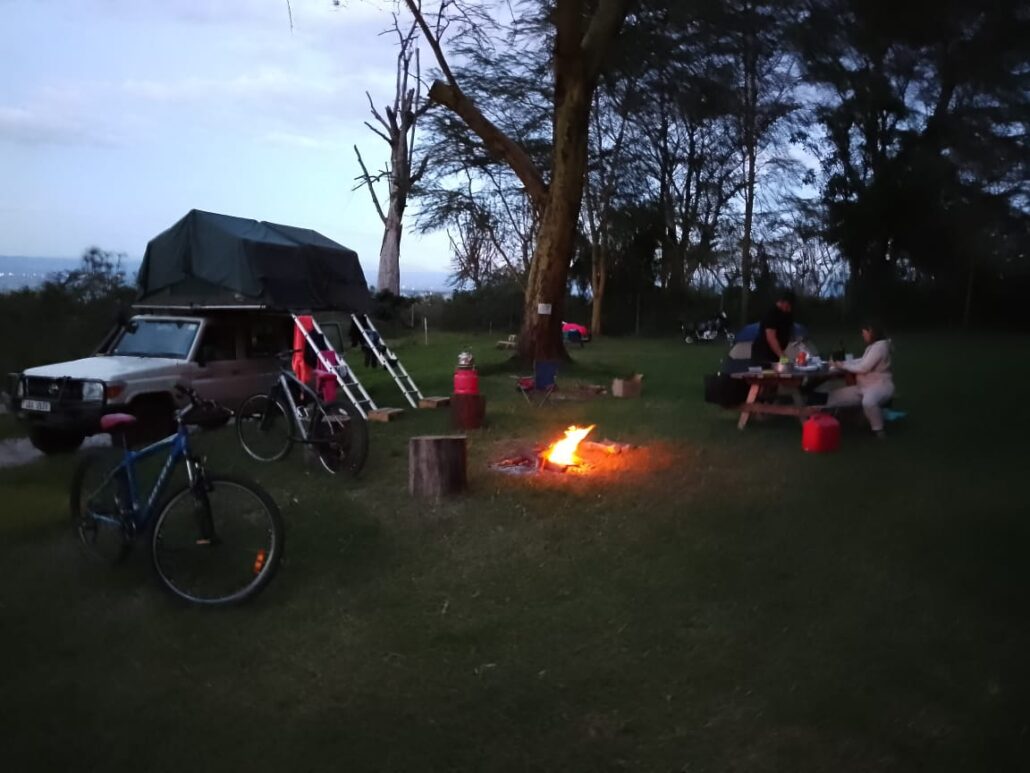
Public sites generally offer basic facilities, while special campsites are private and reserved for a single group. Facilities, water supply, and rules vary, so check the current details before you travel and bring what you need. A rooftop tent and camping equipment make camping in the park straightforward, and you can find them through camping gear and rooftop tent rental.
Lodges and camps
Lodges and tented camps on or near the park boundary include Lake Nakuru Lodge, Sarova Lion Hill Game Lodge, Lake Nakuru Sopa Lodge, and Flamingo Hill Tented Camp, according to published guides. Availability, standards, and prices change, so confirm before you book. If you prefer town facilities, Nakuru City hotels are only a short drive from the Main Gate.
Picnic sites
Baboon Cliff, Out of Africa, and Makalia Falls have designated picnic areas. Pack lunch before you enter, since there are few places to buy food inside the park.
Self-Drive or Guided: Choosing How to Explore
Lake Nakuru National Park is one of the more approachable parks in Kenya for self-driving, subject to the park’s rules, our terms, and the condition of the roads. A self-drive gives you freedom to set your pace and stop wherever the wildlife is, while a driver-guide brings local knowledge of animal behavior, current conditions, and where to look, which can improve your chances of seeing rhinos and leopards.
If you want to drive yourself, our pages on self-driving Lake Nakuru National Park and self-driving in Nakuru explain the practical details, and if you are choosing a vehicle, our page on car rental for Lake Nakuru National Park and our car rental in Nakuru page cover the options. A pop-up roof makes viewing and photography easier, and a 4×4 with good ground clearance is recommended during the rains.
Sample Lake Nakuru National Park Itineraries
Half day (4 to 5 hours)
- Enter at Lanet or Main Gate and head straight for the rhino areas.
- Drive through the fever-tree woodland.
- Finish at Baboon Cliff for the view and a picnic.
Full day (8 to 10 hours)
- First light: eastern forest and rhino areas.
- Mid-morning: a lakeshore for pelicans and waders and a check for flamingos.
- Midday: picnic at Out of Africa or Baboon Cliff.
- Afternoon: Southern grassland, Makalia Falls, and Lion Hill.
- Leave in good time to reach the gate before it closes.
Overnight (sunset to sunrise)
- Afternoon: arrive, check in, and drive to the Southern Plains.
- Sunset: Baboon Cliff or Out of Africa lookout.
- Next morning: first-light drive in the rhino areas, then breakfast.
- Late morning: lakeshore, then exit or continue to Nakuru town, Naivasha, or the Maasai Mara.
Extending Your Trip Beyond the Park
Many travelers combine the park with other nearby stops. Menengai Crater, Hyrax Hill, Lake Elmenteita, and Soysambu Conservancy are within an hour, and Lake Naivasha and Hell’s Gate sit on the road to Nairobi. We cover all of these, plus restaurants, fuel, and where to stay in town, in our Nakuru travel guide. For bigger routes, such as the Maasai Mara, Amboseli, Tsavo, or a cross-border trip, our Kenya safari routes guide shows how Nakuru fits into longer itineraries.
Before You Travel
- Entry authorization: most foreign visitors need a Kenya eTA before they arrive.
- Mandatory health insurance: Kenya requires most overseas visitors travelling on an eTA to hold a Kenyan health insurance policy as well, bought through the eTA process or eCitizen. Check the official portal on the day you apply, because the rules have changed since launch.
- Your cover: a comprehensive travel policy with medical evacuation remains a good idea.
- Driving documents: bring your license and an International Driving Permit.
- Park fees: check the current tariff and payment method with the Kenya Wildlife Service.
- Health notices: regional Ebola-related screening is in place at some airports and borders. Safari areas are described as unaffected, but read the latest Ministry of Health and embassy notices before you travel.
- What to pack: layers for cool mornings, sun protection, binoculars, water, snacks, a hat, and a rain jacket.
Lake Nakuru National Park Frequently Asked Questions
Where is Lake Nakuru National Park?
It lies in Nakuru County in the Great Rift Valley, immediately south of Nakuru city and about 156 km north-west of Nairobi.
What is Lake Nakuru National Park famous for?
A rhino sanctuary, a herd of Rothschild’s giraffe, abundant birdlife, and the soda lake that once held millions of flamingos.
Are there flamingos in Lake Nakuru National Park now?
Occasionally. Flamingo numbers have fallen and become more mobile as the lake has expanded and changed. Ask the park or your guide about recent sightings before you plan around them.
Can you see rhinos at Lake Nakuru National Park?
Yes. The park is a rhino sanctuary with both black and white rhinos, and sightings are common on a well-timed drive, though they are never guaranteed.
Are there elephants in Lake Nakuru National Park?
No. The park is fenced, and it does not support elephants. Amboseli and Tsavo are better for elephants.
Are there lions and leopards?
Yes. Lions, including some that rest in trees, and leopards live in the park, but they are harder to see than rhinos or giraffes.
What is the best time to visit Lake Nakuru National Park?
Dry months give the firmest tracks and the clearest sightings, and migrant birds make November to April a strong period for birdwatching.
How long do you need at Lake Nakuru National Park?
A full day is enough for most visitors, a half day covers the highlights, and one night adds sunrise and sunset drives.
Which gate should I use?
Choose the gate nearest where you start the day: Lanet when driving in from Nairobi, Main Gate from Nakuru City, and Nderit from the Elmenteita side.
What time do the gates open and close?
Gates typically open around dawn and close around dusk. Confirm the current times before you travel.
Is Lake Nakuru National Park good for a first-time safari?
Yes, for many travelers. The park is compact, the wildlife viewing is varied, and the logistics are straightforward, which makes it a good introduction to a safari.
What is the best vehicle for Lake Nakuru National Park?
A 4×4 with good ground clearance is recommended, particularly in the rainy months, and a pop-up roof helps with viewing and photography. Ask for the vehicle and equipment details in writing when you request a quote.
Can I self-drive in Lake Nakuru National Park?
Yes. The park’s size and road network make it one of the easier parks for a first self-drive. See our guide to self-drive Lake Nakuru National Park for advice.
Do I need a 4×4 for Lake Nakuru National Park?
A standard car can manage many dry-weather tracks, but high clearance and four-wheel drive give you a margin on wet ground and on the less-maintained southern roads.
Can I camp in Lake Nakuru National Park?
Yes. Both public and private special campsites are reported within the park boundary. Please reserve through the official channel and confirm the current facilities first.
Is Lake Nakuru National Park good for children?
Yes. Short distances, plentiful wildlife and picnic sites make it family-friendly, and a vehicle with a pop-up roof helps young children see out.
Get a Quote for Your Lake Nakuru National Park Trip
Share your dates, party size, and whether you want a day in the park, a night inside it, or a camping trip, and we will suggest the vehicle that fits: a self-drive 4×4, a pop-up roof safari vehicle, a driver-guide, or a rental that comes with camping equipment. You will see the itemized costs, insurance, and paperwork before you commit.