Self Drive Moshi | Kilimanjaro Rules & 4x4 Hire
Book a 4×4 self-drive car rental in Moshi, and drive yourself from Moshi, at the foot of Kilimanjaro: every mandatory Tanzania travel rule, the new travel insurance, driving and park rules, Kilimanjaro gate rules, a calm first drive, how to reach every northern and southern park from one rental, drop-offs across Tanzania, Kenya, Uganda, and Rwanda, plus rooftop tents, camping gear, and one-way and long-term 4×4 hire.
Can you self-drive from Moshi? Yes. Visitors can drive themselves to the Kilimanjaro gates, the foothill villages, waterfalls, and hot springs, and on to Mkomazi, the northern parks, and, with an overnight stop, the southern parks. Walking on Kilimanjaro itself needs a registered guide
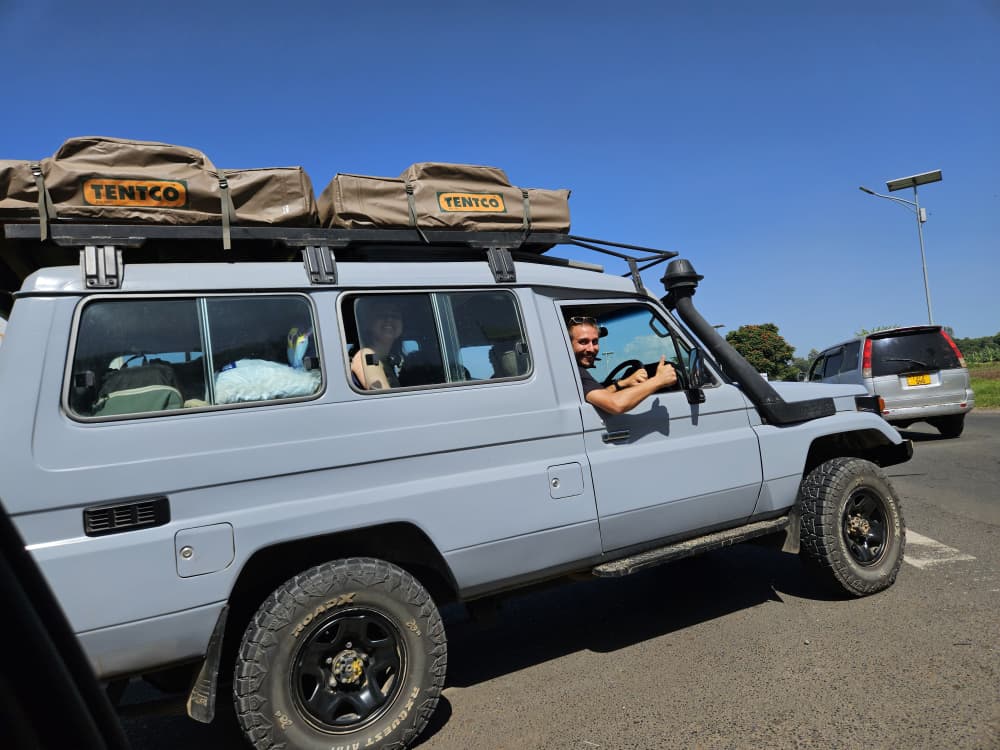 Leave Moshi in the early morning, and Kilimanjaro rises over the town, snow on the summit on a clear day, with the green foothills below it: coffee farms, banana groves, and Chagga villages, waterfalls in the forest, and a hot spring in the plain. Moshi is the base for the mountain, and a self-drive vehicle lets you see its foothills, its gates, and its neighbors at your own pace, with the northern safari circuit a few hours west. And because Moshi sits on the road between Arusha and Dar es Salaam, one rental can take you to the northern parks, down to the southern parks, or across the border to Kenya, Uganda, and Rwanda.
Tanzania also has its own mandatory rules, and several changed recently. From 1 October 2026, most foreign visitors entering mainland Tanzania must hold a mandatory inbound travel insurance policy before they arrive. This page explains how self-drive works from Moshi, including how to reach all the northern and southern parks from one rental, where to collect and drop off across Tanzania and into Kenya, Uganda, and Rwanda, one-way rental, long-term rental, rooftop tents, and camping gear, and sets out all the mandatory travel rules for Tanzania in one place: entry and visa requirements, the new insurance rule, health requirements, driving rules, park rules, the Kilimanjaro National Park rules, and cross-border rules. Please read them before you book.
Self Drive Moshi at a Glance
New from 1 October 2026: most foreign visitors entering mainland Tanzania must hold the government’s mandatory inbound travel insurance, about USD 44 per adult, bought from the National Insurance Corporation (NIC). Arriving without it may mean being refused entry. Also required: a passport valid for at least six months, a visa or e-visa (unless exempt), and a yellow fever certificate if you arrive from or via a yellow fever risk country, including Kenya. Kenya-registered vehicles are not allowed into Tanzanian national parks. Tanzania’s Tourism Act 2008 bars foreign-registered tourist vehicles from tourist sites, and Kenya-registered tourism vehicles are refused at park gates. For the parks, you need a Tanzanian-registered vehicle. Foreign vehicle fees: privately owned foreign-registered vehicles that are allowed into the parks pay a much higher vehicle fee, reported at about USD 177 per day, against roughly USD 10 for Tanzanian-registered vehicles. Driving: Tanzania drives on the left. Carry your home license and an International Driving Permit (strongly recommended). Speed limits are strictly enforced by the traffic police. How hard is it? The paved roads around Moshi are straightforward but busy, with speed bumps, motorbikes, and police checks. The foothill and rural tracks are steep and can be slick in the rains. Start with the main sights, and consider a driver-guide for the first day. Best vehicle: a 4×4 with high clearance, such as a Land Cruiser or Hilux, for the foothill tracks and the parks. A RAV4 manages the paved roads. Kilimanjaro National Park: about USD 82.60 per person per day (USD 70 plus VAT) for non-residents, cashless, with a registered guide required on the mountain. Driver-guide: optional, from $40 per day. Also from Moshi: rooftop tent hire, full camping gear, one-way Tanzania rental (fee from $50 up to $600, quoted per route), and long-term rental. See the sections below. Every park is from one rental: Moshi is the hinge between Tanzania’s north and south. The northern parks are 1 to 9 hours away (Mkomazi, Arusha National Park, Tarangire National Park, Lake Manyara National Park, Ngorongoro, and the Serengeti), and the southern parks are one to two days down the Chalinze road (Saadani, Mikumi, Udzungwa, and Nyerere). See the Moshi hub section. Collect in Moshi; drop almost anywhere: Arusha, Kilimanjaro Airport, Dodoma, Morogoro, Tanga, Dar es Salaam, and Mwanza, and by arrangement Nairobi, Mombasa, Kampala, and Kigali. Daylight only: our vehicles are on the road between 6:00 am and 7:00 pm. Deposit and excess: $500 security deposit where requested; excess $500 (RAV4), $1,500 (Prado TX/TZ), and $2,000 (LX, V8, GX). Mileage and support: unlimited mileage and 24/7 roadside assistance. Request a quote or write to rent@carrental4x4.com. |
Can You Self-Drive From Moshi?
Yes. Visitors can self-drive in Tanzania with a valid license and the right paperwork. From Moshi you can drive yourself to the Kilimanjaro National Park gates, the foothill villages, the Materuni waterfalls, the Chemka hot springs, Lake Chala, and Mkomazi National Park, and on to Arusha, Tarangire, and Lake Manyara. The Serengeti and the Ngorongoro Crater are much further, and the Crater has extra requirements: advance arrangements, a crater vehicle fee, and, according to safari-sector sources, a registered guide or ranger in the vehicle.
Three points set Moshi apart.
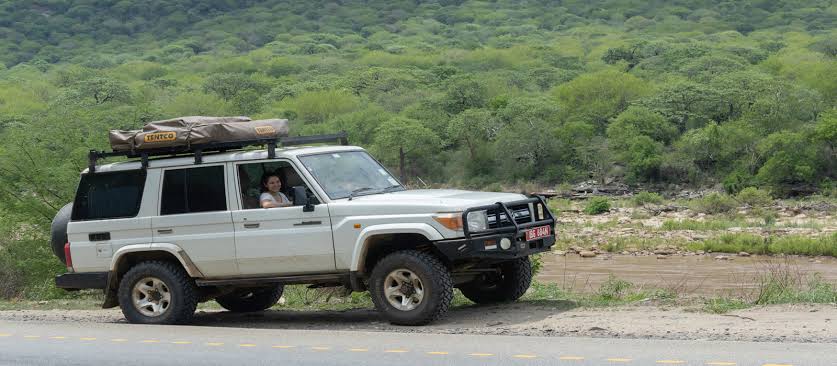
- Kilimanjaro itself cannot be self-driven: vehicles stop at the gates, and anyone entering the national park on foot needs a registered guide.
- Rural roads in the foothills are steep and narrow, and slick after rain.
- And everything else, from insurance to fines, follows Tanzania’s national rules: traffic police are visible and strict, and the hirer pays every fine.
Who Can Rent a Car and Drive in Tanzania?
Any hirer who holds a valid driving license, presents a passport, signs the rental agreement in person, and is named as a driver. Only named drivers may drive, and the vehicle may not be sublet. Minimum age and license-tenure requirements are stated in your written quotation.
What Documents Do You Need?
- Passport valid for at least six months, with a visa or e-visa unless you are exempt.
- Proof of Tanzania’s mandatory inbound travel insurance (the NIC certificate, or ZIC if you entered through Zanzibar).
- Yellow fever certificate if you arrive from or via a risk country.
- A valid driving license from your home country and an International Driving Permit.
- Booking confirmation and the signed rental agreement.
- Security deposit, where requested.
- Proof of payment for any park tickets.
- Your own travel, medical, and life insurance. Our vehicle insurance does not cover personal injury.
Do You Need an International Driving Permit?
A valid license from your country of origin works best, and an International Driving Permit is strongly recommended just for security purposes. It is required if your license is not in English or the Latin alphabet. Carry it alongside your license, never instead of it. Visitors commonly drive on a home license and permit for up to 90 days, while some official advice requires a Tanzanian license for stays over six months, so check the current rule for your stay
Which Vehicle Should You Rent in Moshi?
4×4 Car Rental Tanzania
The main highways around Moshi are paved, but the park roads are murram, made of sand and black cotton soil, and in the rains many roads, urban and rural, are passable only with a four-wheel-drive vehicle. Ground clearance and traction are the arguments for a 4×4. See 4×4 Fleets.
Land Cruiser for Self-Drive
The LX, V8, Prado, and GX versions are the safari standard: strong, comfortable, and easy to service, with room for luggage, water, and a camping kit. The best all-round choice for the northern parks.
Hilux Double Cab
Rugged and practical, with an open load bed for gear. A popular choice for confident drivers who want capability and simplicity.
RAV4
A RAV4 is comfortable around Moshi and on the paved highways and can manage dry-weather drives in the Kilimanjaro foothills and Mkomazi. It has the lowest excess of our 4×4 class ($500), but it is not recommended for the Ngorongoro, Serengeti, or Lake Natron roads, soft ground, or the rains, and it cannot take a rooftop tent.
Pop-Up Roof Safari Vehicles
Renting a car with a pop-up roof in Tanzania from Moshi lets you stand to photograph an elephant, a lion, and a giraffe. Available on the Extended Land Cruiser, self-drive or guided. Stand inside the roof; never on top. See Car with Pop-Up Roof in Tanzania
4x4 Toyota Land Cruiser LX
4×4 Toyota Land Cruiser Hardtop
4x4 Toyota Land Cruiser Prado
4x4 Toyota Land Cruiser LX
4×4 Toyota Land Cruiser Hardtop
4x4 Toyota Land Cruiser Prado
Toyota Land Cruiser V8 With Rooftop Tent
4x4 Toyota Rav4 (Car Rental 4x4 Africa)
Safari Van With Driver Guide
Compare Our Moshi Vehicles
Vehicle | Travelers | Luggage | Game viewing | Rough tracks | Camping | Rooftop tent |
Up to 5 | Generous | Excellent | Excellent | Yes | Yes (single or double) | |
Up to 5 | Generous | Excellent | Excellent | Yes | Yes | |
Up to 5 | Good | Very good | Very good | Yes | On request | |
4 to 5 | Generous | Excellent | Excellent | Yes | Yes | |
Up to 8, incl. driver | Good | Outstanding | Very good | Limited | No | |
4 to 5 | Open load bed. | Good | Very good | Yes | Yes | |
4 to 5 | Moderate | Fair | Moderate (dry only) | Light | No |
Pick-Up and Drop-Off Points in Moshi
You can collect and return your vehicle at any of the points below by arrangement. Delivery to your hotel or the airport arrivals hall can be arranged on request.
Point | Why travelers choose it | Approximate distance from Moshi |
Moshi town and hotels | The usual starting point, close to the Kilimanjaro gates | In town |
Kilimanjaro International Airport (JRO) | About 40 to 45 km; 45 to 60 minutes | |
Base for the northern parks | About 80 km; 1.5 hours. | |
Marangu or Machame | Useful before or after a Kilimanjaro climb | About 40 to 45 minutes to 1 hour. |
Arusha Airport (ARK) | Handy if you fly to or from the Serengeti by light aircraft. | About 80 km plus the town road. |
Dodoma | The capital, on the road to the Lake Zone and the south | About 500 to 520 km. |
The base for Mikumi and the southern parks | About 540 km. | |
The coast, Pangani, and the road to Mombasa | About 370 km. | |
Zanzibar, Saadani, and the South | About 550 km. By arrangement | |
The Lake Victoria exit from the Serengeti | About 900 to 1,000 km, or about 700 km via the Serengeti. | |
Cross-border one-way, with a vehicle swap for parks | About 360 and 400 km. | |
Long cross-border one-ways | About 1,000 to 1,200 km. |
Is It Safe to Drive Yourself from Moshi?
Risk | How to manage it |
Road traffic | Trucks, buses, dala-dalas, and boda-bodas stop and overtake without warning on the Arusha road; leave generous gaps, watch for pedestrians, bicycles, and livestock, and avoid driving at dusk or after dark. |
Speed bumps and potholes | Often unmarked at town and village entrances; slow down early. |
Police checks and fines | Be polite, carry your documents, and keep to the limits, and the hirer pays any fine. Do not pay anything without an official receipt. |
Steep and slick village tracks | Use four-wheel drive and low range, drive slowly, and turn back if conditions worsen. |
Wildlife in parks | Stay in the vehicle, keep a respectful distance, and never approach on foot |
Tsetse flies and baboons | Keep windows up and food out of sight; never feed wildlife. |
Cold and rain in the foothills | Carry warm and waterproof clothing. |
Heat and dehydration | Carry plenty of water, and wear a hat and sunscreen. |
Altitude on the mountain | Follow your guide’s advice; self-guiding is not permitted. |
Getting stuck | Avoid soft ground. Carry traction boards, a shovel, and a tow strap (ask us to add), and call us if you cannot recover. |
Malaria | Present in northern Tanzania; take medical advice about prophylaxis and use repellent. |
Theft | Lock the vehicle, keep valuables out of sight, and do not leave bags in a parked vehicle at the gates. |
Breakdowns | Our rental includes 24/7 roadside assistance. Call us first; do not arrange your own repairs. |
Emergency contacts | Tanzania’s emergency numbers include 112 for general emergencies. Save our WhatsApp number. |
Health | Hold Tanzania’s mandatory travel insurance and your own medical and evacuation cover |
How to Plan Your Time Around Moshi
A One-Day Self-Drive: Materuni and Chemka
Time | What to do |
7:00 to 8:00 am | Collect the vehicle; fill up in Moshi; buy water and snacks |
8:00 to 8:45 am | Drive to Materuni village. |
8:45 am to 12:30 pm | Walk to the waterfall with a local guide, then have a village lunch and a coffee demonstration. |
12:30 to 2:30 pm | Drive to Chemka Hot Springs. |
2:30 to 4:30 pm | Swim and relax |
By 5:30 pm | Drive back to Moshi. Do not drive after dark. |
A One-Day Self-Drive: Marangu
Drive to Marangu Gate (about 40 to 45 km, one hour) for a guided hike into the forest, or spend the day in Marangu village, its waterfall, and its coffee farms. Be back in Moshi before dark.
Longer Self-Drives
For Mkomazi, Arusha National Park, Tarangire, and Lake Manyara, plan overnight stops and book accommodation or campsites in advance. For Kilimanjaro, your operator arranges the climb while you rest. See the itineraries below.
Tips From the Road
- Start early: the mountain is clearest in the morning, and clouds build later.
- Fill your tank in Moshi and carry water, snacks, and warm clothing.
- Use local guides at waterfalls and villages, and pay local fees as asked.
- Never leave the vehicle in a park except at designated points.
- Be patient. Slow driving is safer and shows you more.
Self-Drive vs. Driver-Guided Around Moshi
What matters | Self-drive | With a driver-guide |
Village tracks and waterfalls | You find and judge them | The guide knows the tracks and local guides. |
Tanzanian traffic police and speed limits | You manage them. | Your driver handles them. |
Kilimanjaro gate procedure | You arrange it with your operator. | Your guide can help arrange it |
Park gates and cashless payment | Yours | Handled for you |
Navigation | Offline maps and a paper map | Your guide knows the roads. |
Freedom and privacy | Total | Set around your brief. |
Cost | Vehicle plus fuel plus deposit | Vehicle plus about $40 per day plus fuel |
Who should choose self-driving? Confident drivers who enjoy exploring the foothills at their own pace, who have bought their insurance, and who are comfortable with strict policing and busy roads.
Who should choose a driver guide? First-time visitors, anyone who would rather not manage the Arusha road and the police checks, and travelers combining Moshi with the northern parks. Many guests self-drive and add a guide for the first day. See a car with a driver in Tanzania.
Car Rental With a Rooftop Tent From Moshi
Hiring a car with a rooftop tent in Tanzania from Moshi turns your 4×4 into a self-contained camp. It lifts you off the ground, away from damp, insects, and curious animals, and it lets you sleep wherever you can camp legally, from a public campsite in Tarangire to the rim of Ngorongoro. We fit rooftop tents to our Land Cruisers and hire them with the vehicle.
Item | Details |
Price | $20 per day for two people. |
Sizes | A single tent sleeps two; a dual tent sleeps three to four |
Vehicles | Fitted to Land Cruisers. Not available on the RAV4. Hilux fitting on request. |
Insurance | Not covered by vehicle insurance. |
Bedding | CONFIRM mattress, pillows and bedding supplied; ask about warm bedding for cold nights |
Where you may use it | Only at designated campsites in parks and conservation areas. Bush camping is not permitted. |
Pairs well with | Camping gear: kitchen, table, chairs, lamps, water, and a fridge, below |
Is a Rooftop Tent Right for You?
Good for | Think twice if |
Park campsites and flexible itineraries | You want hot showers and room service every night |
Sleeping above the ground, away from damp and insects | You are travelling in the long rains, when it is wet, cold, and muddy |
Quick setup after a long drive | You dislike climbing a ladder at night. |
Keeping costs down on a multi-day safari | You have very young children, who may be happier in a lodge or ground tent. |
Driving With a Rooftop Tent
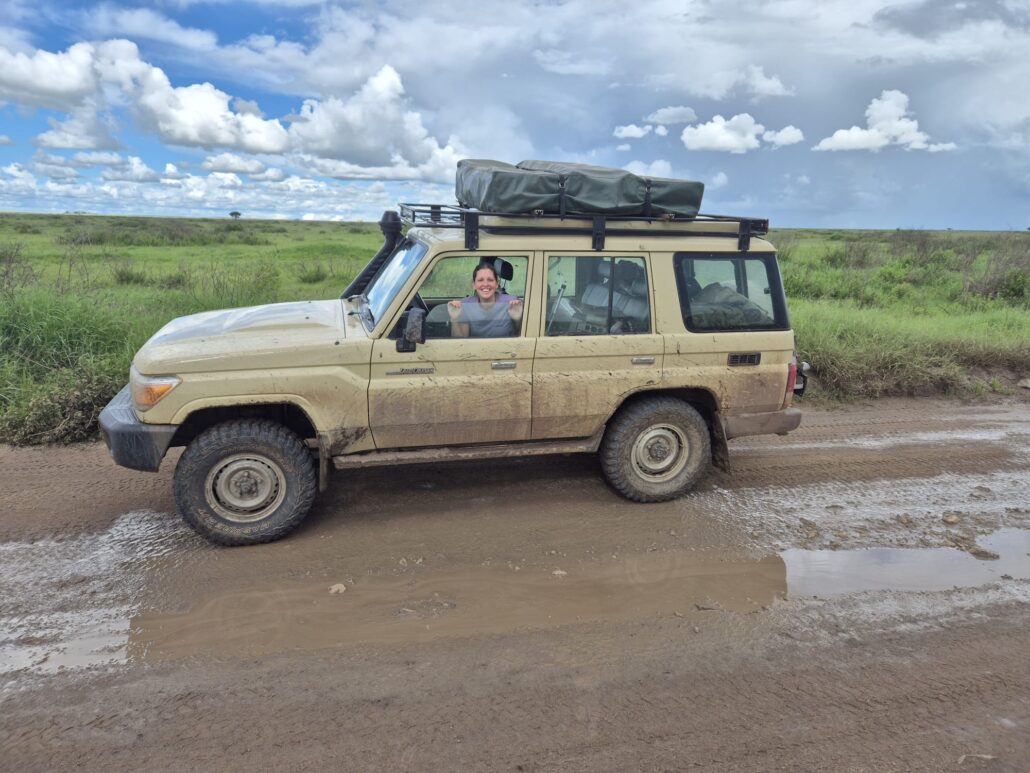
- Mind the height. The tent raises the vehicle’s height, so watch low branches and overhead barriers.
- Expect more wind noise and fuel use, and drive a little slower on rough roads.
- Park on firm, level ground before opening the tent, and never sleep in a tent on a slope.
- Keep food out of the tent. Store food and rubbish in the vehicle or the designated stores, because hyenas, elephants, and baboons are attracted to it.
- Stay inside the campsite after dark, and follow the campsite’s instructions.
- Check the closed tent and straps before each drive.
See our Car with Rooftop Tent in Tanzania page for photographs and more detail.
Car Rental With Camping Gear From Moshi
Car rental with a rooftop tent in Tanzania and camping gear are everything else you need to camp. You can hire either or both, with a vehicle from Moshi. A fully equipped 4×4 car rental in Tanzania with camping gear lets you sleep inside the parks, close to the animals and the dawn game drive.
Item | Details |
Ground tent | $5 per day for two, with two foam mattresses |
Rooftop tent | $20 per day for two (see above) |
Fridge | $10 per day |
Cooking equipment | Gas burner and bottle, pots, pans, and utensils |
Crockery and cutlery | Plates, mugs, and cutlery for your group |
Furniture | Camp table and chairs |
Lighting | Battery lamps |
Water and cleaning | Water container and wash-up kit |
Where You Can Camp
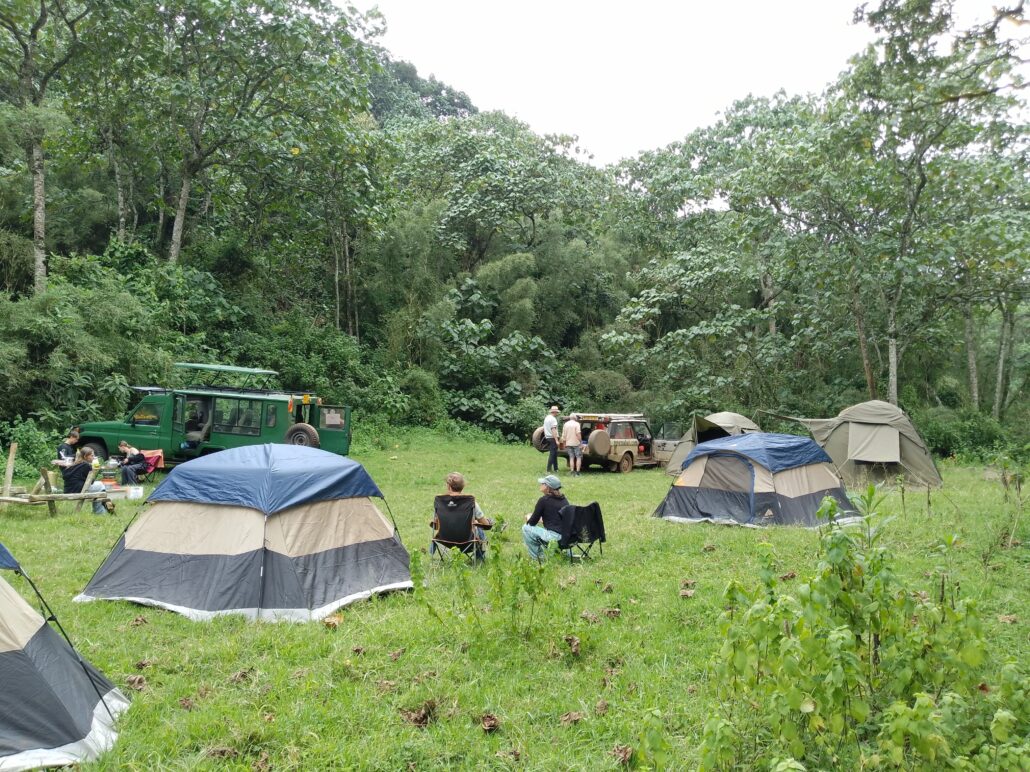
- Public campsites inside the parks are booked in advance with the park authority and charged per person per night on top of entry. They have basic facilities.
- Special campsites are more private and more expensive and are booked in advance.
- Campsites outside the parks, near Moshi, Arusha, Same, Karatu, Mto wa Mbu, Morogoro, and Mikumi, are privately run.
- Only camp at designated sites. Bush camping is not permitted, and camping gate and campsite payments are cashless.
Camping Tips for Northern Tanzania
- It gets cold. The Ngorongoro rim and the highlands are cold at night, so bring warm layers and ask about warm bedding.
- Respect the animals. Elephants, hyenas, and baboons visit campsites. Keep food in the vehicle, and never walk away from camp at night.
- Shop in Moshi. Buy food, water, firewood, and ice there; supplies inside the parks are limited.
- Arrive before dark. Our vehicles are on the road between 6:00 am and 7:00 pm, and the parks close at 6:00 pm.
- Leave no trace. Take all rubbish with you; fires only where designated.
Long-Term Tanzania Car Rental From Moshi
Long term car rental in Tanzania from Moshi suits anyone who needs a dependable vehicle in Tanzania for weeks or months: researchers and film crews, volunteers and NGOs, overland travellers, business visitors, and people settling in Moshi. You collect your vehicle in Moshi and keep it for the whole stay, with unlimited mileage and 24/7 roadside assistance.
What to agree | How it works |
Rate | A lower daily rate for longer hires. |
Mileage | Unlimited kilometers on all hire vehicles |
Servicing | Routine services and wear items are agreed in advance, including who arranges and pays for them and how the vehicle is covered meanwhile. |
Tyres and repairs | Punctures and tire damage are the hirer’s responsibility under our contract; breakdown repair is arranged by our team. |
Insurance and excess | Vehicle insurance is included, subject to excess ($500 RAV4, $1,500 Prado TX/TZ, $2,000 LX, V8, GX). |
Deposit | $500 where requested; a larger deposit may apply for longer hires. |
Payment | Bank transfer, in installments for long hires. Card payments carry a 4% surcharge. |
Extensions and swaps | Request extensions before the return date. A vehicle swap can be arranged if the hired vehicle needs long repair |
Cross-border | Only with prior written approval and a COMESA Yellow Card cover |
Tanzania Rules That Matter for Long Stays
Topic | What to check |
Visa | A tourist visa has a limited stay. Longer stays need the right visa or residence permit. Check your status with Tanzania Immigration. |
Mandatory travel insurance | The NIC policy is valid for up to 92 days. Stays longer than that need a new policy. |
Driving license | A home license and International Driving Permit are commonly accepted for up to 90 days; some official advice requires a Tanzanian license after six months. Plan ahead. |
Park fees | Entry is charged per 24-hour period, so frequent park use adds up. Ask about annual or multi-day arrangements. |
Night driving | Not allowed in our vehicles at any time |
Fines | Traffic fines during the hire are the hirer’s responsibility. |
Who Long-Term Rental Suits
- Research and film teams working across the northern circuit and beyond.
- Volunteers, NGOs, and project staff based in Moshi.
- Overland and long-trip travellers who want one vehicle for the whole journey.
- Business visitors and relocating families who need a reliable car while they settle.
See also long-term car rental in Tanzania.
One-Way Tanzania Car Rental From Moshi
One Way Tanzania car rental from Moshi lets you collect your vehicle in Moshi and return it somewhere else, so you do not have to drive back. It suits travelers who finish a Kilimanjaro trip in Arusha, drive on to Dar es Salaam, Dodoma, Morogoro, Tanga, or Mwanza, or continue to the Kenyan coast, Nairobi, Kampala, or Kigali. The one-way fee is route-specific and is quoted in writing at booking, from $50 up to $600.
Route from Moshi | Approximate distance and time | What to know |
Kilimanjaro International Airport | About 40 to 45 km; 45 to 60 minutes | The simplest one-way. |
Arusha | About 80 km; 1.5 hours | A popular one-way before the northern parks |
Dar es Salaam | About 550 km; 8 to 9 hours | Our daylight-only rule means an overnight stop. |
Nairobi (Kenya) | About 360 km via Arusha and Namanga; 6 to 8 hours | Cross-border: written approval and COMESA coverage are needed |
Dodoma | About 500 to 520 km; 8 to 9 hours | Via Arusha and Babati. |
Morogoro | About 540 km; 8 to 9 hours | Via Chalinze. Base for Mikumi |
Tanga | About 370 km; 6 to 7 hours | Via Same and Mombo. |
Mwanza | About 900 to 1,000 km; two days | Or about 700 km through the Serengeti. |
Kampala (Uganda) | About 1,000 to 1,200 km; 2 to 3 days | Cross-border, quoted separately. |
Kigali (Rwanda) | About 1,100 km; around 3 days | Cross-border, quoted separately. Rwanda drives on the right. |
Mombasa (Kenya) | About 400 km via Holili and Taveta; 6 to 8 hours | Cross-border. |
Zanzibar | Not by vehicle | Vehicles may not be driven onto ferries. Return the vehicle in Dar es Salaam. |
Popular One-Way Combinations
Collect | Return | Typical use |
Moshi | Moshi | A Kilimanjaro foothills loop, with Mkomazi or Chala |
Kilimanjaro Airport | Kilimanjaro Airport | Arrive, drive, fly home. |
Moshi | Arusha | Foothills first, then the northern safari circuit |
Moshi | Mombasa or Nairobi (cross-border) | Tanzania to Kenya. Needs written approval and COMESA coverage |
Moshi | Dar es Salaam | Northern parks first, then the long road south, ending on the coast or at the Zanzibar ferry |
Moshi | Dodoma or Morogoro | Cross the country, with Mikumi or Udzungwa on the way. |
Moshi | Tanga | The coast road, with Mkomazi and the Usambaras on the way. |
Moshi | Mwanza | Through the Serengeti and out of the west gate. |
Moshi | Kampala or Kigali (cross-border) | A long cross-border route; written approval and cover are needed. |
Dar es Salaam, Arusha, or Mwanza | Moshi | Reverse routes work too, by arrangement. |
Nairobi, Kampala, or Kigali | Moshi | Start abroad and finish at the mountain. Needs written approval and a swap for parks. |
How a One-Way Rental Works
- Tell us at inquiry. Give your collection and return points, dates, and route so we can quote the one-way fee and check availability.
- Daylight driving only. Our vehicles are on the road between 6:00 am and 7:00 pm, so long one-way routes need an overnight stop.
- Cross-border one-way needs extra paperwork. Written approval, the COMESA Yellow Card cover, and the border formalities are in the section below.
- Reverse and mixed routes work too. Start in Dar es Salaam, Arusha, Kenya, Uganda, or Rwanda, and finish in Moshi, by arrangement.
- One rental, one return point. A rental ends where it is returned. For a loop through several countries, plan a swap or a new rental at each border.
- Return and inspection. The vehicle is inspected at the drop-off point, and the deposit is refunded when it returns without offenses.
- Late returns are charged for extra days. Request any extension before the return date.
One-way fees are not the same on every route.
Driving Between Tanzania and Kenya From Moshi
Moshi is close to the Kenyan border at Holili and Taveta, about 60 km away. Crossing with a rental vehicle is possible only by prior arrangement. The rules are strict, the paperwork takes time, and a vehicle registered in Tanzania cannot be used as a tourist vehicle in the other country’s parks.
Requirement | What applies? |
Written approval | You may not cross any international border without our prior written approval. |
Parks | A Kenya-registered vehicle must not enter Tanzanian national parks, and a Tanzanian-registered vehicle must not enter Kenyan parks, reserves, and conservancies. Plan a vehicle swap at the border if your trip includes parks on both sides. |
COMESA Yellow Card | Additional third-party cover is required, and the COMESA fee is $50 |
Vehicle formalities | Temporary import and vehicle documents must be completed at the border. Carry the registration, insurance, and approval letter. |
Your own entry | Your visa or e-visa, passport, yellow fever certificate, and Tanzania’s mandatory travel insurance must be in order before you cross. If you enter Tanzania by land first, the NIC policy is needed. |
Border posts | Holili and Taveta (from Moshi), Namanga (on the Arusha to Nairobi road), and Isebania and Sirari (Mara and Serengeti side) |
One-way fee | Route-specific and disclosed at booking, from $50 up to $600 |
Time | Allow extra time for border formalities; borders close at night |
Driving Between Tanzania and Uganda or Rwanda From Moshi
From Moshi, Uganda is reached through Nairobi or round Lake Victoria, and Rwanda through the Lake Zone. Both are long cross-border drives that are possible only by prior arrangement, with our written approval and cross-border cover.
Destination | Route from Moshi | Distance and time |
Kampala, through Kenya | Arusha, Namanga, Nairobi, then Malaba or Busia | About 1,000 to 1,050 km; 2 to 3 days |
Kampala, round Lake Victoria | Arusha, Singida, Shinyanga, Mwanza, Bukoba and Mutukula | About 1,150 to 1,200 km; around 3 days |
Kigali | Arusha, Singida, Kahama, Nyakanazi and the Rusumo border | About 1,100 km; around 3 days |
Kigali, through the Serengeti | Arusha, Ngorongoro, the Serengeti, Mwanza, and then Rusumo | About 1,200 km or more; 4 days. |
Border Posts You Will Use
Border | Between | Used for |
Holili and Taveta | Tanzania and Kenya | Moshi to Tsavo, Amboseli, and Mombasa |
Namanga | Tanzania and Kenya | Arusha to Nairobi |
Horohoro and Lunga Lunga | Tanzania and Kenya | Tanga to Mombasa |
Isebania and Sirari | Tanzania and Kenya | The Serengeti and Maasai Mara side |
Mutukula | Tanzania and Uganda | Bukoba to Masaka and Kampala |
Malaba and Busia | Kenya and Uganda | Nairobi to Kampala |
Rusumo | Tanzania and Rwanda | The Lake Zone to Kigali |
Gatuna and Katuna | Uganda and Rwanda | Kampala to Kigali |
Rules for Uganda and Rwanda
Requirement | What applies? |
Written approval | You may not cross any international border without our prior written approval. |
Cross-border cover | Additional third-party cover is required. Our published fee is $50 |
Side of the road | Kenya and Uganda drive on the left, as Tanzania does. Rwanda drives on the right. |
Parks | A Tanzanian-registered rental must not be used as a tourist vehicle in another country’s parks without our approval, and a vehicle registered in Kenya cannot enter Tanzanian parks, while Uganda & Rwanda can enter but at an extra fee for foreign vehicles. Plan a vehicle swap if your trip includes parks on both sides, or remain with the same car, but accept the extra charges |
Visas | The East Africa Tourist Visa covers Kenya, Rwanda, and Uganda, but not Tanzania. Check each country’s visa and yellow fever rules. |
Rwanda specifics | Single-use plastic bags are banned, and community work on the last Saturday morning of the month limits movement. |
Time and fee | Allow extra time at borders, which close at night. One-way fees for these long routes are quoted separately. |
Crossing a Border Step by Step
Step | What to do |
Before you book | Tell us the countries, the crossing points, and your dates so we can approve the route and quote the cover. |
The day before | Fill the tank, and carry your passports, visas, yellow fever cards, the rental agreement, and the cross-border certificate. |
At the exit post | Clear Tanzanian immigration and customs, and have the vehicle papers stamped. |
At the entry post | Buy the visa or confirm the East Africa Tourist Visa, show the cover, and complete the temporary vehicle import. |
Timing | Allow one to three hours, arrive early, and cross well before 7:00 pm. |
Parks | Swap to a vehicle registered in that country for park days, or use a registered local operator. |
Moshi Self Drive Itineraries
1 Day: Materuni and Chemka
- Collect in Moshi, visit the Materuni waterfall and a coffee farm, swim at Chemka, and return before dark.
1 Day: Marangu
- Drive to Marangu Gate for a guided forest hike to Mandara Hut, or explore Marangu village and its waterfall.
2 to 3 Days: Foothills, Chala, and Mkomazi
- Day 1: Materuni and Marangu. Day 2: Lake Chala. Day 3: Mkomazi National Park, then back to Moshi.
4 Days: Moshi and the Northern Parks
- Day 1: Moshi foothills. Day 2: Drive to Arusha National Park. Day 3: Day 4: Lake Manyara, then Arusha. See self drive Arusha.
6 to 7 Days: Kilimanjaro and the Northern Circuit
- A Kilimanjaro climb with your operator, then collect the vehicle in Moshi and continue to Arusha, Tarangire, Manyara, and Ngorongoro. A driver-guide is recommended for the Crater.
Tanzania and Kenya: Moshi to Tsavo and Amboseli
- Cross at Holili and Taveta (with written approval and COMESA cover) to Tsavo West and Amboseli, swapping to a Kenya-registered vehicle at the border, because Tanzanian-registered vehicles cannot enter Kenyan parks. See our self drive Tsavo West and self drive Amboseli
9 Days: Kilimanjaro Airport to Kilimanjaro Airport, With the Serengeti
- Day 1: land and sleep in Moshi or Arusha. Day 2: Collect the vehicle, fill the tank, and drive to Arusha National Park. Day 3: Lake Manyara, then Karatu. Day 5: the Ngorongoro Crater with a licensed guide or ranger, then the Serengeti. Day 6: the Serengeti. Day 7: back to the Ngorongoro rim or Karatu. Day 8: Arusha. Day 9: Return the vehicle at the airport.
16 Days: Every Northern and Southern Park, from Moshi to Dar es Salaam
- Day 1: Collect in Moshi and visit the foothills. Day 2: Arusha National Park. Day 3: Lake Manyara and Karatu. Day 5: the crater with a guide or ranger, then the Serengeti. Days 6 and 7: the Serengeti. Day 8: back to Karatu. Day 9: Moshi. Day 10: Drive to Morogoro via Same, Korogwe, and Chalinze. Day 11: Mikumi. Day 12: Udzungwa. Day 13: Drive to Dar es Salaam. Days 14 to 16: Nyerere (or Saadani), then return the vehicle to Dar es Salaam. A driver-guide is recommended for the Serengeti and Nyerere.
Moshi to Mwanza Through the Serengeti (6 Days)
- Day 1: Moshi to Arusha National Park. Day 2: Lake Manyara and Karatu. Day 4: the Ngorongoro Crater, then the Serengeti. Day 5: the Serengeti. Day 6: exit through the western gate and drive to Mwanza, where you return the vehicle.
Dar es Salaam to Moshi: Southern Parks First (10 to 12 Days)
- Collect in Dar es Salaam, visit Saadani or Nyerere, then Mikumi and Udzungwa, and drive north via Morogoro, Chalinze, Korogwe, and Same to Moshi. Add Arusha National Park, Tarangire, Manyara, and Ngorongoro, and return the vehicle in Moshi or at Kilimanjaro Airport.
Moshi to Kigali: Serengeti, Lake Victoria, and Rwanda (10 to 12 Days)
- Northern parks and the Serengeti, then out of the western gate to Mwanza and on to the Rusumo border and Kigali. Swap to a Rwanda-registered vehicle for Akagera, and return the vehicle in Kigali. Rwanda drives on the right.
Moshi to Kampala: Through Nairobi or Round Lake Victoria (5 to 12 days)
- Through Kenya: Moshi, Namanga, and Nairobi, then Malaba or Busia to Kampala, about 1,000 to 1,050 km over two to three days. Round the lake: Arusha, Singida, Mwanza, Bukoba, and Mutukula, about 1,150 to 1,200 km over three days. Swap vehicles for parks.
East Africa Grand Loop: Moshi, Nairobi, Kampala, Kigali, and Dar es Salaam (21 to 28 Days)
- Moshi to Nairobi (about 360 km), Nairobi to Kampala (about 650 km), Kampala to Kigali (about 500 km), and Kigali to Dar es Salaam (about 1,400 km), for about 3,000 km in all. Each country adds its own cover, visas, and vehicle swap for parks, and every leg is quoted individually.
Vehicle: a Land Cruiser or Hilux for the whole route. Camping option: add a rooftop tent and kit for park nights. Return point: any pick-up point, by arrangement.
When to Visit Moshi and Kilimanjaro
Months | Conditions | What to expect |
January to February | Short dry season | Clear views of Kilimanjaro; warm and dry |
March to May | Long rains | Wet, misty and muddy; the mountain is often hidden. A 4×4 is essential. |
June to October | Cool and dry | The classic time: the clearest views and the best roads. Busiest for climbers |
November to December | Short rains | Showers and clouds; variable roads |
Moshi can be visited all year. The dry months give the best views of the mountain and the easiest roads, while the rains bring green landscapes, mist, and mud.
The northern and southern parks follow their own rhythms. The Serengeti herds move through the year, with calving about January to March and river crossings about July to October. Tarangire is best from June to October, and the southern parks are best in the dry months, June to October, when roads are firm and animals gather near water. The rains slow or close tracks in all of them
How Much Does a Self Drive From Moshi Cost?
Each self-drive trip from Moshi has four kinds of costs: the vehicle, your add-ons, Tanzania’s mandatory insurance, and the parks’ own charges. Vehicle rates are quoted per model, season, and length of hire in your written quotation.
Mandatory Tanzania Travel Insurance
Traveler | Cost |
Adult (18 and over) | USD 44, valid for up to 92 days |
Child (3 to 17) | USD 22 |
Infant (0 to 2) | Free |
Group of 10 or more adults | 10% discount on the adult premium |
Park and Attraction Fees (non-residents)
Place | Adult | Child |
Kilimanjaro National Park (per 24 hours) | About USD 82.60 (USD 70 plus VAT) | Lower rates apply. |
Kilimanjaro day hike guide fee | About USD 25 to 40 per person | n/a. |
Arusha, Tarangire, Lake Manyara | About USD 59 | About USD 17.70 |
Serengeti | About USD 82.60 | About USD 23.60 |
Ngorongoro Conservation Area | About USD 70.80 | About USD 23.60 |
Ngorongoro Crater service fee | About USD 295 per vehicle, per descent. | n/a |
Mkomazi National Park | About USD 30 to 35.40. | |
Mikumi, Udzungwa, and Saadani | About USD 35.40 | About USD 11.80. |
Nyerere National Park | About USD 50 to 82.60 | $20 |
Mkomazi National Park | $30 | $10 |
Materuni, Chemka, and Lake Chala | Local entrance and guide fees, often paid in cash. | n/a |
Vehicle fee: Tanzanian-registered vehicle | A modest daily fee, varying by park and vehicle size. | n/a |
Vehicle fee: foreign-registered private vehicle (where allowed) | Reported at about USD 177 per day. | n/a |
Kenya-registered rental or tour vehicle | Not allowed in the parks | n/a |
Car Rental 4×4 Published Add-Ons
Item | Published price (USD) |
Rooftop tent | $20 per day (two people) |
Ground tent | $5 per day (two people) |
Fridge | $10 per day |
Driver-guide | From $40 per day |
Security deposit | $500, refundable |
Cross-border COMESA cover | $50 |
One-way fee | Route-specific, quoted at booking, from $50 up to $600 |
Card payment | 4% surcharge |
What Else to Budget For
- Fuel, paid by the hirer. Moshi to Arusha is about 80 km, and Moshi to Ngorongoro is about 260 km.
- Visa or e-visa fees (typically about USD 50) and yellow fever vaccination where needed.
- Food, water, and accommodation for your days, and tips for local guides.
One-way and cross-border fees if you drop at a different point or cross the border
What Do You Need to Rent a Car in Moshi?
Requirement | Details |
Passport | Valid for at least six months; required at pick-up |
Visa or e-visa | Required for most nationalities; see the entry rules above. |
Tanzania’s mandatory travel insurance | Proof of the NIC policy (or ZIC if you entered via Zanzibar), for most foreign visitors |
Yellow fever certificate | Where required for your route |
Driving license | Valid license from your home country |
International driving permit | Accepted and strongly recommended; required if your license is not in English or Latin script |
Age | Stated in your written quotation. Tell us your age and years of license when you inquire. |
Deposit | $500 where requested |
Payment | Cash on arrival or bank transfer (USD, EUR, or GBP). USD notes dated 2009 or newer. Card payments carry a 4% surcharge. |
Rental agreement | A binding contract, signed before departure |
Additional driver | Only drivers named in the contract may drive. Add any extra driver at the enquiry. |
Your own insurance | Your own travel, medical, and evacuation cover. Our vehicle insurance does not cover personal injury |
Insurance for a Moshi Car Rental
Our fleet is insured for collision and theft of the vehicle. We do not provide life or personal cover for occupants. The following reflects our published East Africa contract; your Tanzania quotation confirms the figures that apply.
Topic | Position |
What is covered? | Vehicle collision and theft, subject to excess |
Excess | RAV4 $500 · Prado TX/TZ $1,700 · LX, V8, GX, and TXL $2,000. Other models quoted in writing. |
Accident damage | Report to the police and to us immediately. Do not leave the scene or arrange repairs before police inspection. |
Damage inside national parks and conservation areas | Not covered, including collisions with wildlife |
Off-track driving | Excluded. Stay on designated tracks. |
Tyres | Punctures and tire damage are the hirer’s responsibility. |
Underbody | Treated as careless driving and the hirer’s responsibility |
Water damage | Deep-water crossings and engine knock are excluded; a $1,000 fine applies for the RAV4 and $1,500 for the Land Cruiser |
Night driving | Excluded; $1,200 plus damage costs |
Unauthorized use | No subletting, no hire-or-reward, no racing, no unnamed drivers |
Fines and tickets | Traffic fines and parking tickets during the hire are the hirer’s responsibility. |
Windscreen | Not specified in our published contract. Ask us to confirm in your quotation. |
Rooftop tent and camping gear | Not insured. Tent replacement is stated in our contract at $1,500. |
This table covers the vehicle only. It is separate from Tanzania’s mandatory inbound travel insurance and from your own travel and medical cover.
Security Deposit for a Moshi Car Rental
Question | Answer |
Amount | $500, as requested by the operator |
Payment method | Confirmed in your written quotation |
When it is held | From handover until the vehicle has been returned and inspected |
When it is released | At the end of the trip, if the vehicle returns without offenses |
What affects the refund? | Lost accessories, damage, traffic or park fines, and any breach of the contract |
Does it vary by vehicle? | The deposit is generally the same; the excess varies by vehicle. |
Fuel and Mileage
Question | Answer |
Is mileage unlimited? | Yes. All hire vehicles come with unlimited kilometers. |
What fuel does each vehicle use? | Land Cruisers and Hilux are typically diesel; RAV4s are typically petrol. Check the fuel cap label and confirm at handover. |
How much fuel does it use? | Planning figures: about 8 to 10 L/100 km (RAV4); 12 to 15 L/100 km (Land Cruiser), more on sand, rough tracks, and in traffic. Estimates only |
Where can I refuel? | Plentiful in Moshi, Arusha, and Karatu. Fill your tank in Moshi or Arusha before heading into the parks; fuel inside parks is limited or unavailable. Use stations on our approved list. |
What is the fuel policy? | You pay for fuel and oil. No credit is given for unused fuel at return. |
Can I go to remote areas? | Yes, on designated routes, with a full tank, water, and recovery kit. |
What if I run out of fuel? | Call us; we will advise. Fuel and recovery costs caused by running dry are the hirer’s. |
What Happens If Your Rental Car Breaks Down?
Step | What happens? |
1. Call | Call or WhatsApp us immediately. If you have no signal, ask a ranger or passing vehicle for help. |
2. Diagnosis | We establish what has happened and where you are. Do not arrange or undertake repairs yourself. |
3. Roadside assistance | Our rental includes 24/7 roadside assistance. We arrange a mechanic, targeted within 12 hours. |
4. Recovery | If the vehicle cannot be repaired on the spot, we arrange recovery. |
5. Repair or replacement | If repair is not possible within a day, we provide a replacement vehicle (within 24 hours from base; within 48 hours across a border) or compensate for the lost day. |
6. Continuing | We cover the replacement car’s fuel and driver allowance; you pay fuel for returning the broken-down car. |
What support actually means. A person answers the phone, takes responsibility, and works to get you moving. It does not mean instant arrival on a remote road, and in the northern parks, help can take hours. It does not cover damage from breach of the contract. Stay with your vehicle, stay calm, and keep clear of traffic and animals while you wait.
How Pickup and Handover Work
Stage | What happens? |
Pickup | At Moshi (town and hotels), Kilimanjaro International Airport, or Arusha, or at your hotel by arrangement. |
ID and document verification | Passport and license checked |
Rental agreement | Contract read and signed; routes and the daylight rule confirmed |
Vehicle inspection | Walk around the vehicle together. |
Photographing existing damage | Photograph every panel, wheel, and windscreen before you leave. |
Vehicle controls | Lights, wipers, fuel type, warning lights, and fuel cap |
4×4 controls | How and when to use four-wheel drive, low range, and differential lock |
Tyre and recovery equipment | Spare tires, jacks, tools, tow straps, and traction boards are shown and tested |
Camping equipment | The tent, kitchen, fridge, and furniture were demonstrated and checked off |
Emergency procedures | Whom to call and what to do after an accident or breakdown |
Route questions | We discuss your route, the traffic, and current conditions. We also ask about your experience with gravel, sand, mud, and manual gearboxes. |
Departure | Sign, collect keys, and go. |
Return
Return the vehicle at the agreed point and time with all accessories. We inspect it together. Late returns are charged for extra days. The deposit is refunded when the vehicle comes back without offenses. Request any extension before the return date.
Self-Drive Readiness Check: Are You Ready?
Ten honest questions. Answer yes to most of them, and a self-drive from Moshi will suit you.
Question | If the answer is no… |
Are you comfortable driving on the left with trucks, buses, motorbikes, speed bumps, and police checks? | Take a driver for the highway stretches, or keep to short drives around Moshi at first. |
Do you have a valid license and an International Driving Permit? | Arrange a permit before you travel. |
Have you bought Tanzania’s mandatory travel insurance and arranged your visa and any yellow fever certificate? | Buy the policy on the official NIC portal and sort the visa before you fly. |
If you plan to walk on Kilimanjaro, have you booked a registered guide and paid the park fees? | Book through a licensed operator; you cannot enter the park on foot without a guide. |
Have you driven on steep, narrow, or muddy rural tracks in a 4×4? | Choose a 4×4, keep to the main tracks, and consider a driver-guide. |
Can you change a wheel and use a jack? | Practise before you travel; we supply the tools. |
Will you stay in the vehicle in the parks and keep to the tracks? | The rules are strict, and the penalties apply to you. |
Can you keep to the speed limits and stay off the road after dark? | Plan shorter days; our vehicles do not drive at night |
Can you navigate with offline maps and a paper map with a patchy signal on the foothill roads? | Take a driver guide, or stay on the main tarmac roads. |
Do you know who to call if something goes wrong, including after an accident? | Save our 24/7 number and the police report procedure before you set off. |
Are you ready for 8- to 10-hour days and overnight stops inside a 6:00 am to 7:00 pm driving window? | Choose a shorter route, or add a driver for the long legs. |
If you cross a border, have you arranged written approval, cross-border cover, and visas for each country? | Ask us before you book; no border can be crossed without our written approval. |
Do you have a plan for fuel, cash, and water on long routes? | Use the fuel and services guide on this page and fill it out in every large town. |
We also ask about your experience on gravel, mud, steep descents, and manual gearboxes at booking, because it shapes the vehicle and route we recommend. It is not a test; it is how we help you avoid a bad day.
Tanzania Mandatory Driving and Car Rental Rules
If you rent a car in Moshi, these rules apply to you from the moment you leave the yard. The traffic police are visible and strict, especially on the roads between Kilimanjaro Airport, Moshi, and Arusha.
Topic | What applies? |
Side of the road | Traffic drives on the left. |
License | Carry your valid home license and an International Driving Permit (strongly recommended). Visitors may commonly drive on these for up to 90 days; some official advice requires a Tanzanian license for stays over six months. Check the current rule for your stay. |
Hirer | Hirers must be named on the rental agreement, present a passport and license, and sign in person. Only named drivers may drive. Minimum age and license tenure are in your quotation. |
Documents to carry | Passport (or a certified copy), driving license and permit, rental agreement, vehicle registration and insurance papers, and your park receipts. Police checkpoints are common. |
Speed limits | Typically 50 km/h in built-up areas (many rental firms advise 40 km/h in towns and villages) and 80 km/h on open roads. There are no motorways. Safari vehicles are often treated like trucks. Follow every posted sign and watch for unmarked speed bumps at town entrances. |
Enforcement | Speed checks and roadblocks are frequent, and on-the-spot fines are common. The hirer pays all fines and tickets. |
Seat belts | Compulsory for front-seat occupants, and we require them for everyone |
Phones | Do not use a hand-held phone while driving. |
Alcohol and drugs | Drink-driving is strictly enforced (a blood alcohol limit of 0.08 g/dL or lower). Our contract prohibits any driving under the influence. |
Safety equipment | Carry reflective triangles and a high-visibility vest. |
Night driving | Prohibited under our contract. Our vehicles are on the road between 6:00 am and 7:00 pm. Roads are poorly lit, and hazards are hard to see. |
Accidents | Stop, call us immediately, take photographs, and obtain a police report. Do not leave the scene or arrange repairs yourself. The report is needed for any insurance claim. |
Third-party insurance | All vehicles must carry valid third-party liability insurance. Ours is supplied with the vehicle. |
Vehicle limits | Do not sublet the vehicle, drive in restricted areas, or drive off-track in parks. |
Your First Self-Drive: From Kilimanjaro Airport or Moshi Town
Moshi is about 40 to 45 km from Kilimanjaro International Airport. The road is paved and busy and strictly policed. A calm approach makes the first day easier.
- Do the paperwork before you fly. Buy your Tanzanian travel insurance, arrange your visa, and carry your yellow fever certificate if required. If you plan to walk on Kilimanjaro, confirm your guide and park fees.
- Collect the vehicle in daylight and in no hurry. Walk around it with us, check the tires, lights, spare, and jack, and sit in the driver’s seat until the controls feel familiar.
- Check the paperwork in the car. Registration, insurance, and rental agreement; reflective triangles and vest; and your license and permit within reach.
- Set your navigation before you move. Enter the gate or village while parked, and download offline maps.
- Know the limits before you drive. Typically 50 km/h in built-up areas (40 km/h advised in towns and villages) and 80 km/h on open roads; traffic police check speeds, especially on the Kilimanjaro Airport and Arusha roads.
- Watch for speed bumps and motorbikes, often unmarked, at town entrances and village crossings.
- Fill the tank in Moshi, and buy water and supplies. Fuel is limited in the foothills and the parks.
Leave early and plan to be off the road by 7:00 pm and out of any park by 6:00 pm.
The Moshi Hub: Every Northern and Southern Park From One Rental
Moshi is different: it sits on the main road between Arusha and Dar es Salaam, so one rental can reach every northern park, turn south without returning to Arusha, and end on the coast or across a border as tabulated below
Park | From Moshi | How to plan it |
About 1 to 2 hours | Day trip or overnight; quiet, and a good first drive. Self-drive: yes | |
About 30 to 45 km; around 1 hour | Drive to the gate; climbing needs a registered guide. A day hike is possible. | |
About 1.5 to 2 hours | Day trip or overnight. Self-drive: yes | |
About 200 km; 3.5 to 4 hours | Overnight. Self-drive: yes | |
About 200 km; 3.5 to 4 hours | Half day; combine with Tarangire or Ngorongoro | |
About 260 km; around 5 hours to the gate | Overnight on the rim; the crater floor needs a guide or ranger. | |
About 355 km to Naabi Hill gate; 8 to 9 hours | Two to three nights; remote; self-drive with careful planning | |
About 540 to 560 km via Chalinze; 9 to 10 hours | Overnight on the way or at the end; bush meets beach. | |
About 640 km via Chalinze and Morogoro; 10 to 11 hours | Two days, sleeping near Morogoro. The easiest southern park for self-driving | |
About 700 km; 11 to 12 hours | Two days: walking needs a ranger or guide. | |
About 700 to 760 km; two days | Best with a 4×4 and a guide; boat and walking safaris through your lodge. | |
About 930 to 950 km via Mikumi and Iringa; three days | A long extension, best for a one-way ending in Iringa or Dar es Salaam. |
Distances follow the road, not the straight line, and the daylight-only rule (6:00 am to 7:00 pm) shapes every plan.
Why Moshi Works as a Hub
- No backtracking. Finish the northern circuit, return through Moshi and carry on south without going back to Arusha or the coast.
- One rental, one handover. Collect in Moshi, and drop in Arusha, Dar es Salaam, or another agreed point instead of driving back.
- A calm first drive. Moshi is smaller and easier than Dar es Salaam or Arusha, and Kilimanjaro Airport is only 40 to 45 km away.
- The mountain on your doorstep. Add a day at the gate, or rest here after a climb, before you start the safari.
Rent in Moshi, Kilimanjaro Airport, Arusha, or Dar es Salaam?
Start point | Best for | Trade-offs |
Moshi | The foothills, the Marangu or Machame gates, a gentle first drive, and a one-way heading south | The northern parks are about a half day further than from Arusha. |
Kilimanjaro Airport (JRO) | Collecting on arrival and going straight to the mountain or Arusha | If you land after dark, collect the vehicle in the morning. |
Arusha | The closest start for Arusha National Park, Tarangire, Manyara, and Ngorongoro | Busier traffic and fewer foothill sights |
Dar es Salaam | The southern parks and Zanzibar first, then the long road north. | A long first leg; see our Dar es Salaam pages. |
Ways to Rent in Moshi
- Self-drive: a 4×4 for the foothills and the parks, with unlimited mileage and 24/7 roadside assistance.
- Self-drive with a rooftop tent and camping gear for park nights and campsites along the way.
- A driver guide for part of the trip: for the first day, the Serengeti or the crater, then self-drive for the rest.
- One-way: collect in Moshi and return in another town, or the reverse.
- Long-term: for field teams, overlanders, and extended stays.
- Cross-border by arrangement: to Kenya, Uganda, and Rwanda, with written approval and cover.
Distances and Driving Times From Moshi
Destination | Approximate distance and time from Moshi | Notes |
Kilimanjaro International Airport | About 40 to 45 km; 45 to 60 minutes | Paved. Strict speed checks |
Marangu Gate (Kilimanjaro) | About 40 to 45 km; around 1 hour | Gate for the Marangu route and day hikes |
Machame Gate (Kilimanjaro) | About 30 to 40 km; around 1 hour | Gate for the Machame route. |
Materuni Waterfalls | About 45 minutes | Steep village road; park and walk with a local guide |
Chemka (Kikuletwa) Hot Springs | About 1 to 1.5 hours | Part paved, part rough |
Lake Chala | About 1.5 hours | Crater Lake on the Kenya border; a rough final stretch. |
Mkomazi National Park | About 1 to 2 hours | Via Same. |
Arusha | About 80 km; 1.5 hours | Paved, busy |
Arusha National Park | About 1.5 to 2 hours | Via Arusha |
Tarangire and Lake Manyara | About 200 km; 3.5 to 4 hours | Via Arusha |
Ngorongoro Crater gate | About 260 km; around 5 hours | Via Arusha and Karatu |
Taveta border (Kenya) | About 60 km to Holili; 1 to 1.5 hours | Needs cross-border permission |
Dar es Salaam | About 550 km; 8 to 9 hours | Via Same, Korogwe, and Chalinze |
Serengeti (Naabi Hill gate) | About 355 km; 8 to 9 hours | Via Arusha, Karatu, and Ngorongoro. |
Namanga border (Kenya) | About 190 km; 3 to 4 hours | On the Arusha to Nairobi road |
Same | About 100 km; 1.5 hours | On the Dar es Salaam road, the gateway to Mkomazi |
Tanga | About 370 km; 6 to 7 hours | Via Same and Mombo. |
Morogoro | About 540 km; 8 to 9 hours | Via Chalinze; the base for Mikumi |
Mikumi National Park | About 640 km; 10 to 11 hours | Via Chalinze and Morogoro |
Udzungwa Mountains | About 700 km; 11 to 12 hours | Beyond Mikumi |
Nyerere National Park | About 700 to 760 km; two days | Via Chalinze and Kibiti, or via Dar es Salaam. |
Saadani National Park | About 540 to 560 km; 9 to 10 hours | Via Chalinze. |
Dodoma | About 500 to 520 km; 8 to 9 hours | Via Arusha and Babati. |
Iringa | About 780 to 830 km; two days | Via Dodoma or via Mikumi. |
Mwanza | About 900 to 1,000 km; two days | Or about 700 km through the Serengeti. |
Nairobi (Kenya) | About 360 km via Arusha and Namanga; 6 to 8 hours | Cross-border permission is needed. |
Mombasa (Kenya) | About 400 km via Holili and Taveta; 6 to 8 hours | Cross-border permission is needed. |
Kampala (Uganda) | About 1,000 to 1,200 km, via Nairobi or Mwanza; 2 to 3 days | Cross-border permission is needed. |
Kigali (Rwanda) | About 1,100 km via Rusumo; around 3 days | Cross-border permission is needed. Rwanda drives on the right. |
Times are for light traffic and are approximate. Speed bumps, village crossings, and police checks slow journeys.
Road Conditions
Road or area | Condition | 4×4 needed? |
Moshi to Arusha and the airport | Paved and busy, with speed bumps | No |
Roads to the Kilimanjaro gates | Paved or good murram; steep in places | Recommended |
Villages track to waterfalls and farms. | Steep, narrow, and slick after rain | Yes |
Roads to Chemka, Lake Chala, and Mkomazi | Rough in sections; dusty | Yes |
Tracks after heavy rain | Black cotton soil and red clay turn slick; some roads close. | Yes, sometimes impassable. |
Moshi to Arusha, Karatu, and the Ngorongoro rim | Paved, with some steep climbs | No |
Ngorongoro Crater, Serengeti, and Tarangire tracks | Rough, rocky, or sandy; slick when wet | Yes |
Moshi to Same, Korogwe, Chalinze, and Morogoro | Paved, with heavy trucks and speed cameras | No |
Roads in Nyerere, Saadani, and Udzungwa | Murram, sand and black cotton soil | Yes |
The long rains fall roughly from March to May, and the short rains in November and December. Moshi’s foothills can be wet and misty at any time. In wet conditions, delay or shorten your day rather than push on.
Daylight Driving Planner: Plan Long Legs Around 6:00 am to 7:00 pm
Our vehicles are on the road only between 6:00 am and 7:00 pm, and parks close at 6:00 pm. Use this table to decide where to sleep and when to start.
Leg | Driving time | Plan |
Moshi to Arusha | About 1.5 hours | Any morning start? |
Moshi to Tarangire or Lake Manyara | 3.5 to 4 hours | Leave by 9:00 am for an afternoon game drive. |
Moshi to the Ngorongoro rim | Around 5 hours | Leave by 7:00 am; the crater descent needs a full morning. |
Ngorongoro rim to the Serengeti (Naabi Hill) | About 2 to 3 hours | Leave early: the gate closes at 6:00 pm, and the park is large. |
Moshi to Dar es Salaam | 8 to 9 hours | Leave by 6:30 am and arrive before dark, or sleep at Korogwe or Chalinze |
Moshi to Morogoro | 8 to 9 hours | Leave by 6:30 am and plan the night in Morogoro. |
Morogoro to Mikumi | About 1.5 hours | A relaxed start for an afternoon game drive |
Moshi to Nairobi | 6 to 8 hours, plus the border | Leave by 6:30 am so you arrive before 7:00 pm. |
Moshi to Kigali or Kampala | Three days or more | Sleep each night in a town with secure parking. |
Fuel, Cash, and Services Along Your Route
Town | What you will find | Notes |
Moshi | Fuel, banks and ATMs, supermarkets, pharmacies, and mechanics | The best place to prepare |
Arusha | Fuel, banks, supermarkets, hospitals, mechanics, and parts | Busy; allow time. |
Karatu | Fuel and shops | The last good stop before Ngorongoro and the Serengeti |
Mto wa Mbu | Fuel, a market, and basic shops | For Lake Manyara |
Babati | Fuel and basic shops | On the Arusha to Dodoma road |
Same | Fuel and basic shops | On the Dar es Salaam road, for Mkomazi |
Korogwe | Fuel and shops | About halfway to Dar es Salaam |
Chalinze | Fuel and a junction town | Where the Moshi road meets the Dar es Salaam to Morogoro highway |
Morogoro | Fuel, banks, supermarkets, and mechanics | The base for Mikumi |
Mikumi | Fuel and basic shops | Fill up before the park. |
Fuel, banks, and supermarkets | The capital, on the road to Iringa and the Lake Zone | |
Dar es Salaam | Everything | Heavy traffic; avoid peak hours. |
Fuel inside parks is limited or unavailable. Carry small cash notes for village fees
Where to Self-Drive From Moshi: Foothills, Northern Parks, and Southern Parks
Local guides and rangers can tell you which tracks are open on the day. Times are approximate, from Moshi.
Around Moshi
Place | What to look for | Self-drive notes |
Kilimanjaro foothills and Marangu | Rainforests, Chagga villages, waterfalls, and coffee farms | Paved to the gate area; park and walk with a local guide |
Marangu Gate day hike | The forest up to Mandara Hut at about 2,700 m | A registered guide, a park fee, and registration are required. Drive yourself to the gate and park. |
Materuni Waterfalls | A tall waterfall in the forest, with a coffee demonstration in the village | Steep, slick village road; walk with a local guide; local fees in cash. |
Chemka (Kikuletwa) Hot Springs | Clear turquoise springs in the plain, popular for swimming | Part of a rough road; busy at weekends; local entrance fee. |
Lake Chala | A deep crater lake on the Kenya border | Rough final stretch; check conditions. |
Mkomazi National Park | Dry bush, rhino sanctuary, wild dog, and birdlife | A quieter park; fees and gates to confirm. |
Arusha National Park, Tarangire, and Manyara | Mount Meru, elephants and baobabs, flamingos, and tree-climbing lions | Via Arusha; see our self-drive Arusha page. |
The Northern Parks
The Northern Parks are a few hours from Moshi, through Arusha. Each can be a self-drive, with a driver-guide worth considering for the Serengeti and the crater.
Place | What to look for | Self-drive notes |
Arusha National Park | Giraffes, buffalo, colobus monkeys, and flamingos on the Momela Lakes and views of Mount Meru | Via Arusha, a gentle first northern park. |
Tarangire National Park | Large elephant herds, baobab trees, and lions along the river | About 3.5 to 4 hours from Moshi; good for self-driving on Murram tracks; tsetse flies in places. |
Lake Manyara National Park | Hippos, flamingos, baboons, and groundwater forest beneath the escarpment | Paved to the gate; a compact park for a half day |
Ngorongoro Conservation Area | The crater floor, with lions, elephants, hippos, and black rhinos, and views from the rim | About 5 hours to the gate; a 4×4 is needed; a licensed guide or ranger rides in your vehicle on the crater floor; NCAA and crater fees. |
Serengeti National Park | Endless plains, big cats, and the Great Wildebeest Migration | About 355 km to Naabi Hill gate; remote: fill your tank, carry water, and book campsites. |
The Southern Parks
From Moshi, the southern parks are a two-day drive via Same, Korogwe, Chalinze, and Morogoro, without going through Dar es Salaam. Sleep at Same, Korogwe, or Morogoro, and be out of every park by 6:00 pm.
Place | What to look for | Self-drive notes |
Saadani National Park | A coastal park where the bush meets the beach, with elephants, giraffes, and birdlife | About 9 to 10 hours from Moshi via Chalinze; sandy tracks, so a 4×4 is recommended. |
Mikumi National Park | Elephants, giraffes, zebras, and lions on a plain beside the highway | The easiest southern park for self-driving. The main highway crosses it, with wildlife-crossing speed limits and heavy trucks. |
Udzungwa Mountains National Park | Rainforest trails, waterfalls, and rare primates | Walking needs a ranger or guide; park at the gate. |
Boat and walking safaris, elephants, hippos, and lions on the Rufiji | Best with a 4×4 and a guide; murram roads; arrange activities through your lodge. | |
Wide plains, baobabs, big cats, and elephants | A long extension past Iringa; a 4×4 is needed. |
Foreign and Kenya-Registered Vehicles in Tanzanian National Parks
This is one of the most important rules for self-drivers who plan to combine Kenya and Tanzania, and it is routinely misunderstood.
Topic | What applies? |
The law | Tanzania’s Tourism Act 2008 stipulates that foreign-registered tour vehicles are not allowed entry into tourist sites. Vehicles registered in other East African Community countries, including Kenya, are treated as foreign. |
Kenya-registered tourism vehicles | Prohibited in Tanzanian national parks. Under a 1985 bilateral tourism agreement between Kenya and Tanzania, tour operators’ vehicles and tourist hire vehicles must stay in their own country’s parks. Kenya-registered tourism vehicles are refused at the gates. |
Rental cars | A hired tourist vehicle counts as part of the tourism trade. A Kenya-registered rental vehicle must not be taken into Tanzanian national parks, including Mikumi, Nyerere, Tarangire, Manyara, the Serengeti, and the Ngorongoro Conservation Area. |
What a Kenya-registered vehicle can do | Cross at an approved border post, with our written approval and COMESA cover, and use public roads. At the park gates, you must switch to a Tanzanian-registered vehicle or a registered local operator. |
Vehicle swap | Some operators offer a vehicle swap at the border, for example at Namanga or Oloitokitok. We can arrange a Tanzanian-registered vehicle for your park days. |
Reverse rule | Tanzanian-registered tour vehicles are in turn not allowed into Kenyan parks, reserves, and conservancies. Do not take your Tanzanian rental into Kenya’s parks. |
Our Moshi vehicles | Registered in Tanzania, so they can enter Tanzanian national parks on payment of the normal vehicle fee. |
Privately owned foreign cars | A privately owned foreign-registered vehicle, not used commercially, may be allowed into the parks on payment of a much higher foreign vehicle fee (see below). This does not apply to rental vehicles |
Penalties | Entering with a prohibited vehicle can mean refusal at the gate, fines, vehicle impounding, and loss of insurance cover. The hirer is responsible. |
Foreign Vehicle Fees in Tanzanian National Parks
Vehicle | Park vehicle fee |
Tanzanian-registered vehicle | A modest daily fee, varying by park and vehicle size, is roughly USD 10 in some guides. |
Foreign-registered private vehicle (where allowed) | Reported at about USD 177 per day in some guides. |
Kenya-registered rental or tour vehicle | Not allowed |
Tanzanian-registered rental from Dar es Salaam | Pays the Tanzanian vehicle fee, which is the practical way to self-drive the parks |
Other Strict Tanzanian Laws Every Visitor and Driver Should Know
Tanzanian law applies to every visitor, and breaking it, even unknowingly, can lead to fines, arrest, deportation, or loss of your insurance. These are the rules most often overlooked.
Topic | What applies? |
Photography | Photographing military installations, police and military personnel, government buildings, airports, bridges, and other infrastructure is prohibited and can lead to camera confiscation and arrest. Sites are not always marked, so ask first. |
Plastic bags | Single-use plastic carrier bags are banned, including importing them. Only small, clear, reusable zip-lock bags for toiletries are allowed. |
Drones | Drones need prior authorization and are not allowed in the national parks. |
Wildlife products and trophies | Importing or exporting animal products and trophies without papers is a serious offense. |
Drugs | Penalties are severe, including for cannabis, whatever the law at home. |
Alcohol and driving | Drink-driving is prohibited and strictly enforced. |
Smoking | Not allowed in public places, markets, and public transport, or on game drives |
Volunteer work | Not allowed on a tourist visa. Volunteers and long-stay visitors need the right visa or permit |
Same-sex relationships | Same-sex sexual activity is illegal in Tanzania, including Zanzibar, and public displays of affection are best avoided. Check your own government’s advice. |
Dress and conduct | Dress modestly in towns and villages, and cover up outside beach resorts. Zanzibar can issue fines for inappropriate clothing. Ask before photographing people. |
Documents | Carry your passport or a certified copy; police checkpoints are common. |
Protests and gatherings | Avoid demonstrations and large gatherings, which are limited or not authorized. Follow your government’s travel advice. |
Government travel advice | Several governments currently advise caution or reconsider travel to parts of Tanzania. Check your own advice before you book |
Tanzania Mandatory Rules for Kilimanjaro National Park
Kilimanjaro National Park is managed by the Tanzania National Parks Authority (TANAPA). You can drive yourself to the gates, but you cannot self-guide on the mountain.
Topic | What applies? |
Guides | Anyone entering the park on foot, including on a day hike, must be accompanied by a registered guide. Climbers also use porters and cooks through a licensed operator. |
Park fee | A conservation fee of about USD 70 per person per day plus 18% VAT (about USD 82.60), charged per 24 hours in the park. Hut fees (Marangu route) are about USD 60 per night plus VAT, camping fees on other routes are about USD 50 per night plus VAT, and a rescue fee is about USD 20 per trip. Crew fees are extra. |
Payment | Cashless; paid through your operator or the official portal. Cash is not accepted at the gates. |
Day hikes | A short guided hike from Marangu Gate to Mandara Hut is possible, with a park fee, guide fee, and registration. |
Gate hours | Registration is typically open from about 6:30 am to 6:00 pm. |
Vehicles | Vehicles stop at the gate. Park in the designated area, and do not drive beyond it. |
Altitude | Altitude sickness is a real risk on the mountain; follow your guide’s advice, and do not push on if unwell. |
Drones and litter | Drones need authorization and are not allowed in the park; take all litter out |
Insurance | Your own medical and evacuation insurance should cover trekking at altitude. Tanzania’s mandatory policy is a separate entry requirement. |
A self-drive vehicle is ideal for reaching the gate, the foothills, and the surrounding sights, but it is not a way to climb Kilimanjaro without a guide.
Tanzania Mandatory Park and National Park Rules
The northern and southern parks in this guide are managed by the Tanzania National Parks Authority (TANAPA). The Ngorongoro Conservation Area is managed separately by the Ngorongoro Conservation Area Authority (NCAA). Their rules apply to every visitor, and our rental agreement adds penalties of its own.
Topic | What applies? |
Payment | Cashless. Park fees are paid by card, smart card, or the official online portal. Cash is not accepted at the gates. Keep proof of payment on your phone and in print. |
Hours | Driving in the parks is generally allowed between 6:00 am and 6:00 pm only. Be out of the gate by closing time. |
Park speed limits | Commonly 50 km/h in TANAPA parks and 25 km/h in the Ngorongoro Crater. Rental firms advise 25 to 40 km/h depending on the road. Our contract sets 40 km/h, with a USD 50 overspeeding penalty. |
Stay on track. | Off-road driving is prohibited and heavily penalized; otherwise, you shall be charged a penalty of USD 150 per person in the vehicle. |
Stay in the vehicle. | Only get out at designated points. Sitting on top of the vehicle carries a USD 100 penalty under our contract. |
Wildlife | Animals have the right of way. Do not feed, call, hoot, clap, or harass them. No radios or music. |
Drones | Not allowed in any park without authorization |
Litter and smoking | Take all litter with you; no smoking on game drives |
Picnics and camping | Only at designated sites |
Ngorongoro Crater | Access to the crater requires advance arrangements, a crater vehicle fee (about USD 295 per vehicle for a six-hour descent), and, according to safari-sector sources, a registered guide or armed ranger in the vehicle. Fees are paid by smart card, not cash. |
Serengeti | Self-driving is possible with the right permits and payments. Concession and camping fees apply at some sites. |
Tarangire, Lake Manyara, and Arusha National Parks | Standard TANAPA rules apply. Give elephants and buffalo room on the tracks, keep windows up in tsetse areas, and get out only at designated points. |
Mkomazi National Park | A quieter park with limited facilities. Check gate access and conditions before you go. |
Mikumi National Park | The Morogoro to Iringa highway crosses the park; wildlife-crossing and speed limits apply, so keep to the posted limits. |
Nyerere National Park | Boat and walking safaris are arranged through lodges. Keep to marked tracks; vehicle fees apply. |
Saadani and Udzungwa | Standard TANAPA rules apply; walking in Udzungwa needs a ranger or guide. |
Pets and weapons | Not allowed in parks |
Permits outside parks | Some areas outside the parks, such as Lake Natron and parts of Loliondo, need separate permits. |
Our insurance does not cover collisions with wildlife, and off-track driving is excluded. See the insurance section.
If You Get Stuck, Have an Accident, or Break Down on a Self-Drive
Step | What to do |
1. Stop safely. | Pull off the track if you can, switch on hazard lights, and put out the reflective triangles. In a park, stay in the vehicle. |
2. Do not spin the wheels. | It digs you deeper in mud or sand. Switch off and assess. |
3. Use the right gear. | On soft ground or sand, engage four-wheel drive and low range, and try gentle reversing in your own tracks. |
4. Clear and support | If it is safe, clear soil from the wheels and place traction boards under the driven wheels. |
5. In an accident | Call us immediately, take photographs of the vehicles and the scene, and obtain a police report. Do not leave the scene or arrange repairs yourself. The report is needed for any insurance claim. |
6. Call us. | Call or WhatsApp our 24/7 line with your location. If there is no signal, wait for a ranger or another vehicle. |
7. Stay with the vehicle. | Keep doors closed and wait. Never walk for help across a park with wildlife, and conserve water. |
What to Pack for Moshi and Kilimanjaro
Category | Bring |
Documents | Passport (valid six months or more), visa or e-visa, proof of Tanzania’s mandatory travel insurance, yellow fever certificate where required, license, international permit, booking confirmation, and park receipts |
Clothing | Light neutral colors, a hat, sunglasses, closed shoes, and a layer for cool mornings. Tsetse flies are active in parts of the northern parks and are attracted to dark blue and black, so choose light neutral colors |
Navigation | Offline maps, a paper map, and our contact numbers |
Electronics | Phone, vehicle charger, power bank, camera with spare batteries, and a dust cover |
Food and water | At least 4 liters of drinking water per person per day, snacks, and a cool box (kept out of sight from baboons) |
Safari equipment | Binoculars, bird guide, camera with long lens, beanbag for window support |
Emergency items | First-aid kit, torch, tow strap, traction boards, and shovel (ask us to add) |
Personal items | Medication, insect repellent, sun cream, and cash in small USD notes dated 2009 or newer |
What to Check Before Booking
- You have bought Tanzania’s mandatory inbound travel insurance from the official NIC (or ZIC) portal and saved the certificate.
- Your passport is valid for at least six months, and you hold your visa or e-visa and a yellow fever certificate if required.
- Your license is valid for the whole trip, and you carry an international permit.
- Your pick-up and drop-off points are confirmed, including any one-way or cross-border fee and approval.
- You know the Tanzanian speed limits and have a plan to avoid driving after dark.
- You have your park payments ready: cashless, by card, or smart card.
- If you plan to visit the northern and southern parks, you have planned the overnight stops, fuel, and cashless park payments for each leg.
- If you plan to drop the vehicle in another town or country, you have told us the return point, and for cross-border routes you have our written approval and cover.
- If you plan to enter the Ngorongoro Crater, you have arranged the guide or ranger and the vehicle fee.
- If you plan to camp or use a rooftop tent, you have booked campsites in advance and know the campsite rules.
- If you need a one-way or long-term rental, you have agreed on the return point, route, duration, and fees in writing.
- You understand the excess, deposit, exclusions, and cancellation terms.
- You have your own travel and medical insurance, including evacuation.
- You have read the full terms.
Frequently Asked Questions About Self Drive Moshi
Can I take a Kenya-registered rental car into Tanzanian national parks?
No. Tanzania’s Tourism Act 2008 does not allow foreign-registered tour vehicles into tourist sites, and Kenya-registered tourism vehicles are refused at the park gates under a 1985 bilateral tourism agreement. Use a Tanzanian-registered vehicle for the parks.
What is the foreign vehicle fee in Tanzanian parks?
A privately owned foreign-registered vehicle that is allowed in pays a much higher vehicle fee, reported at about USD 177 per day compared with roughly USD 10 to USD 30 for a Tanzanian-registered vehicle. This does not apply to rental vehicles, which must be Tanzanian-registered.
Can I self-drive from Moshi?
Yes. You can drive yourself to the Kilimanjaro gates, the foothill villages, waterfalls, hot springs, Lake Chala, and Mkomazi, and on to the northern parks. Walking on Kilimanjaro needs a registered guide.
Can I self-drive up Kilimanjaro?
No. Vehicles stop at the gate, and anyone entering the national park on foot, including on a day hike, must be accompanied by a registered guide.
How much does Kilimanjaro National Park cost?
About USD 82.60 per person per day (USD 70 plus 18% VAT) for non-residents, with extra hut or camping, rescue, and crew fees on a climb.
Can I leave the vehicle at the gate while I hike?
Yes, in the designated parking area for a day hike. Lock it and take your valuables. For a multi-day climb, arrange the vehicle with us beforehand.
Is travel insurance mandatory for Tanzania?
Yes, from 1 October 2026. Most foreign visitors entering mainland Tanzania must hold the government’s inbound travel insurance, about USD 44 per adult, bought from the National Insurance Corporation (NIC). Arriving without it may mean being denied entry.
Who is exempt from Tanzania’s insurance rule?
Citizens and residents of East African Community and Southern African Development Community countries are reported as exempt. Check your own status with the official sources.
How long is the Tanzanian insurance valid?
Up to 92 days, including multiple entries. A longer stay needs a new policy.
Is my own travel insurance enough?
No. Tanzania’s policy is a separate entry requirement and is not replaced by private insurance. Keep your own medical and evacuation cover as well.
Do I need a visa for Tanzania?
Most nationalities do. Apply for an e-visa online before you travel, or get a single-entry visa on arrival at major entry points. EAC citizens are exempt.
Do I need a yellow fever certificate?
If you arrive from or transit through a yellow fever risk country, including Kenya, yes. Some sources report stricter checks, so carry your certificate.
Does your car rental insurance cover me medically?
No. Our insurance covers the vehicle (collision and theft), subject to excess. It does not cover personal injury or medical costs.
Is it hard to self-drive from Moshi?
The paved roads are straightforward but busy, with speed bumps, motorbikes, and police checks. The foothill tracks are steep and slick in the rain. Start with Marangu or Materuni, or take a driver guide for the first day.
Do I need an International Driving Permit?
A valid home license and an International Driving Permit are advised. Visitors commonly drive on these for up to 90 days; longer stays may need a Tanzanian license.
What are the speed limits?
Typically 50 km/h in built-up areas and 80 km/h on open roads, with many firms advising 40 km/h in towns. Traffic police are strict, and fines are common. Park limits are lower.
Can I drive at night?
No. Our contract prohibits it. Vehicles operate from 6:00 am to 7:00 pm, and the parks close at 6:00 pm.
How do I pay park fees?
Cashless, by card or smart card or the official online portal. Cash is not accepted at the gates.
Can I self-drive the Ngorongoro Crater?
Access needs advance arrangements, a crater vehicle fee of about USD 295, and, according to safari-sector sources, a registered guide or ranger in the vehicle.
Can I self-drive the Serengeti?
Yes, with the right permits and payments, but it is a very long way from Moshi, so plan overnight stops and consider a driver guide.
Can I get out of the vehicle?
Only at designated picnic and viewing points. Elsewhere you stay in the vehicle. Sitting on top of the vehicle carries a USD 100 penalty under our contract.
Can I leave the track to get closer to the animals?
No. Off-road driving is prohibited and attracts fines. Our agreement sets a penalty of USD 150 per person in the vehicle, and insurance does not cover off-track damage.
What if I get stuck?
Stop, do not spin the wheels, engage four-wheel drive and low range, use traction boards if it is safe, and call us and the nearest rangers if you cannot recover. Stay with the vehicle.
What if I am in an accident?
Stop, call us, take photographs, and obtain a police report. Do not leave the scene or arrange repairs yourself.
Is there fuel in the parks?
Limited or none. Fill your tank in Moshi or Arusha before heading into the parks.
Can I rent a car with a rooftop tent?
Yes. We fit rooftop tents to Land Cruisers at $20 per day for two people. Tents are not insured and are not available on the RAV4.
Can I hire camping gear with the vehicle?
Yes: ground tents ($5 per day for two), a fridge ($10 per day), a gas burner, pots, crockery, cutlery, a table, chairs, lamps, and water containers.
Can I camp anywhere in the parks?
No. Camp only at designated public or special campsites, booked in advance with the park authority. Bush camping is not permitted.
Can I do a one-way rental from Moshi?
Yes, by arrangement. The one-way fee is route-specific and disclosed at booking, from $50 up to $600. Common drop-offs are Kilimanjaro Airport, Arusha, Dar es Salaam, Nairobi, and Mombasa.
Can I take the vehicle to Zanzibar?
No. Vehicles may not be driven onto ferries. Return the vehicle in Dar es Salaam before your ferry or flight.
Can I cross the border to Kenya?
Only with our prior written approval and a COMESA Yellow Card covering $50, plus your own visa and insurance. A Kenya-registered vehicle cannot enter Tanzanian parks, so plan a vehicle swap at the border.
Do you offer long-term car rentals in Moshi?
Yes, with unlimited mileage, roadside support, and a lower daily rate for longer hires, on request. Long stays need the right visa, a new insurance policy after 92 days and, for some visitors, a Tanzanian driving license.
What is the security deposit?
$500 where requested, refunded at the end of the trip less any deductions.
Is mileage unlimited?
Yes, on all hired vehicles.
What happens if my vehicle breaks down?
Call us. We provide 24/7 roadside assistance and arrange a mechanic and a replacement vehicle or compensation if repair is not possible. In a remote park, help can take hours.
Where can I pick up and drop off the vehicle?
Moshi, Kilimanjaro International Airport, and Arusha, by arrangement. Ask about airport and hotel delivery.
Can I rent a car in Moshi and visit both the northern and southern parks?
Yes. Moshi sits on the main road between Arusha and Dar es Salaam, so one rental can reach the northern parks (Mkomazi, Arusha National Park, Tarangire, Lake Manyara, Ngorongoro, and the Serengeti) and the southern parks (Saadani, Mikumi, Udzungwa, and Nyerere). Allow about 16 days for all of them.
How long does it take to drive from Moshi to the southern parks?
About 10 to 11 hours to Mikumi via Same, Korogwe, Chalinze, and Morogoro, and about 11 to 12 hours to Udzungwa, so allow two days. Nyerere is about two days, and Saadani is about 9 to 10 hours.
Can I rent in Moshi and return the car in another town?
Yes, by arrangement. Common returns are Kilimanjaro Airport, Arusha, Dodoma, Morogoro, Tanga, Dar es Salaam, and Mwanza. The one-way fee is quoted at booking, from $50 up to $600 on Tanzanian routes.
Can I rent in Moshi and drop the car in Nairobi, Mombasa, Kampala, or Kigali?
Yes, by prior arrangement, with our written approval, cross-border cover, and your own visas and insurance. Nairobi is about 360 km, Mombasa about 400 km, Kampala about 1,000 to 1,200 km, and Kigali about 1,100 km. Long cross-border routes are quoted separately.
Can I start in Dar es Salaam, Arusha, Nairobi, Kampala, or Kigali and finish in Moshi?
Yes, by arrangement. A vehicle registered in another country cannot enter Tanzanian parks, so plan a swap for park days.
Can I drive from Moshi to the Serengeti and leave through Mwanza?
Yes, in principle. Many guests drive through the Serengeti and exit by the western gate, then continue to Mwanza, with park fees paid cashlessly and the crater rules observed. A driver-guide is recommended.
Is it better to rent in Moshi or in Arusha?
Moshi suits the foothills, the Kilimanjaro gates, a gentle first drive, and a one-way heading south. Arusha is closer to Tarangire, Manyara, and Ngorongoro. Many guests collect in one and return in the other.
Can I drive from Moshi to Dar es Salaam in one day?
It is about 550 km, 8 to 9 hours of driving, and possible inside our 6:00 am to 7:00 pm window if you leave early. Many guests prefer an overnight stop at Korogwe or Chalinze.
Where can I refuel between Moshi and Dar es Salaam?
In Moshi, Same, Korogwe, Chalinze, and Morogoro. Fuel is limited inside parks, so fill up in every large town.
Can I do a loop through Kenya, Uganda, Rwanda, and Tanzania?
Yes, as a planned route. Moshi to Nairobi, Kampala, Kigali, and Dar es Salaam is about 3,000 km, with border formalities, visas, cover, and a vehicle swap for parks in each country. Each leg is quoted individually.
Get Your Moshi Self Drive Quote
Step | What happens? |
1. Enquire | Send dates, group size, pick-up and drop-off points, route, and your nationality to rent@carrental4x4.com or WhatsApp +256 701 893 844 / +256 777 131 912. |
2. Quotation | A rental expert replies with a written quotation including vehicle rate, add-ons, one-way and cross-border fees, excess, and deposit. |
3. Confirm | Pay by bank transfer or card (4% surcharge). Cancellations are in writing. |
4. Prepare | Buy your Tanzanian insurance and visa, and arrange your yellow fever certificate. |
5. Collect | At your chosen point, with a full handover and briefing |
6. Drive | 24/7 support throughout |
7. Return | Inspection, deposit refund, and your story of the road |
Contact: Contact page · rent@carrental4x4.com