Car rental With Camping Gear in Tanzania

Rent a 4×4 car rental in Tanzania with full camping gear, a rooftop or ground tent, a fridge, a gas cooker, and a camp kit. Pick up in Arusha, Moshi, JRO, or Dar es Salaam. Explore Tanzania with a 4×4 car rental and the camping equipment you need for an independent safari or overland adventure. Choose your vehicle, camping setup, travel dates, pickup and return locations, and whether you want to drive yourself or travel with a driver-guide.

Yes, you can rent a 4×4 in Tanzania that comes fully equipped for camping. Car Rental 4×4 supplies Land Cruisers and Hilux double cabs fitted with rooftop or ground tents, plus a complete camp kit: bedding, a 12V freezer, a gas cooker, a table, chairs, cookware, and cutlery. Vehicles are collected in Arusha, Moshi, Kilimanjaro Airport, or Dar es Salaam, and camping gear is only rented alongside a vehicle.

What “car rental with camping gear” actually means in Tanzania
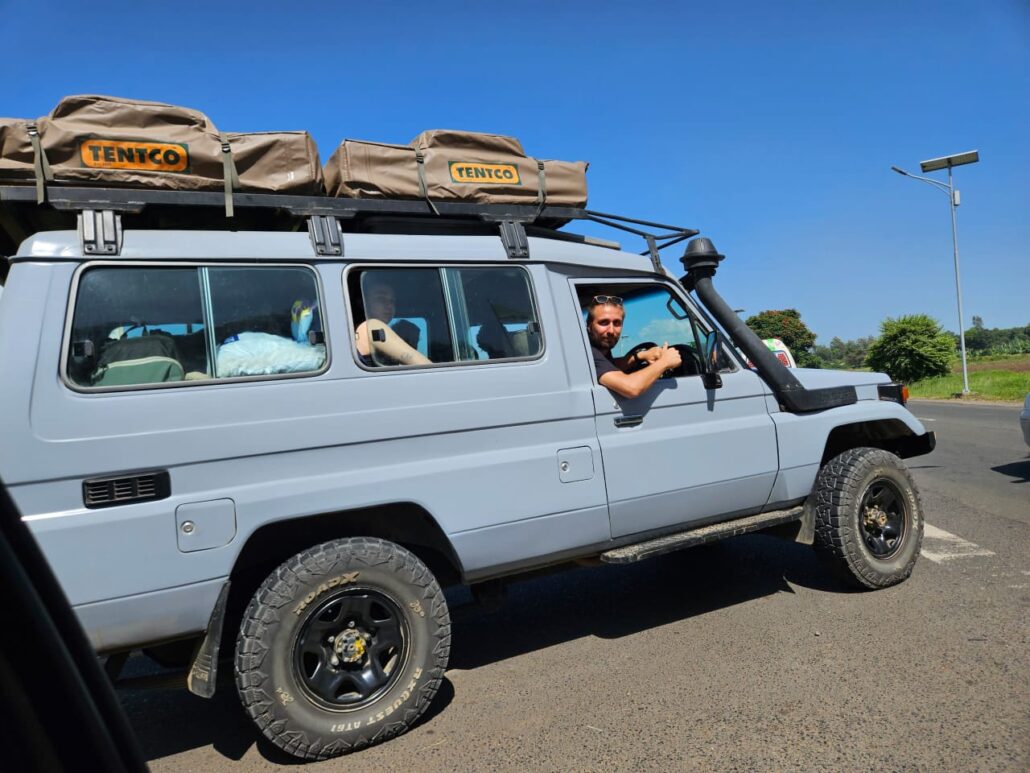
Land cruiser Car rental with camping gear with rooftop tent in TanzaniaIt means your vehicle is your accommodation. You collect a 4×4 that has already been packed with everything needed to sleep, cook, and wash up in the bush, and from that moment your itinerary stops depending on lodge availability. You can stay an extra night at Ndutu because the cats are hunting. Instead of waiting for a lodge breakfast, you can leave the Serengeti at first light. You are not paying $400 a night for a room you will be asleep in for seven hours.

That freedom has a cost, and it is not financial. Camping in Tanzania asks more of you than a lodge safari does. You pitch and strike camp every day, you plan fuel and water two days ahead, and you sleep in cold air on the Ngorongoro rim and in still, heavy heat at Lake Manyara, and you accept that hyenas will walk through your campsite at night because that is what they do. Travellers who want that experience are usually delighted. Travellers who wanted a lodge holiday with a discount were usually disappointed.

This page is written for the first group. It covers what’s in the kit, which vehicles carry it, where you can legally camp, what it costs, who is liable for tent damage, and when we’d honestly advise against camping.

What is included in the camping kit in Tanzania with 4x4 Car rental

Our standard camping kit is built around a self-sufficient party of two to four people. The list below is the full standard inventory; the exact configuration supplied depends on which vehicle you book and how many people are travelling and is confirmed in writing at booking.

Category

Items supplied

Sleeping

Rooftop tent or ground tent, resting mattress, and sleeping bags. Pillow with pillowcase, fitted sheet, duvet, and duvet cover available on request at extra cost

Cold storage

40-liter 12V freezer, powered from the vehicle

Cooking

Gas bottle with cooker plate or mini gas stove with burners, grill grate with tongs, spacious stewpot, small saucepan, frying pan, chopping board, wooden spoon, can opener, cheese grater

Eating

Crockery set for 2 or 4, cutlery set for four, including egg lifter, bread knife, vegetable knife, and wine opener

Camp furniture

Camping table, outdoor seating chairs

Water and washing

Plastic water container, dishwashing bowl, scoop, dishcloth, cleaning cloth

Light

Battery-powered lamps

Beyond the camp kit, every vehicle leaves our yard with its own recovery and safety equipment: a spare tire, jack, fire extinguisher, reflective triangles, and a first aid kit, together with unlimited mileage, comprehensive vehicle insurance, and 24/7 roadside assistance.

What is not included, and what must you bring?
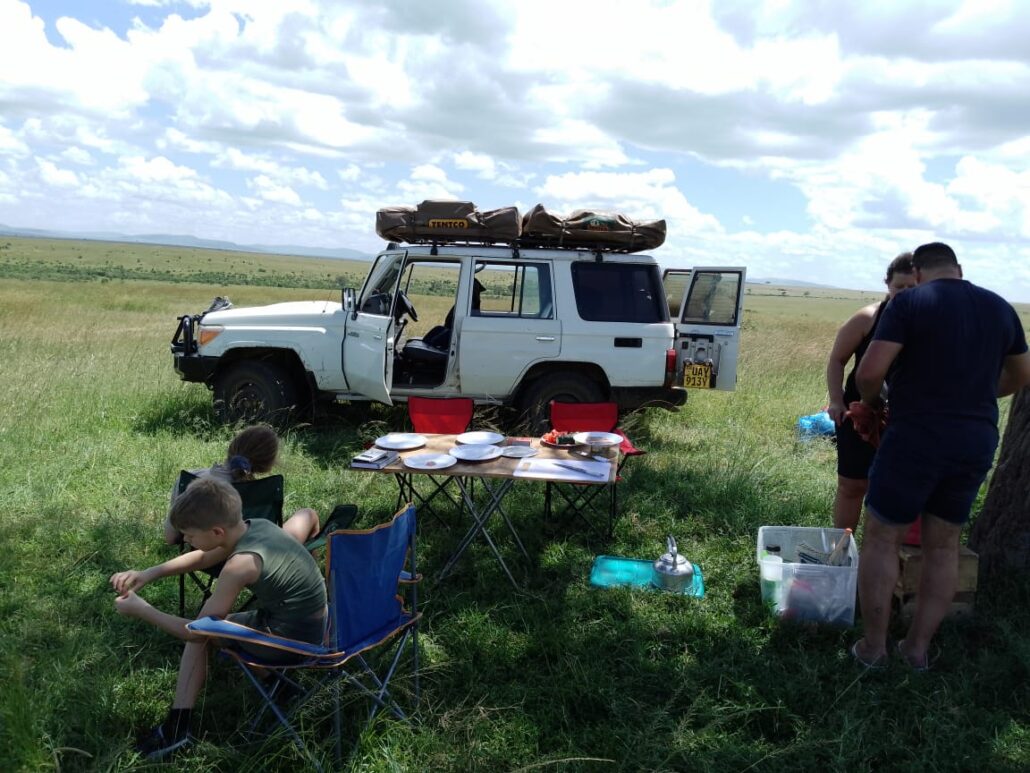
Land cruiser LX with 2 rooftop Tent for camping safaris in Uganda Kenya Tanzania Rwanda BurundiWe would rather you read this now than discover it at Naabi Hill Gate. Not supplied by us: food and drink, firewood or charcoal, refills of gas beyond the bottle supplied, drinking water beyond the container we provide (the container is for carrying water, not a supply of it), personal toiletries, towels, head torches, insect repellent, sunscreen, and any medication. You must pay park entry, camping, and concession fees directly to the park authority, as they are never included in a rental.

Bring from home: a head torch per person, warm layers for Ngorongoro and the Crater Highlands, a light waterproof, closed shoes for camp at night, and a power bank. The vehicle will charge devices while the engine runs, but the freezer has first claim on the battery, and a stationary vehicle should not be used as a charging station overnight.

Worth knowing: the 40-litre freezer is a freezer, or a fridge with a door you open casually. Shop for two or three days at a time in Arusha or Karatu, pack it once, and open it as little as possible.

What is included in the camping kit in Tanzania with 4x4 Car rental

Our standard camping kit is built around a self-sufficient party of two to four people. The list below is the full standard inventory; the exact configuration supplied depends on which vehicle you book and how many people are travelling and is confirmed in writing at booking.

Category

Items supplied

Sleeping

Rooftop tent or ground tent, resting mattress, and sleeping bags. Pillow with pillowcase, fitted sheet, duvet, and duvet cover available on request at extra cost

Cold storage

40-liter 12V freezer, powered from the vehicle

Cooking

Gas bottle with cooker plate or mini gas stove with burners, grill grate with tongs, spacious stewpot, small saucepan, frying pan, chopping board, wooden spoon, can opener, cheese grater

Eating

Crockery set for 2 or 4, cutlery set for four, including egg lifter, bread knife, vegetable knife, and wine opener

Camp furniture

Camping table, outdoor seating chairs

Water and washing

Plastic water container, dishwashing bowl, scoop, dishcloth, cleaning cloth

Light

Battery-powered lamps

Beyond the camp kit, every vehicle leaves our yard with its own recovery and safety equipment: a spare tire, jack, fire extinguisher, reflective triangles, and a first aid kit, together with unlimited mileage, comprehensive vehicle insurance, and 24/7 roadside assistance.

Which vehicles carry camping gear In Tanzania

Camping gear is only rented together with a vehicle, and not every vehicle in the fleet is a sensible camping platform. These are the ones we equip.

VehicleSleepsTent typeBest suited to
Toyota Land Cruiser Hardtop2–41 or 2 rooftop tentsCouples and small groups on the northern circuit; the standard Tanzania camping car
Toyota Land Cruiser LX2–41 or 2 rooftop tentsLonger routes with more luggage; comfortable on the way between parks
Toyota Land Cruiser Double Cab2–4Rooftop tent over the load bedDusty, remote routes; gear stays in a sealed canopy, out of the cabin
Toyota Hilux Double Cabin2–4Rooftop tent over the load bedLong-stay and field-team hires; the most economical to run
Toyota Land Cruiser GX / TX / TZ2–5Rooftop tent, or ground tentFamilies wanting cabin space with a camping option
Extended Land Cruiser with pop-up roofup to 7 seatedGround tentsLarger groups combining game viewing with camping; see also pop-up roof rental in Tanzania

The Toyota RAV4 can be supplied with ground camping equipment for travellers staying on graded roads and outside the heavier parks, but we do not recommend it for the western Serengeti, Ndutu in the wet season, or any route where you may need to recover the vehicle yourself.

If you already know you want the tent on the roof rather than on the ground, our dedicated page on 4×4 cars with rooftop tents in Tanzania goes deeper into tent configurations, and rooftop tent cars in Arusha cover collections from the northern gateway specifically.

Where you can legally camp in Tanzania

Tanzania does not permit wild camping inside its national parks, and this is where independent travellers most often come unstuck. Understand the categories before you plan a route.

Public campsites (TANAPA) are the standard option inside national parks such as Serengeti National Park, Tarangire, Lake Manyara, Arusha National Park, Mikumi, and Ruaha. They have long-drop or flush toilets, cold showers of variable reliability, and a covered cooking or dining shelter. They are shared, they can be busy in high season, and they are not bookable in the way a hotel is; most operate on arrival, though this has been tightening and should be confirmed for the specific park and season you are travelling in.
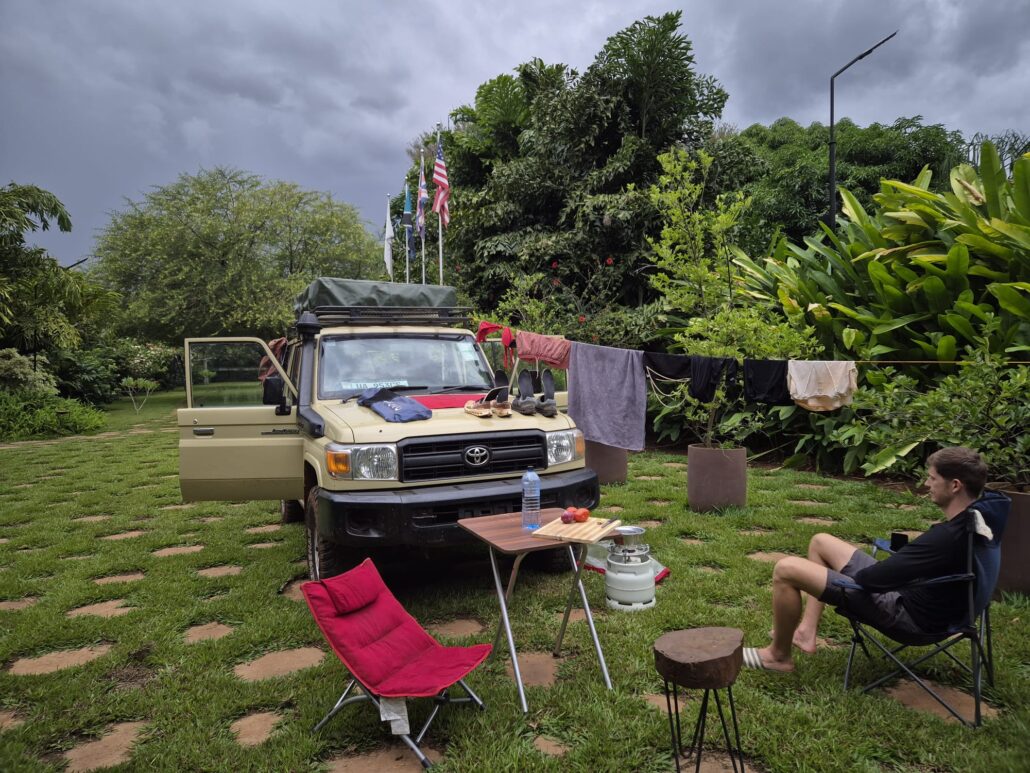
Camping gear with rooftop tent plus camping gear in Uganda, Kenya, Tanzania, Rwanda, BurundiSpecial campsites (TANAPA) are unserviced, exclusive-use sites in more remote parts of the same parks. No facilities of any kind. They must be booked and paid for in advance, they are allocated to a single party, and they are considerably more expensive per night. They are the closest thing Tanzania offers to a true wilderness camp, and for experienced campers they are the highlight of the trip.

Ngorongoro Conservation Area is administered separately from the national parks by the Ngorongoro Conservation Area Authority rather than TANAPA and has its fee structure and rules. The well-known public campsite sits on the Crater rim at roughly 2,300 meters. Camping on the Crater floor itself is not permitted. Bring genuinely warm clothing, the rim is cold, wet, and windy at night, and every year people arrive there having packed only for the Serengeti.

Outside the parks, campsites in Arusha, Karatu, Moshi, Mto wa Mbu, and around Lake Eyasi are privately run, generally cheaper, usually better equipped, and a sensible place to spend your first and last nights while you organize shopping, fuel, and park payments.

Park entry fees, camping fees, concession fees, and vehicle entry fees are all separate charges, payable by you, and subject to change by the authorities. Tanzania’s parks have moved toward cashless payment at the gates, so carry a working international card and do not plan on settling park fees in cash. Confirm current tariffs and payment methods for your route before you travel; our Tanzania safari cost page covers the fee structure in more detail, and the Tanzania national parks lists the parks themselves.
Season, ground conditions, and when we would tell you not to camp

The long rains run from roughly March to May, and the short rains from around November into December. The rest of the year is broadly dry.

Camping in the long rains is possible and not inherently dangerous, but it is a different holiday from the brochure. Black cotton soil across the western Serengeti and the Ndutu area turns to a grease that will stop a well-driven 4×4, campsites flood, and a ground tent packed wet on day three is still wet on day nine. If you are travelling in April and it is your first time driving in Africa, we will suggest a rooftop tent at minimum, and we may suggest a driver guide rather than self-drive. That is not an upsell; it is the recommendation that results in fewer recovery calls.

Altitude matters more than people expect. Seronera in the central Serengeti sits around 1,500 meters and is mild at night. The Ngorongoro rim is roughly 800 metres higher, and that difference can mean the difference between a comfortable night and a miserable one. Pack for the rim, not for the plains.

We would honestly steer you away from camping if you are travelling with children under about five, you have limited mobility, you are visiting for four days or fewer and want to see the Serengeti in that time, or you are in Tanzania during the long rains without prior 4×4 experience. In every one of those cases, a lodge-based trip or a car with a driver guide in Tanzania will give you a better holiday than camping gear.

What Car Rental with camping gear in Tanzania costs and what moves the price

We publish directional figures only. Live rates depend on season, vehicle, rental duration, and configuration and are confirmed in writing at booking rather than quoted here as a fixed number.

Cost element

How it behaves

Vehicle daily rate

Falls sharply with duration; a 14-day hire costs far less per day than a 4-day hire.

Camping gear

Charged as an add-on per vehicle or per person set, not per night of camping

Park entry fees

Paid by you at the gate, per person per 24 hours, varies by park

Camping fees

Separate from entry fees, public sites are modest; special campsites are several times higher.

Vehicle entry fee

Charged per vehicle per day; Tanzania-registered vehicles are charged at a lower rate than foreign-registered ones.

Fuel

The largest variable running cost: Serengeti distances are long, and fuel inside the parks is limited and expensive.

Driver-guide

Optional daily rate plus the driver’s accommodation and allowance

Cross-border paperwork

Applies only if you are leaving Tanzania; see cross-border car rental

The honest summary: the vehicle and gear are a predictable, quotable number. Park fees are not predictable; they are substantial, and for a two-week northern circuit trip they will frequently exceed what you are paying us for the car. Budget them separately and early.

Insurance and camping gear liability of Car Rental with Camping Gear of Tanzania

This is the part that most rental websites blur, and we would rather be plain about it.

The vehicle is covered by comprehensive insurance. That cover has stated exclusions, and the usual ones apply: tires and windows, underbody damage from careless driving, water damage from attempting a flooded crossing, damage sustained while driving at night off tar, and any damage sustained while the vehicle is being driven by someone not named on the rental agreement.

The camping equipment is not covered by the vehicle insurance. It is a separate category. Tents, mattresses, the freezer, the gas system, furniture, cookware, and cutlery are rented to you as equipment, and loss of or damage to that equipment, including damage caused by wildlife, weather, or a tent left open in the wind, is charged to the hirer at replacement or repair cost. This practice is standard across all Tanzanian rental operators, but it is often buried in the terms rather than stated on the page, and it produces the majority of unpleasant surprises at handover.

What this clause means in practice is to strike the tent before you leave camp for a game drive, zip everything closed, do not store food in a ground tent, and treat the gas system as the one item to be careful with. Our full terms and conditions for self-drive car hire set these rules out in detail, and the equipment inventory is signed by both sides at collection and checked again at return.

Sample routes for a Car Rental 4x4 Camping in Tanzania

These are the routes our camping clients actually drive. Times assume dry-season conditions and no game-viewing stops; add generously for both.

Seven days, classic northern circuit

Collect in Arusha, shop, and fuel overnight at a campsite in or near town.

Day two: travel from Arusha to Tarangire, covering about 120 km in two hours on smooth tar, and camp inside the park.

Day three, Tarangire to Karatu via Mto wa Mbu, stopping at Lake Manyara, with a private campsite at Karatu, this is your last reliable supermarket and fuel before the highlands.

Day four: up to the Ngorongoro rim, crater descent, and camp on the rim. On days five and six, you will travel to the central Serengeti, which is roughly 145 km from the Ngorongoro gate to Seronera, but expect to spend four to five hours on washboard dirt, with two nights at a Seronera public campsite. Day seven, the long run back to Arusha, around 320 km and six to eight hours. Return the vehicle.

Twelve days, northern circuit at a proper pace

The same route with the compression taken out: two nights at Tarangire, two at Ngorongoro, four in the Serengeti, including a night at a special campsite in the north or west, and a detour to Lake Natron or Lake Eyasi. This is the trip we recommend if you have the time. The seven-day version is a lot of driving.

Ten to fourteen days, southern circuit

On day one, collect in Dar es Salaam and drive to Mikumi, which is only about 300 km away and the most accessible park in the south, before continuing on to Udzungwa or Ruaha. Fewer vehicles, longer distances, thinner infrastructure, and campsites that are genuinely remote. This route suits second-time visitors and people who found the northern circuit crowded. It is not the route for a first African self-drive.

Our Tanzania safari routes page maps these in more detail, and the destination pages for Serengeti, Ngorongoro Crater, Tarangire, Lake Manyara, Mikumi, and Ruaha cover each park individually.

Practical camping know-how for Tanzania—Car rental with Camping Gear In Tanzania

Wildlife in camp is normal. Public campsites in the Serengeti are unfenced. Hyenas, buffalo, and elephants move through at night, and baboons and vervets will raid anything left out in daylight. The rules are simple and non-negotiable: nothing edible outside the vehicle after dark, no food in tents at any time, do not walk between tent and ablution block without a torch, and do not leave the campsite on foot.

Fuel. Fill in Arusha and again in Karatu. Fuel inside the Serengeti exists but is limited and priced accordingly. On the southern circuit, plan fuel stops two legs ahead.

Water. Treat campsite water as washing water, not drinking water, unless you have confirmed otherwise. Buy bottled or purify. The container we supply is for carrying a supply you have sourced yourself.

Firewood. Collecting firewood inside national parks is prohibited. Buy charcoal or wood outside the gates, or cook on the gas, which is what most of our clients end up doing.

Connectivity. Buy a local SIM at the airport or in Arusha. Coverage is reasonable along the main routes and around Seronera, but absent in large parts of both circuits. Download offline maps before you leave town.

Timing at gates. Park gates open at 06:00 and close at 18:00. You must be in camp by dark; driving in the parks at night is not permitted.

Collection points and cross-border travel

Vehicles with camping gear can be collected in Arusha (the standard choice for the northern circuit), Kilimanjaro International Airport, Moshi, Dar es Salaam for the southern circuit, and Dodoma or Zanzibar on request. See 4×4 Arusha, Moshi car rental, Dar es Salaam, Car Rental Dodoma, and Car Rental Zanzibar.

Picking up in one city and dropping in another is possible through our one-way car rental in Tanzania option; a repositioning fee applies and is quoted at booking.

If your trip continues into Kenya, Uganda, Rwanda, or Burundi, camping gear can travel with you, but the vehicle needs cross-border documentation arranged in advance, including a COMESA yellow card where applicable. Start that conversation at least two weeks before collection. See cross-border Tanzania car rental

4x4 Toyota Land Cruiser Double Cab Tanzania safaris with rooftop Tent Africa

With our 4×4 camping vehicle, you will be far away in the middle of nature, from the hustle and bustle. We mainly hire out 4×4/4WD cars with an extensive collection of camping gear/equipment. The cars come fully equipped with camping equipment/gear. Our top-of-the-range equipment provides everything you need for an exciting, comfortable journey.

Frequently asked questions About Car Rental With Camping Gear In Tanzania

Can I rent a car with camping gear in Tanzania?

Yes. Car Rental 4×4 rents 4×4 vehicles fitted with rooftop or ground tents and a complete camping kit, collected in Arusha, Moshi, Kilimanjaro Airport, or Dar es Salaam. Camping gear is only rented together with a vehicle and is not hired out on its own.

What camping equipment is included?

A rooftop or ground tent, mattress and sleeping bags, a 40-liter 12V freezer, a gas bottle with cooker or mini gas stove, grill grate and tongs, stewpot, saucepan and frying pan, crockery for two to four, a cutlery set for four, a chopping board, a can opener, a cheese grater, a camping table, camp chairs, a water container, a dishwashing bowl and battery-powered lamps. Pillows, fitted sheets, and duvets are available on request at extra cost.

Is camping gear included in the rental price?

No. Camping gear is charged as an add-on to the vehicle rental and is quoted separately at booking.

Can I camp anywhere in Tanzania with My Car rental with camping gear?

No. Wild camping inside national parks is not permitted. You must use designated public campsites or pre-booked special campsites inside the parks or private campsites outside them. Camping on the floor of the Ngorongoro Crater is not allowed.

Do I need a 4×4 to camp in Tanzania?

For the Serengeti, Ngorongoro, and any park in the wet season, yes. Park roads are unsurfaced, and the Ngorongoro Crater descent is restricted to 4×4 vehicles. A two-wheel-drive vehicle is not adequate for a camping safari on either the northern or southern circuit.

Is the camping equipment covered by the vehicle insurance?

No. The vehicle carries comprehensive insurance, but camping equipment is a separate category that is not insured. Loss of or damage to tents, the freezer, the gas system, furniture, or cookware is charged to the hirer at repair or replacement cost.

Are park fees included with the Car Rental with Camping Gear In Tanzania?

No. Park entry fees, camping fees, concession fees, and vehicle entry fees are paid by you directly to the park authority and are separate from the rental. Tanzania’s parks operate largely cashless at the gates, so bring a working international payment card.

Is a rooftop tent better than a ground tent?

It depends on how you travel. Rooftop tents are faster to pitch and better when you move camp most nights. Ground tents can be left standing while you take the vehicle out on a game drive and sleep with more people, which suits multi-night stays at one campsite.

How many people can sleep in one camping vehicle?

Two rooftop tents on a single Land Cruiser can accommodate up to four people. Larger parties use a combination of rooftop and ground tents or two vehicles.

Can I rent a car with camping gear and a driver in Tanzania?

Yes. A driver guide can be added to any camping rental. The driver’s daily rate, accommodation, and allowance are additional, and the vehicle configuration needs to account for the extra person, so tell us at booking rather than on the day.

When is the best time for a camping safari in Tanzania?

June to October is the most reliable: dry, cooler, and firm underfoot. January and February are good and quieter. The long rains from March to May make camping harder, with flooded sites and black cotton soil that can trap a vehicle.

How cold does it get camping in Ngorongoro?

It can get cold enough to need a warm jacket, a hat, and a proper sleeping bag. The rim campsite sits at around 2,300 meters, and night temperatures there are far lower than in the Serengeti, which is roughly 800 meters lower. It is the single most common packing mistake on the northern circuit.

Can I take the camping gear across the border into Kenya?

Yes, with cross-border documentation arranged in advance for the vehicle. Please let us know at the time of booking so that we can ensure all paperwork, including a COMESA yellow card where applicable, is in place before collection.

Is it safe to camp in the national parks?

Public campsites are unfenced, and wildlife moves through them at night, which is normal and manageable if you follow the rules: no food outside the vehicle after dark, no food in tents, a torch at all times, and no walking outside camp. Serious incidents are rare and almost always result from poor food storage.

How to book A Car rental with Camping Gear in Tanzania

Tell us four things, and we can quote accurately: your travel dates, the number of adults and children, your intended route or the parks you want to see, and whether you want to self-drive. From there we confirm the vehicle, the tent configuration, the camp kit inventory, and the daily rate in writing.

At collection you will need a valid driving license from your home country (an International Driving Permit is also accepted), your passport, and the security refundable deposit agreed at booking. We walk through the vehicle and the equipment inventory with you, show you how the tent, freezer, and gas system work, and you sign the inventory before you leave the yard. Allow an hour for this process; it is the hour that prevents most problems.

Contact us or email rent@carrental4x4.com with your dates and route

Contact Us
First
Last
What Are Your Interests?
Which Countries Do You Want To Visit
Other addon Interests
With Whom Are You Travelling

Scroll to Top