Renting a Car with a Driver Guide at Kilimanjaro Airport.
Hire a private 4×4 car rental with driver guide at Kilimanjaro Airport (JRO). Pop-up roof land cruisers for Serengeti, Ngorongoro & Tarangire. Car Rental 4×4 provides private 4×4 vehicle hire with a professional driver guide, collected directly at Kilimanjaro International Airport (JRO), for travelers who want to explore northern Tanzania without driving themselves. Your driver-guide meets you in the arrivals hall holding a sign with your name, loads your luggage into a private safari Land Cruiser with a pop-up roof, and drives you wherever your itinerary leads: Arusha, Tarangire, Lake Manyara National Park, Ngorongoro, the Serengeti, Arusha National Park, the Kilimanjaro gates at Moshi, or across the border into Kenya. You choose the route, the pace, and the accommodation. The daily rate covers the vehicle, the driver-guide, fuel, and the vehicle’s taxes and insurance, while park entry fees, accommodation, and meals are arranged separately so that you pay only for what you actually want. Rates are quoted per day and depend on the vehicle and the length of the hire. To request a quote, contact us through rent@carrental4x4.com.
Kilimanjaro International Airport is one of the few airports in the world where the baggage hall opens onto a view of a mountain. On a clear morning, Africa’s highest peak stands above the Hai plains to the northeast, its summit glowing in a light that seems unconnected to the heat on the tarmac below, and the first-time visitor, passport still in hand, has the distinct and slightly unreal sensation of having arrived somewhere that does not need introducing. That first hour matters more than most travelers realize. After an overnight flight, you want to step out of the terminal and see a face you recognize, a name on a sign, a cold bottle of water, and a vehicle that is exactly what you booked. You do not want to negotiate with taxi touts, compare rental desks, or work out a handover of keys for a car you will then have to navigate through Arusha’s traffic on the wrong side of the road. This is the experience Car Rental 4×4 has built its Kilimanjaro Airport service around: a private vehicle and a professional driver-guide, waiting for you from the moment you clear customs.
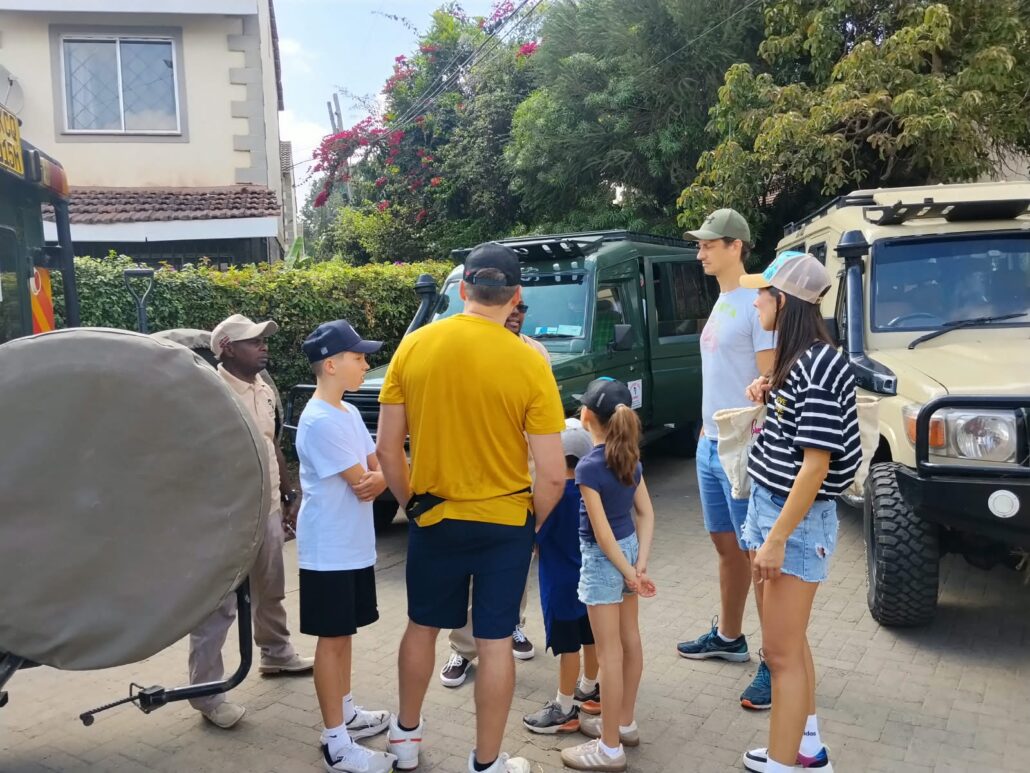
Tanzania’s northern circuit is a landscape of volcanic highlands, a 600-meter-deep crater, plains that stretch to the horizon, and park roads where speed limits, daylight-only driving hours, and wildlife behavior all shape the day. A closed-window hatchback driven by a visitor who has never seen a lion in the wild is not the way to experience it. A private Land Cruiser with a pop-up roof, a driver-guide who has spent years reading these parks, and the freedom to build your own itinerary.
This page explains how car rental with a driver-guide works at Kilimanjaro Airport, how it differs from self-drive hire and from a packaged group safari, what the vehicles and guides are like, which destinations you can reach and how long each takes, what the park rules mean for your day, what is and is not included in the price, and what a typical itinerary looks like day by day. If you are weighing it against the alternatives, you may also want to read our pages on self-drive Tanzania and car rental with driver in Tanzania.
What Does Car Rental with a Driver Guide Mean at Kilimanjaro Airport?
The phrase is used loosely, so it is worth being precise. At Kilimanjaro Airport, travellers looking for a vehicle and a driver will find three distinct products, and understanding the differences will save you money and disappointment.
The first is self-drive rental, where you collect the keys and drive yourself. This suits confident drivers who are comfortable with left-hand traffic, unmarked park tracks, and being responsible for the vehicle in remote areas. It is the cheapest per day, and it is what we also mostly sell on our Self Drive Tanzania page. The second is the all-inclusive group or private safari package, where we sell you a fixed itinerary with accommodation, meals, park fees, and a guide bundled into one price. This is convenient, but you are booking our itinerary and our choice of lodges, and the price is transparent about how much goes to the vehicle and guide versus everything else.
The third, and the one this page is about, sits between the two: private vehicle hire with a professional driver guide, where you rent the Land Cruiser and the guide by the day and then design everything else yourself. You decide where to go and how long to stay. You book your own lodges, or we book them for you. You pay park fees at cost rather than inside a package price. And you have a guide who is yours for the duration, not shared with other guests. For travellers who know roughly what they want, or who want to be able to change their minds, it is the most flexible and the most transparent way to see Tanzania. Many of our guests then add a rooftop tent or camping gear through our rooftop tent Tanzania service to bring the accommodation cost down further.
Meet and Greet at Kilimanjaro International Airport: How Pickup Works
From Aircraft to Safari Vehicle
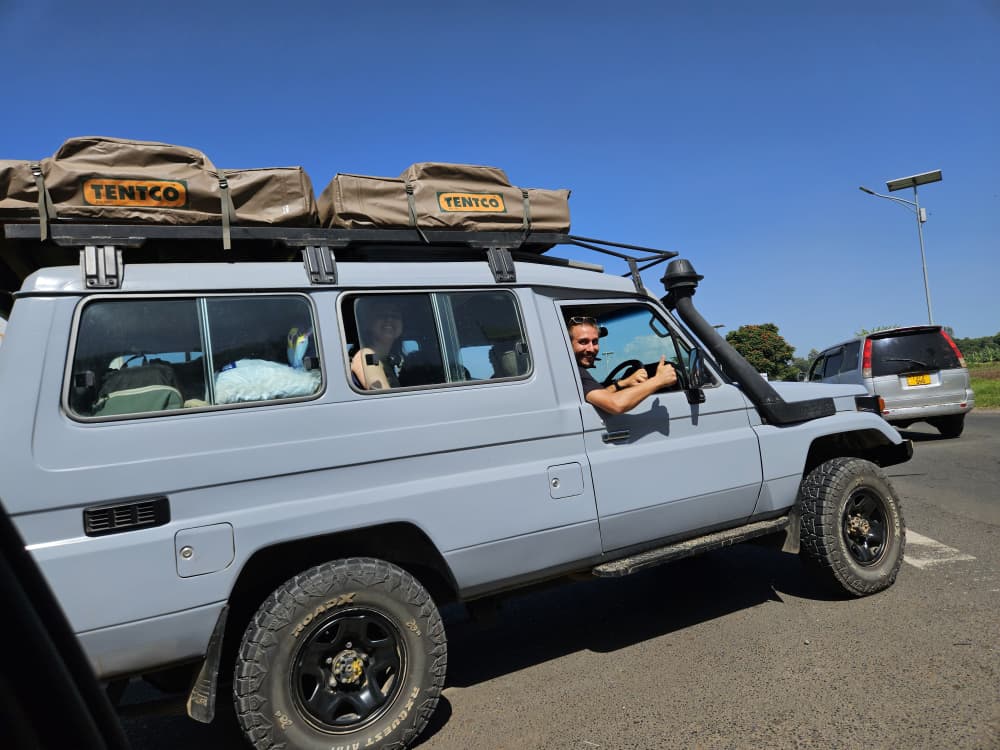
Once your booking is confirmed, we ask for your flight number, arrival time, and the name of the lead traveller. On the day, your driver-guide waits in the arrivals area beyond the customs exit, holding a sign with your name. He helps with your luggage, walks you to the vehicle in the airport car park, and, once you are settled, talks through the plan for the next few days. If you want to go straight to a park, you can; if you would rather go to your Arusha hotel first and rest, he will take you there. The vehicle is cleaned, fuelled, and stocked with drinking water before every collection.
Flight Delays, Late Arrivals, and Early Starts
We track the flight you give us. If it is delayed, your driver guide adjusts his arrival to match, at no extra charge, so you are never standing outside the terminal waiting for a driver who has gone home. Many international flights into Kilimanjaro land in the evening, and for these the standard arrangement is a transfer to your first night’s accommodation in Arusha or one of the lodges nearer the airport, with the safari starting the next morning. If you land in the early hours or the morning and want to make the most of the first day, an immediate departure to Tarangire is realistic, putting you inside the park by late morning.
Visa, Immigration, and Your First Hour
Most nationalities can obtain a Tanzanian visa on arrival at Kilimanjaro or apply for an e-Visa in advance through the Tanzanian immigration portal; since rules and fees change, please confirm the current requirement for your passport before travelling. Allow thirty to sixty minutes for immigration and baggage. If you have not yet arranged your Tanzanian shillings, there are ATMs and exchange facilities in the terminal, and your driver-guide can advise on the nearest reliable ATM in Arusha.
Where Is Kilimanjaro Airport?
Kilimanjaro International Airport lies in the Hai district of the Kilimanjaro region, on the main road between Moshi and Arusha. The drive to Arusha takes roughly forty-five minutes to an hour, depending on traffic, and the drive to Moshi is of a similar length. This position is the airport’s great advantage: it places you within a single day’s drive of every major northern Tanzania park, and it is two hours or so from the Kenyan border at Namanga.
Why Choose a Driver Guide Over Self-Drive From Kilimanjaro Airport?
Self-driving is possible in Tanzania, and for a confident, experienced traveller on a longer trip, it can be rewarding. But for most visitors arriving at Kilimanjaro, a driver-guide is the better choice, and there are practical reasons for that beyond comfort.
The first is the road itself. Tanzania drives on the left, traffic between Arusha and the park gates mixes lorries, buses, motorcycles, livestock, and pedestrians, and traffic police are strict about speed limits. Inside the parks, speed limits are low, roads are unsurfaced, and the rules on staying on tracks, staying in the vehicle, and finishing the day before the gates close are enforced. A driver-guide handles all of this as routine, and you spend your attention on the wildlife instead of on the road.
The second is wildlife. A great deal of what separates a good game drive from a great one is knowing where to look and when. A guide who has spent seasons in the Serengeti knows which drainage line the lions favor in the morning, which rocks the cheetahs use as lookouts, and how the herds move as the rains shift. He hears the radio calls from other guides about a leopard in a tree or a river crossing about to begin, and he positions the vehicle accordingly. This knowledge is not in any app or guidebook.
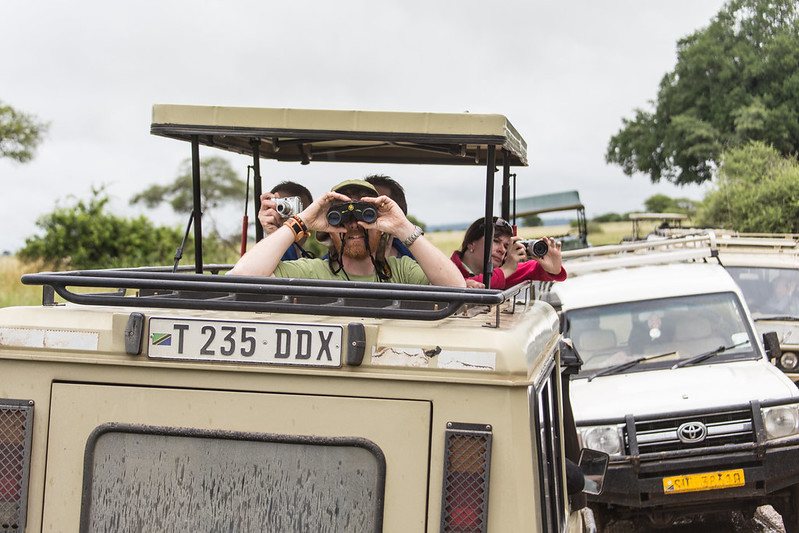
The third is the Ngorongoro Crater. Safari-sector sources report that vehicles entering the crater are required to carry a registered guide even when the visitor is driving, so a self-drive visitor will, in practice, need to hire one anyway, and the crater descent road is steep, narrow, and busy. If you are travelling with us, the rule is simply met by the guide who is already in your vehicle. Rules like this do change, and we confirm the current position with you when we quote.
Finally, there is the quiet matter of responsibility. When you drive a rental vehicle through a remote country, a puncture, a stuck wheel, or a breakdown is your problem to solve. With a driver-guide, it is his, and he has solved it before. For families, couples, and groups, that difference alone is often what makes the trip relaxing rather than anxious.
The Vehicles: Private Land Cruisers with Pop-Up Roofs
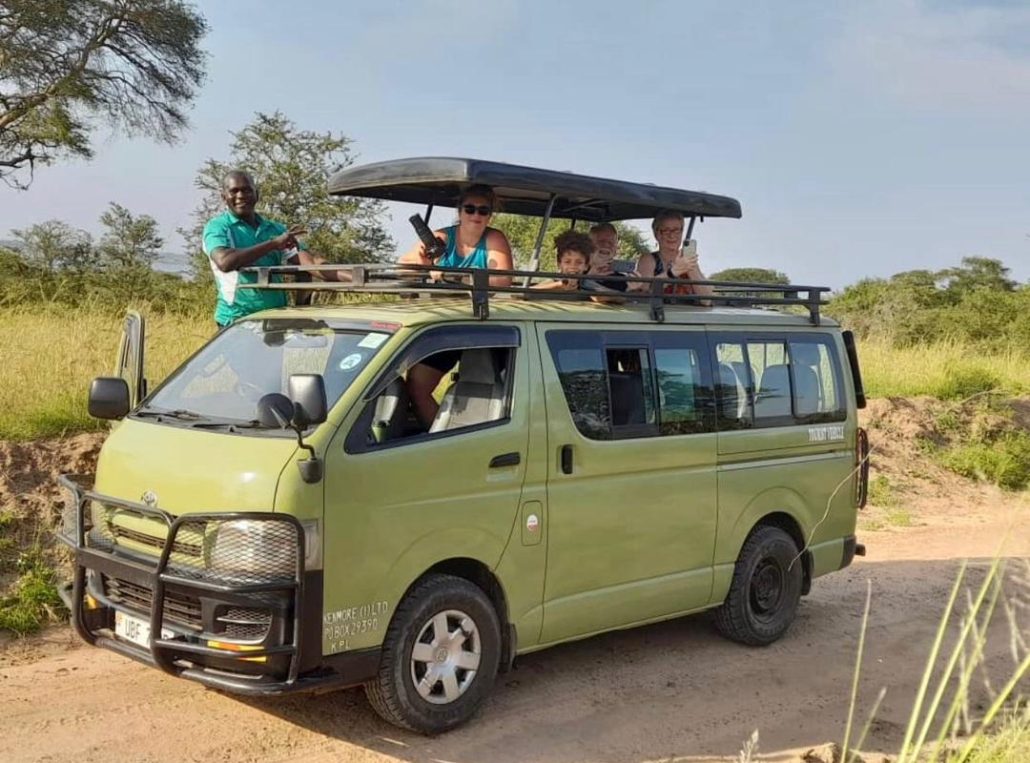
Every vehicle in our Kilimanjaro Airport service is a four-wheel-drive Toyota Land Cruiser configured for game viewing, with a pop-up roof, large windows, and a layout that gives every guest a window seat. You can see the full range on our 4×4 fleet page, and our guide to pop-up roof car rental in Tanzania explains why the roof matters so much in open country.
Safari Land Cruiser Extended with Pop-Up Roof
The extended Land Cruiser is the standard private-safari vehicle across northern Tanzania, and it is the one we recommend for families and small groups. It is comfortable for up to six guests with guaranteed window seats and access to the roof hatch. A seventh passenger can travel in the front seat, but cannot use the roof hatch, so for groups of seven we usually recommend a second vehicle or a safari van. Each vehicle carries a cool box, charging points for phones and cameras, drinking water, and a binocular for the guests.
Toyota Land Cruiser V8 with Roof Hatch
For couples and smaller parties who want more refinement on the road, the V8 offers a stronger and more comfortable ride on the long Arusha-to-Serengeti drive, while still carrying a roof hatch for game viewing. It handles the steep Ngorongoro descent and the corrugated Serengeti tracks with composure.
Safari Van with Pop-Up Roof
For groups of eight or more, a safari van with a full pop-up roof gives everyone a seat, a window, and a place to stand at wildlife sightings. It is the practical answer for large families, friends travelling together, and corporate groups.
What Is in Every Vehicle
Whatever the model, you can expect a clean, serviced, fully insured vehicle with a spare wheel and recovery equipment, a first-aid kit, drinking water, a cool box, charging facilities, and a binocular. Our vehicles are fuelled and checked before every hire, and your driver-guide carries a phone with local coverage and our twenty-four-hour support number.
Your Driver-Guide: Who Will Be in the Vehicle With You
The vehicle matters, but the person in the driver’s seat matters more. Our driver-guides are professionals who have worked the northern circuit for years, speak fluent English and Swahili, and carry current first-aid training. They are not generalists who learned the parks from a brochure; they know the specific behaviour of the animals in each park and how it changes through the year.
A good guide does several jobs at once. He drives safely through difficult country. He finds the wildlife, often well before you can see it. He explains what you are looking at, whether it is a lilac-breasted roller or the social structure of a lion pride. He manages the park gates, the permits, and the paperwork. He tells you when to stay and when to move, and he tells you honestly if a plan you have in mind will not work. Above all, he adapts to you: some guests want to photograph every bird, some want to find the big cats, and some want to sit quietly with the elephants for an hour. A private guide lets you do what you came for.
Gratuities are not included in the price and are entirely at your discretion; a common guideline for good service is around USD 20 to USD 30 per day for the guide, shared by the guests.
Where You Can Go: Driving Times from Kilimanjaro Airport
Kilimanjaro Airport’s position makes it an excellent hub. The times below are approximate and assume normal driving conditions on the main roads; your guide will adjust them according to the season, the traffic, and the stops you want to make.
Arusha and Arusha National Park
Arusha town is about forty-five minutes to an hour from the airport, and Arusha National Park is of a similar distance, making it the easiest first-day or last-day destination. The park is small and varied, with forest, lakes, and the slopes of Mount Meru, and it is one of the few Tanzanian parks where walking safaris are offered. You will see giraffe, buffalo, colobus monkeys, and flamingos, and on a clear day Kilimanjaro rises to the east.
Tarangire National Park
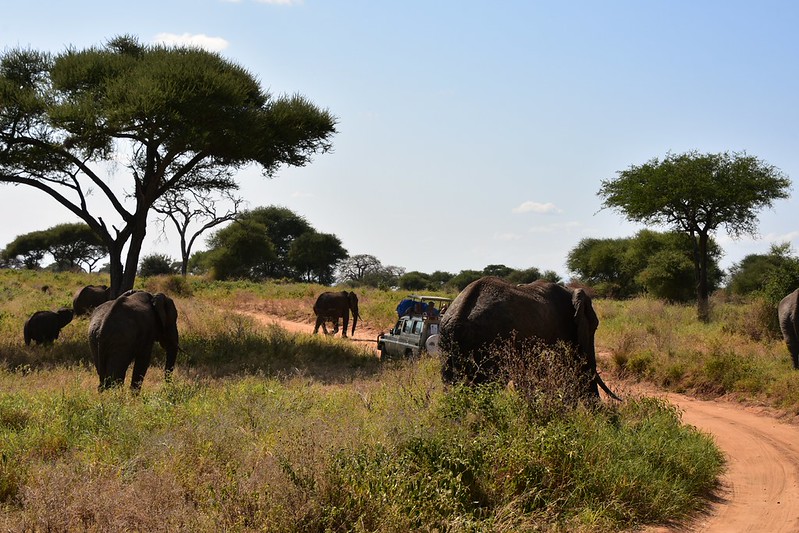
Tarangire is about two and a half to three hours from the airport, passing through Arusha. It is famous for its elephants and ancient baobab trees, and in the dry season, from roughly June to October, the animals concentrate along the Tarangire River in numbers that few other parks can match. It is also excellent for birds.
Lake Manyara National Park
Lake Manyara is about three hours away. A small park between the escarpment and the lake, it combines groundwater forest, open floodplain, and the alkaline lake itself, and it is known for its tree-climbing lions, though these are not guaranteed, and for its flamingos, hippos, and baboons.
Ngorongoro Crater and Conservation Area
The crater rim is about four hours from the airport via Arusha and Karatu. The crater itself is a collapsed volcano some nineteen kilometres across, with a floor roughly 600 metres below the rim, and it supports a remarkable concentration of wildlife in a compact space, including lions, elephants, buffalo, hippos, and the endangered black rhino. A typical visit involves an early descent, a full morning on the crater floor, and a picnic lunch before climbing out.
The Serengeti national Park
The central Serengeti is about six to seven hours from the airport, so most itineraries break the journey at Ngorongoro or at a lodge on the way. The park is vast, and its character changes with the season: the southern plains around Ndutu in the calving season, the central Seronera valley for year-round big cats, the western corridor and the Grumeti River, and the north, where the herds cross the Mara River from roughly July to October. Your guide will match the region to the month.
Moshi and the Kilimanjaro Gates
Moshi is about forty-five minutes to an hour from the airport, and the climbing gates of Kilimanjaro National Park are a further one to two hours, depending on the route. We can transfer you and your luggage to any of the gates or to a hotel in Moshi. To climb the mountain itself, you must go through a licensed Kilimanjaro climbing operator like our safari Company because guides and porters are required by law, and we are happy to help you coordinate the transfer around your climb dates.
Crossing into Kenya
The border post at Namanga is about two hours from the airport, and from there the road continues to Nairobi and, in a further day, to the Masai Mara. Cross-border hire, including one-way drop-offs in Nairobi, can be arranged with the necessary insurance and documents prepared in advance. See our page on one-way car rental in Tanzania for details.
Tanzania Park Rules and Fees: What Every Visitor Should Know
Tanzania’s national parks are run by the Tanzania National Parks Authority (TANAPA), and the Ngorongoro Conservation Area has its own authority. Both have clear rules designed to protect the wildlife and the visitors, and part of your guide’s job is to apply them smoothly so that you do not have to think about them.
Driving Hours and Speed
Driving inside the national parks is generally permitted only between about 6am and 6pm, so game drives start early and finish before dusk. Speed limits inside the parks are low, commonly 50 kilometres per hour at most and lower in places, and lower again on the Ngorongoro Crater floor; limits vary from park to park and on rough roads even a slow speed can be too fast. Outside the parks, the limits through towns and villages are strictly enforced by traffic police.
Staying on Tracks and in the Vehicle
Vehicles must stay on designated tracks, and off-road driving is not permitted. Visitors must stay inside the vehicle in wildlife areas except at designated picnic sites and viewpoints. Feeding wildlife, leaving litter, and making loud noise near animals are all prohibited. Camping is allowed only at designated campsites.
Park Entry Fees and How They Are Paid
Fees are charged per person per day, with a separate daily fee for the vehicle, and the Ngorongoro Conservation Area adds its own entry fee, vehicle fee, and a crater service fee per vehicle for descent. Tanzania’s parks have moved to electronic payment, so fees are normally paid by card or through the authority’s payment system rather than in cash. Fees change periodically, which is one reason they are listed separately from the vehicle and guide: we confirm the current figures when we prepare your quote, and your guide handles the payment process at the gates.
Wildlife Behaviour and Safety
Wild animals are wild. Your guide will keep a safe distance, will tell you when it is safe to stand in the roof, and will ask you to stay calm and quiet near predators and elephants. Please follow his instructions, particularly with children.
Add-Ons and Variations
Rooftop Tent and Camping Gear
For travellers who want to sleep inside the parks, we can mount a rooftop tent and supply camping equipment. Your guide pitches the camp, prepares simple meals, and handles the campsite routine. It brings the nightly cost down significantly and places you inside the park at dawn. See our rooftop tent page and our camping gear page.

Accommodation Booking
If you would rather not book lodges yourself, we can arrange accommodation for every night of your itinerary, from comfortable mid-range lodges to high-end tented camps, matched to your budget and your route. The advantage of arranging it through the same team is that your guide knows each property and plans the driving around check-in times.
Long-Term Hire
For extended trips, photographers, researchers, and production crews, we offer long-term hire with a reduced daily rate and a dedicated guide throughout.
One-Way Hire and Different Drop-Off Points
You do not have to return to Kilimanjaro. We can drop you at Arusha Airport for a flight, at Dar es Salaam, at Nairobi, or at the Kenya border. A one-way hire may include a repositioning fee, which we state in the quote.
Day Hire and Airport Transfers
If you only need a private transfer or a day trip, for example from the airport to your Moshi hotel, or a day in Arusha National Park before your departure flight, a shorter hire with a driver is available. This is also a good way to try us before committing to a longer trip.
How Pricing Works for Car Rental with a Driver Guide
Our daily rate covers the vehicle, the professional driver-guide, fuel for a typical safari itinerary, vehicle insurance, and the vehicle’s applicable taxes. Rates depend on the vehicle, with the extended Land Cruiser at the lower end and the V8 or a safari van at the higher end, on the length of hire, and on the season. As an indication, private driver-guide hire in a Land Cruiser typically starts from around USD 150 to USD 250 per day, and longer hires are priced lower per day. Exact rates are confirmed in a written quote.
It helps to understand what this daily rate is compared with. A self-drive rental from the airport can look cheaper on a comparison site, but that price covers only a vehicle, and it usually carries restrictions on park use and gravel roads, an excess on insurance, and a deposit. A fully packaged safari can look simpler, but the single price hides how much is vehicle and guide and how much is accommodation and margin. A daily rate for a vehicle and a guide, with everything else itemised, lets you see exactly where your money is going and change it as you wish.
What Is Included and What Is Excluded
What’s Included for a full safari
Your daily rate with Car Rental 4×4 includes a private four-wheel-drive Land Cruiser with a pop-up roof, a professional English-speaking driver-guide, fuel for a typical safari itinerary within daylight travel, comprehensive vehicle insurance, a meet-and-greet at Kilimanjaro Airport with a name sign, airport transfers at the start and end of the hire, a cool box, charging points, a binocular, a first-aid kit, a spare wheel and recovery equipment, the driver-guide’s accommodation and meals, and twenty-four-hour support.
What’s Excluded
National park entry and concession fees, vehicle fees in the parks and the Ngorongoro Conservation Area, the Ngorongoro crater service fee, your own accommodation and meals unless we book them for you, international flights, visas, travel and medical insurance (strongly recommended, ideally including emergency evacuation), optional activities such as balloon safaris or cultural visits, gratuities for your guide, alcoholic and soft drinks beyond the water supplied, and personal expenses.
What to Carry and What You Need to Know Before You Travel
You will need a passport valid for at least six months beyond your arrival date, a visa or e-Visa as required for your nationality, and a yellow fever vaccination certificate if you are arriving from, or have recently transited, a yellow fever country. Because rules and vaccination requirements change, please verify the current position with the Tanzanian authorities and your doctor well before you travel. Antimalarial medication is advised for most of Tanzania, and your doctor can advise on the right choice for you. You do not need to hold a driving licence to use a driver-guide service, which is one of its simplest advantages.

For clothing, dress in layers. Game drives start in the cool of the early morning, and at the Ngorongoro rim and in the Serengeti it can be properly cold before the sun is up, while the middle of the day can be hot. Neutral colours, a wide-brimmed hat, sunscreen, sunglasses, a light waterproof jacket, and comfortable closed shoes will cover most situations. Bring binoculars if you have them, a camera with a good zoom lens, spare batteries and memory cards, and a power bank. A soft bag is easier to pack in a safari vehicle than a hard suitcase, and some light aircraft have strict luggage limits if you add a flight to your itinerary.
Carry some cash in small denominations for tips and small purchases, although most large payments, including park fees, are made by card or through our prearranged payments. Mobile coverage is good around towns but patchy in the parks.
Best Time to Book a Private Driver-Guided Safari from Kilimanjaro Airport
June to October: Dry Season and Peak Wildlife Viewing
The long dry season is the most popular and the most reliable time to visit. Grass is short, animals gather at water, roads are good, and Tarangire is at its best. The Serengeti herds move north towards the Mara River between about July and October, when river crossings are most likely. It is also the busiest and most expensive period, so book your vehicle and lodges well in advance.
January to March: Calving Season and Fewer Crowds
The short dry season brings the calving season on the southern Serengeti plains around Ndutu, when tens of thousands of wildebeest calves are born over a few weeks and predators concentrate to hunt. It is outstanding for photographers and predator viewing, and the parks are quieter than in the high season. Days can be hot, and the weather is generally good.
November, April and May: Green Season
The rains turn the plains green and bring migrant birds, spectacular skies, and much lower prices. Some secondary tracks become difficult after heavy rain, and wildlife is more dispersed, but a good guide adapts the route, and the parks are far less crowded. April and May are the wettest months; the short rains in November are usually lighter.
Kilimanjaro and Cultural Travel
The mountain is climbable year-round, with the best weather generally from January to March and June to October. If you are combining a climb with a safari, a post-climb safari from the airport is a popular and relaxing way to finish.
Day-by-Day: A Private Driver-Guided Northern Circuit from Kilimanjaro Airport
The following six-day itinerary is a sample, designed to show how a private driver-guide hire works in practice. It can be shortened, lengthened, reversed, or rebuilt entirely around your interests, your dates, and your budget. The properties named are representative of the standard we aim for; we match accommodation to your budget and availability at the time of booking.
6 Days: Tarangire, Ngorongoro and the Serengeti
Day 1: Kilimanjaro Airport to Arusha
Your driver-guide is waiting in the arrivals hall with your name on a sign. He takes your bags, hands you a cold bottle of water, and walks you to a clean, waiting Land Cruiser whose roof hatch is already latched against the dust. The drive to Arusha takes under an hour, the road passing Maasai herders with their cattle, roadside stalls selling bananas and charcoal, and the shoulder of Mount Meru showing through the haze to the west. Check-in is at Arusha Coffee Lodge, a quiet, plantation-style retreat among coffee bushes that is perfect for a first night, or a comparable property of your choice. Over dinner, your guide spreads a map on the table and talks through the days ahead, adjusting the plan to what you most hope to see. A curated evening, and an early night.
Day 2: Arusha to Tarangire National Park
An early start south-west on the tarmac, with the roof closed for the highway and opened at the park gate. Tarangire reveals itself slowly: the first baobabs, vast and improbable, then a family of elephants crossing the track, a matriarch and her calves moving with unhurried certainty. In the dry season, hundreds gather along the Tarangire River, and your guide positions the vehicle upwind and at a respectful distance so that you can stand through the roof and simply watch. Lunch is a picnic beneath a tree. The afternoon brings giraffe, lesser kudu, and the hunting birds of the baobab woodland.
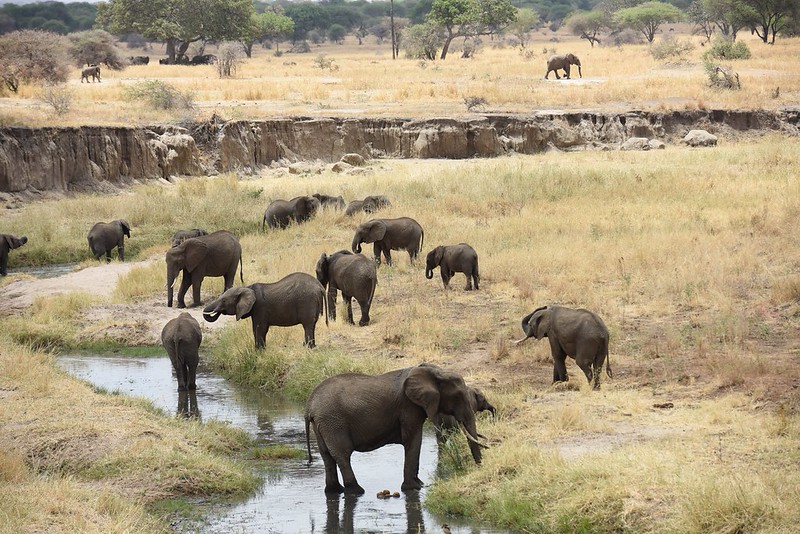
You overnight at Tarangire Sopa Lodge, set high on the escarpment with a view across the plain, or at a tented camp on the park’s edge.
Day 3: Tarangire to Ngorongoro
A morning game drive in Tarangire, then the road north-west through Karatu, a highland farming town where coffee, wheat, and maize grow on volcanic soil. The road climbs through forest to the crater rim, and when the trees open, the crater lies below you, a vast green and gold bowl with the soda lake glinting at its centre. You stay at Ngorongoro Serena Safari Lodge or another rim property, and the sunset from your balcony, with the crater slowly filling with shadow, is one of the finest of the trip. Your guide spends the evening checking permits and planning the descent.
Day 4: Ngorongoro Crater to the Serengeti
The descent begins at dawn, with the roof closed on the steep, narrow road and opened on the crater floor. In the cold clear light, the animals seem close and unguarded: lion prides resting after a night’s hunting, buffalo grazing in the mist, flamingos pink along the lake margin, and, if the morning is kind, a black rhino at the far edge of the grassland. Your guide knows the crater’s circuits and times the picnic lunch for the quietest hour. In the afternoon, you climb out and drive on across the highland plateau, past Maasai bomas and the Olduvai Gorge, into the Serengeti, where the plains open to the horizon in every direction. You overnight in the central Serengeti at Serengeti Serena Safari Lodge or a nearby camp, with the sound of the plains at night outside your window.
Day 5: A Full Day in the Serengeti
A full day in the Serengeti is the point of the journey, and your private guide shapes it as you wish. A dawn drive finds the big cats at their most active, a leopard draped in a sausage tree, a lioness stalking along a drainage line, a cheetah scanning from a termite mound. Mid-morning is for the herds, and in the right season, the movement of thousands of wildebeest and zebra is a spectacle that needs no commentary. Lunch is a picnic by the river, with hippos grunting below. In the afternoon, you can return to the best sightings of the morning or go in search of something new. The roof is open all day, and the light, as the sun drops towards the horizon, turns the grass to gold.
Day 6: Serengeti to Arusha and Kilimanjaro Airport
A last dawn game drive, then breakfast and the long drive east. The road retraces the high plains and the crater rim before dropping through Karatu and Mto wa Mbu to Arusha. Your guide stops at a craft market, if you wish, and arranges lunch in Arusha. In the late afternoon, he delivers you to Kilimanjaro Airport, helps you check in, and, with a handshake and a photograph, sees you on your way. If your flight leaves in the evening, he can arrange a day room in Arusha so that you can shower and rest before the airport.
4 Days: Tarangire, Lake Manyara and Ngorongoro
A shorter circuit covers Tarangire on Day 2, Lake Manyara in the morning of Day 3 with the Ngorongoro rim in the evening, and the crater floor on Day 4 before the drive back to Kilimanjaro. It is ideal for a long weekend, a stopover between a climb and a flight, or a first taste of Tanzania.
1 Day: Arusha National Park Before Your Flight
If you land early or fly late, Arusha National Park is a compact, rewarding day trip. Your guide collects you from the airport, and drives you to the park, where you can see giraffe, buffalo, colobus monkeys, and flamingos, and, on a clear day, Mount Kilimanjaro. He then returns you to the airport for your onward flight.
Custom Itineraries: Serengeti Migration, Kenya Extension and More
We can build almost any route from Kilimanjaro: the northern Serengeti for the Mara River crossings, Lake Natron and the Rift Valley, a Zanzibar extension via Dar es Salaam, or a cross-border continuation to the Masai Mara. Tell us what you want to see and when you are travelling, and we will propose a route, a guide, and a price. To start, contact us at carrental4x4.com.
Why Book Your Kilimanjaro Airport Car Rental with a Driver Guide Through Car Rental 4×4
There are many ways to book a vehicle at Kilimanjaro Airport, and most of them are fine for a certain kind of traveller. We are the right choice for guests who want a private vehicle and a professional guide, without being tied to a fixed package, and who value being able to speak to a real person who will know their plans and answer their questions.
What distinguishes our service is not any single feature but the combination. You get a private Land Cruiser configured for game viewing, a guide who is genuinely experienced, an itinerary you control, transparent pricing in which the vehicle and guide are priced separately from everything else, and a team behind the guide who can book lodges, arrange permits, sort out cross-border paperwork, and respond to you at any hour. If something changes on the road, a flight is delayed, you want another night in the Serengeti, or someone is unwell, we adjust.
Our approach is also deliberately honest about what a driver-guide hire is and is not. It is not a cheap self-drive rental, and it is not a bundled package. If self-drive is right for you, we will say so and point you to our self-drive service. If a fixed-price group safari is more suitable, we will say that too.
Your Tanzania Safari Begins at the Arrivals Hall
There is a moment, usually around the time the tarmac gives way to the first dust of a park road and the guide switches off the engine and says quietly, ‘Look’, when a trip stops being a plan and becomes a place. Everything before that moment is preparation. The more carefully it is done, the sooner and the more completely that moment arrives.
That is what we do. We arrange the vehicle, the guide, the pickup, and the route, so that the only thing you have to do when you land at Kilimanjaro is walk through the arrivals doors and find a person holding a sign with your name on it. Tell us your dates, your group, and the experiences that matter most to you, and we will take care of the rest. To begin planning, send us your enquiry through carrental4x4.com. Every detail handled; no decision left to chance.
Frequently Asked Questions: Kilimanjaro Airport Car Rental with Driver Guide
Can I rent a car with a driver at Kilimanjaro Airport?
Yes. Car Rental 4×4 provides private 4×4 vehicle hire with a professional driver-guide at Kilimanjaro International Airport (JRO). Your driver-guide meets you in the arrivals hall with a name sign and drives you anywhere on your itinerary, including Arusha, Tarangire, Lake Manyara, Ngorongoro, the Serengeti, Moshi, and the Kenyan border.
How much does car rental with a driver cost at Kilimanjaro Airport?
Private Land Cruiser hire with a driver-guide typically starts from around USD 150 to USD 250 per day depending on the vehicle, the season, and the length of hire, with lower daily rates for longer hires. The daily rate covers the vehicle, the driver-guide, fuel for a typical itinerary, and vehicle insurance. Park fees, accommodation, and meals are separate. Contact us for a written quote.
What is the difference between self-drive and car rental with a driver guide?
With self-drive, you collect the vehicle and drive yourself, which is cheaper per day but requires you to navigate, manage park rules, and handle any mechanical problems. With a driver-guide, a professional drives and guides you, finds wildlife, handles permits and gates, and deals with any problems, while you keep full control of the itinerary.
Is a driver guide mandatory for the Ngorongoro Crater?
Safari-sector sources report that vehicles entering the Ngorongoro Crater are required to carry a registered guide, even for self-drive visitors, and the descent road is steep and busy. Rules can change, so we confirm the current requirement at the time of your booking. If you travel with our driver-guide, this is already covered.
How far is Kilimanjaro Airport from Arusha?
Kilimanjaro Airport is roughly forty-five minutes to an hour from Arusha by road, depending on traffic. It is a similar distance from Moshi.
How far is the Serengeti from Kilimanjaro Airport?
The central Serengeti is about six to seven hours by road from the airport, so most itineraries break the journey at Ngorongoro or at a lodge en route. Tarangire is about two and a half to three hours, Lake Manyara about three, and the Ngorongoro rim about four.
Will my driver wait for me if my flight is delayed?
Yes. We track the flight number you give us, and your driver-guide adjusts his arrival to match the actual landing time at no additional cost.
Do I need a driving licence to hire a car with a driver?
No. Because a professional driver does the driving, you do not need a driving licence or an International Driving Permit. These are required only for self-drive hire.
What vehicle will I travel in?
A private four-wheel-drive Toyota Land Cruiser with a pop-up roof, large windows, charging points, a cool box, and drinking water. The extended Land Cruiser is comfortable for up to six guests with guaranteed window seats and roof access; for groups of seven or more we recommend a second vehicle or a safari van.
What is included in the price?
The daily rate includes the vehicle, the professional driver-guide, fuel for a typical safari itinerary, vehicle insurance, airport meet-and-greet and transfers, drinking water, and the driver-guide’s accommodation and meals. Park fees, your own accommodation, meals, visas, travel insurance, optional activities, and gratuities are excluded.
Can I book my own lodges, or do you arrange accommodation?
Either. You can book your own lodges and simply hire the vehicle and guide, or we can arrange accommodation for every night, from mid-range lodges to high-end tented camps, matched to your budget.
Can I take the vehicle from Tanzania to Kenya?
Yes. We arrange cross-border hire through the Namanga border, about two hours from the airport, with a one-way drop-off in Nairobi if you wish. The necessary insurance and vehicle documents are prepared in advance. A one-way hire may include a repositioning fee, which is stated in the quote.
Can you take me to the Kilimanjaro climbing gates?
Yes. We can transfer you and your luggage from the airport to a Moshi hotel or to any Kilimanjaro National Park gate. To climb the mountain itself, you must use a licensed climbing operator, because guides and porters are required by law, and we can coordinate the transfers around your climb dates.
What is the best time of year to book a driver-guided safari from Kilimanjaro Airport?
June to October is the dry season, with the best general wildlife viewing and the northern Serengeti river crossings. January to March offers the calving season on the southern plains with fewer visitors. The green season, November and April to May, has lower prices and fewer crowds, with some difficult tracks after heavy rain.
Do I need a visa for Tanzania?
Most nationalities can obtain a visa on arrival at Kilimanjaro or apply for an e-Visa in advance. Requirements and fees change, so please check the current rules for your passport before you travel. A yellow fever certificate may be required depending on where you are arriving from.
Can I add a rooftop tent or camping gear?
Yes. We can mount a rooftop tent and supply camping equipment, and your driver-guide pitches camp and you prepare the meals. Camping inside the parks reduces your accommodation cost and puts you in the wildlife at dawn.
How far in advance should I book?
For the dry season, from June to October, and for the Christmas and New Year period, we recommend booking at least three to six months in advance, particularly if you want specific lodges. For the rest of the year, four to eight weeks is usually enough, although earlier is always better.