One Way Car Rental from Dar es Salaam to Arusha: Drive Tanzania's Northern Parks Without Driving Back
Car Rental 4×4 offers one-way 4×4 hire from Dar es Salaam to Arusha, so you can collect a vehicle at Julius Nyerere Airport or your Dar es Salaam hotel, drive the 620 to 640 kilometres north, and leave it in Arusha, at Arusha Airport, or at Kilimanjaro Airport, with no return drive. The road takes roughly nine to ten hours, so most guests break it with a night in Moshi or the Usambara Mountains. From Arusha, the same vehicle can carry on through the northern parks: Arusha National Park, Tarangire, Lake Manyara, Ngorongoro, and the Serengeti, before you drop it off. You can drive yourself or hire a professional driver-guide. One thing we want to be open about: for one-way rentals from Dar es Salaam to Arusha we use Tanzania-registered vehicles, which pay the lower local vehicle fee in Tanzania’s national parks. We use Uganda-registered safari vehicles mainly for multi-country one-way trips from Dar es Salaam to Kenya, Rwanda and Uganda, and we do not recommend Kenyan-registered vehicles for trips between Tanzania and Kenya, because Kenyan-registered vehicles are not allowed into Tanzania’s national parks. To plan your route, send us your dates through carrental4x4.com.
There is a particular moment on the road from Dar es Salaam to Arusha when the journey changes character. For the first few hours, you are on the coastal plain, hot, flat, and busy, passing lorries, roadside stalls, and the endless small towns of the Pwani region. Then, somewhere beyond Korogwe, the land begins to rise and dry, the sisal fields give way to thorn scrub, and the blue ridge of the Pare Mountains appears on the left. A little later, if the weather is kind, a white shape floats above the cloud to the north, impossibly high, and you realise that you are looking at Kilimanjaro. From that point on, the road is simply a long, beautiful approach to the northern safari circuit, and by the time you reach Arusha, you have crossed most of Tanzania and arrived at the door of its greatest parks. Car Rental 4×4 offers one-way rental on exactly this route, and this page explains how it works, what it costs, and what you should know before you book.
Dar es Salaam to Arusha is one of the most popular one-way journeys in the country, for a simple reason. Most international visitors fly into Dar es Salaam or arrive by ferry from Zanzibar, while the Serengeti, Ngorongoro, Tarangire, and Lake Manyara all lie in the north, close to Arusha. The two are about 620 kilometres apart. A return trip by road would mean driving the same long road twice, and paying for the vehicle on the way back. A one-way rental removes the second drive, and a rental that continues through the parks lets the road itself become part of the holiday.
We should say at the outset that driving north is not the only way to make the journey, and for some travellers it is not the best. Express buses run daily between Dar es Salaam and Arusha or Moshi, taking nine to ten hours at a fraction of the cost. There are flights from Dar es Salaam to Arusha and Kilimanjaro, taking about an hour and a half, and a slow train that serves part of the route. We compare these honestly below. But if you want to see the country, to stop where you like, to carry luggage and camping gear, to continue into the parks, or to travel as a family or a group, a private vehicle is difficult to beat.
Car, Bus, Flight or Train: Comparing Ways to Get from Dar es Salaam to Arusha
Travel-planning sites give a fair picture of the alternatives, and it is worth knowing what they are before you decide. All figures below are indicative and change often, so please check current fares and schedules before you rely on them.
By Private Vehicle
The road distance is roughly 620 to 640 kilometres, depending on where in Dar es Salaam you start, and typical driving times are eight to ten hours in normal conditions, longer if you leave in the morning rush or stop often. A private vehicle gives you flexibility, space for luggage, and the freedom to detour. Its drawbacks are the length of the drive, the heavy lorry traffic, and the fuel and driver costs. It is the best option for families, groups, and anyone continuing into the parks.
By Express Bus
Coaches run daily between Dar es Salaam and Arusha or Moshi, and travel sites quote fares of roughly USD 11 to 30, with journeys of about nine to ten hours or more. It is the cheapest way to cover the distance, but you are tied to the bus station schedules, you carry your own bags, and you finish in a bus station rather than at your hotel or lodge. For a budget traveller with little luggage, it is a reasonable choice.
By Air
Domestic flights connect Dar es Salaam with Kilimanjaro Airport and Arusha Airport in roughly an hour to an hour and a half, and are the fastest option, at a higher price. Flying removes the long drive but also the journey: you see none of the country in between, and you still need a transfer or a vehicle at the other end.
By Train
Tanzania’s railway network has services between Dar es Salaam and the north, but the journey takes many hours and the schedule is limited, so it suits only those who are prepared to plan carefully and travel slowly. Please check the current timetable with the railway operator.
Why Many Travellers Choose a One-Way Rental
The reason is the combination. A one-way rental takes you from the coast to the north and then lets you use the same vehicle for the parks, so that you do not pay for a separate transfer, a separate safari vehicle, and a separate return. It also lets you break the journey at places like the Usambara Mountains and Mkomazi National Park that buses and flights bypass.
How One-Way Car Rental from Dar es Salaam to Arusha Works
Step One: Tell Us Your Plan
Send us your pick-up point in Dar es Salaam, your dates, the number of people travelling, whether you want to drive yourself or travel with a driver-guide, and whether you want to continue into the northern parks before you drop the vehicle. If you are not sure how long you want, tell us roughly, and we will suggest options.
Step Two: We Quote Everything in Writing
We send a written quote that separates the daily rate, the one-way fee, any driver-guide cost, and the cost of any add-ons you choose. For Dar es Salaam to Arusha we use Tanzania-registered vehicles, so no foreign-vehicle charge applies in Tanzania’s national parks. Nothing is bundled into a single vague figure, so you can see exactly what you are paying for and change it if you wish.
Step Three: Documents and Preparation
Once you confirm, we prepare the vehicle paperwork and ask for copies of your passport and driving licence if you are driving yourself. We also go through the route with you, so that you are not surprised by a long driving day, a closed park gate, or a fuel gap.
Step Four: Collection in Dar es Salaam
Your vehicle is delivered to your hotel or the airport at the agreed time, clean, fuelled, and checked. We walk you through the controls, the documents, and the route, and we photograph the vehicle together so that its condition is recorded at both ends. Where a vehicle has to be positioned to Dar es Salaam for your hire, we say so in the quote and give you the cost.
Step Five: Drop-Off in the North
At the end of your journey, you leave the vehicle at the agreed address in Arusha, at Arusha Airport, at Kilimanjaro Airport, or wherever you have arranged, and one of our team meets you for a short handover inspection. We arrange the vehicle’s return, and you do not have to think about it again.
An Honest Note on Our Vehicles: Tanzania-Registered for This Route, Uganda-Registered for Multi-Country Trips
This matters more on a trip to the northern parks than on any other route, so we want to explain it clearly before you book.
Which Vehicles We Use, and Why
For one-way rental from Dar es Salaam to Arusha, we use Tanzania-registered vehicles. A Tanzania-registered vehicle pays the lower, local vehicle fee in Tanzania’s national parks, so it is the best choice whether you drop it in Arusha or carry on through the northern parks before you do.
We use Uganda-registered safari vehicles mainly for multi-country one-way rentals from Dar es Salaam to Kenya, Rwanda and Uganda, for example to Nairobi, Mombasa, Watamu, Kampala, Entebbe, Kigali and Jinja. A Uganda-registered vehicle can be driven in the national parks of most other East African countries, which makes it the most flexible choice for a multi-country road trip. A guest who starts in Dar es Salaam and drives to Nairobi, the Masai Mara, Kampala or Kigali can stay in one vehicle all the way.
What It Means Inside Tanzania
For a Tanzania-registered vehicle, the vehicle fee in Tanzania’s national parks is the lower local rate, charged in addition to the normal park entry fees for each passenger. A Uganda-registered vehicle is allowed in Tanzania’s national parks, but it is treated as a foreign vehicle and pays a higher vehicle fee on each park entry, which varies with the park and the size of the vehicle. Kenyan-registered vehicles are totally prohibited from Tanzania’s national parks. We confirm the vehicle’s registration and any fee in your written quote, so you know what it will be before you commit.
What It Means on a Northern Circuit
A typical northern circuit enters several parks, for example Tarangire, Lake Manyara, the Ngorongoro Conservation Area, and the Serengeti, and a vehicle fee applies at each entry, so on this route it adds up. This is why we use Tanzania-registered vehicles for Dar es Salaam to Arusha and for northern circuits that end in Tanzania: the local vehicle fee keeps the total lower. If your plan is to drive from Dar es Salaam to Kenya, Rwanda or Uganda, a Uganda-registered vehicle is usually the better choice, since it can carry on across the borders. If you want both a Tanzanian northern circuit and a Kenyan or Ugandan continuation, tell us, and we will compare a Uganda-registered vehicle with a change of vehicle at the border.
A Note on the Rules
Tanzania’s rules on foreign-registered vehicles, especially those carrying paying guests, are set by law and by the park authorities, and have been a subject of discussion among the East African governments. Different operators describe the position differently, and the rules can change. We check the current position for your route and vehicle before we quote, and we tell you plainly if anything is restricted or impractical.
Kenyan-registered vehicles are totally prohibited from accessing Tanzania’s national parks. For that reason, we do not recommend hiring a Kenyan-registered vehicle for a trip from Tanzania to Kenya, or from Kenya to Tanzania. For trips between the two countries, we use a Tanzania-registered vehicle for the Tanzanian leg and a Uganda-registered vehicle for multi-country one-way trips, or we arrange a change of vehicle at the border.
At the Border and on the Road
Our team prepares the vehicle’s documents in advance. For a journey that stays within Tanzania in a Tanzania-registered vehicle, there is no border to cross and no foreign-vehicle paperwork. On a multi-country trip in a Uganda-registered vehicle, we prepare the cross-border documents in advance, and you should keep the documents we give you in the vehicle at all times, because they may be asked for at police checks and at borders.
The Road from Dar es Salaam to Arusha: A Stage-by-Stage Guide
The main road north, the A14, is one of the best in Tanzania, paved all the way and busy with lorries and buses. Understanding the stages makes planning easier, and the stops make the day more interesting.
Leaving Dar es Salaam
Getting out of the city is the hardest part. The roads to the west and north are congested for much of the day, and a vehicle leaving at eight in the morning can take two hours to reach Kibaha, a distance that would take thirty minutes at dawn. We recommend a start before five o’clock, and if you would rather not drive in Dar es Salaam traffic, a driver-guide can take the wheel through the worst of it.
Chalinze and the Turn North
Roughly one to two hours from the city, the road reaches Chalinze, a junction town where the road to Morogoro and the south splits from the road north to Arusha. It is a good place for a first stop, with roadside stalls selling roasted meat, fruit, and drinks, and with fuel.
Segera and the Coast Road to Tanga
North of Chalinze, the road crosses a flat, hot plain of sisal estates and scrub, and at Segera, a junction town, the road to Tanga and the northern coast leaves to the east. Many travellers detour here to visit Pangani, Saadani National Park, or the beaches around Tanga.
Korogwe, Mombo and the Usambara Mountains
Korogwe and Mombo are the gateways to the Usambara Mountains, a lush, cool range of tea farms, forests, and villages, with the charming old town of Lushoto at its heart. A night here makes a lovely break, with fresh air, walks, and views that few visitors see. The turn-off at Mombo climbs for about thirty kilometres to Lushoto on a good paved road.
Same, the Pare Mountains and Mkomazi National Park
Beyond Mombo, the road runs between the Pare Mountains on one side and the dry plains of Mkomazi on the other. The small town of Same is the base for Mkomazi National Park, a dry, little-visited park on the border with Kenya’s Tsavo, with black rhino, wild dog, and elephants. It is a rewarding detour for those who have time.
Moshi and Kilimanjaro
Roughly 540 to 570 kilometres from Dar es Salaam, Moshi lies at the foot of Kilimanjaro and is the natural overnight stop for anyone driving the whole way. The town has good hotels, restaurants, and coffee, and, on a clear morning, a view of the summit.
If you plan to start from or stop in Moshi, see our one-way car rental from Moshi page.
Kilimanjaro Airport and the Final Stretch to Arusha
The road passes Kilimanjaro International Airport, about fifty kilometres before Arusha, and then runs along the foot of Mount Meru into the city. If you are dropping the vehicle at the airport, this is where your journey ends. See our Kilimanjaro Airport transfer and car rental with a driver guide at Kilimanjaro Airport pages for what is available there.
Driving Tips for the Dar es Salaam to Arusha Road
The road is paved and in good condition, but several things catch visitors out. Speed limits drop sharply in the towns and villages along the way, and police use radar and speed cameras and fine drivers on the spot, so please keep to the limits. Speed bumps are numerous and sometimes poorly marked. Lorries and buses drive fast and overtake in risky places, so patience is wise. Driving at night is not recommended, because of unlit vehicles, pedestrians, and livestock on the road. Fuel is available in all the main towns, including Chalinze, Korogwe, Same, and Moshi, but fill up whenever the tank is half full, and carry water and snacks.
How Long Should You Allow?
In ideal conditions, the drive takes eight to nine hours, but in practice, with city traffic, fuel stops, lunch, and police checks, nine to ten hours is more realistic. Because the road is long and tiring, we recommend breaking the journey with a night in Moshi or the Usambara Mountains. Two days is far more enjoyable than one.
Pick-Up Points in Dar es Salaam
Julius Nyerere International Airport
The airport lies roughly twelve kilometres from the city centre, about thirty minutes in light traffic and a good deal longer at rush hour. A representative meets you at the arrivals hall with a name sign. If you land late, we can arrange the collection for the following morning, with a driver to take you to your hotel in the meantime.
City Centre, Msasani, Masaki and Kigamboni Hotels
We deliver to any hotel in the city. We recommend collecting before dawn if you plan to drive straight to Arusha, so that you leave before the traffic builds.
Ferry Terminals
Many travellers arrive from Zanzibar by ferry, and we can meet you at the terminal and hand over the vehicle there. Rental vehicles do not go to Zanzibar itself, so the mainland journey starts here.
Driving On to the Northern Parks: Where You Can Go from Arusha
Once you reach Arusha, the whole northern circuit lies within a day’s drive. You can drop the vehicle there, or keep it for a circuit of the parks and drop it at the end. The drive times below are approximate and assume normal conditions.
Arusha National Park
Arusha National Park lies about forty-five minutes to an hour from the city, a small, varied park of forest, lakes, and the slopes of Mount Meru. You can see giraffe, buffalo, colobus monkeys, and flamingos, and it is one of the few Tanzanian parks where guided walks are offered. It makes an easy first or last day.
Tarangire National Park
Tarangire is about two to two and a half hours from Arusha on a paved road, famous for its elephants and enormous baobab trees. In the dry season, from June to October, animals gather along the Tarangire River in large numbers, making it one of the best parks for elephants in Africa.
Lake Manyara National Park
Lake Manyara lies about an hour and a half to two hours from Arusha, a compact park of groundwater forest, floodplain, and alkaline lake, with flamingos, hippos, baboons, and, occasionally, tree-climbing lions. It is an easy and beautiful half-day or full-day visit, usually combined with Ngorongoro.
Ngorongoro Crater and Conservation Area
The crater rim is three to four hours from Arusha by way of Karatu. The crater, a collapsed volcano some nineteen kilometres across, supports a remarkable density of wildlife on its floor, roughly 600 metres below the rim, including lions, elephants, buffalo, hippos, and the endangered black rhino. The conservation area has its own authority, which charges its own fees, including a crater service fee per vehicle for the descent, and the descent road is steep and busy. Safari-sector sources report that vehicles entering the crater are required to carry a registered guide even when the visitor is driving, so we confirm the current rule with you when you book.
The Serengeti
The central Serengeti is roughly six to seven hours from Arusha, through the Ngorongoro Conservation Area, so most itineraries break the journey at the crater rim or at a lodge on the way. The park’s character changes with the season, from the calving plains of the south in January to March, to the central Seronera valley with its year-round big cats, to the western corridor, and to the Mara River crossings in the north from roughly July to October.
Kilimanjaro National Park, Mkomazi and Lake Natron
On your way north, or as a detour from Arusha, you can reach the Kilimanjaro gates near Moshi, Mkomazi National Park near Same, and, for the adventurous, Lake Natron and the Ol Doinyo Lengai volcano in the north-east. These are quieter alternatives to the main circuit and well suited to a vehicle you control.
For a full guide to driving the northern parks yourself, see our self-drive Tanzania page, and for chauffeured safaris, our car rental with driver in Tanzania page.
Tanzania Park Rules and Fees You Should Know Before You Drive North
Tanzania’s national parks are run by the Tanzania National Parks Authority, and the Ngorongoro Conservation Area has its own authority. Both have clear rules designed to protect the wildlife and the visitors.
Driving Hours and Speed
Driving inside the national parks is generally permitted only between about 6am and 6pm, so game drives start early and finish before dusk. Speed limits are low, commonly around 50 kilometres per hour at most and lower in places, including on the Ngorongoro Crater floor, and they vary from park to park.
Staying on Tracks and in the Vehicle
Vehicles must stay on designated tracks, and off-road driving is not permitted. Visitors must stay in the vehicle in wildlife areas except at designated picnic sites and viewpoints. Feeding wildlife and leaving litter are prohibited, and camping is allowed only at designated campsites.
Fees and How They Are Paid
Fees are charged per person per day, with a separate daily vehicle fee, and foreign-registered vehicles pay a higher vehicle fee than Tanzania-registered ones, as explained above. Your vehicle from Dar es Salaam to Arusha is Tanzania-registered, so it pays the lower local rate. The Ngorongoro Conservation Area adds its own entry fee, vehicle fee, and crater service fee. Tanzania’s parks have moved to electronic payment, so fees are normally paid by card or through the authority’s payment system rather than in cash. Fees change periodically, and we confirm the current figures when we prepare your quote.
Where You Can Drop the Vehicle in the North
Arusha Town and Arusha Airport
The most common drop-off is Arusha itself, at your hotel or at the airport, from which you can continue by air or begin another safari. Arusha Airport handles light-aircraft flights to the Serengeti, Zanzibar, and elsewhere.
Kilimanjaro International Airport
If you are flying out of Tanzania, Kilimanjaro Airport is the natural end point, about an hour from Arusha. Tell us your flight time, and we will plan the return around it.
Moshi and Karatu
Moshi suits climbers, and Karatu, on the road to Ngorongoro, suits travellers who will continue into the crater and the Serengeti by another vehicle.
Namanga, Nairobi and Beyond
From Arusha, the Namanga border is about two hours away, and Nairobi lies a further three to four hours beyond it. If you want to carry on to Kenya or the Masai Mara, we can arrange a one-way into Kenya, using a Uganda-registered vehicle or a change of vehicle at the border. We do not recommend a Kenyan-registered vehicle for this journey, because Kenyan-registered vehicles are not allowed into Tanzania’s national parks. See our one-way car rental in Tanzania and one-way car rental in Kenya pages. In the Masai Mara, self-drive is not permitted inside the National Reserve, although it is permitted in the Mara Triangle.
A Round Trip Back to Dar es Salaam
If you would rather return to Dar es Salaam, for example to fly out, we can arrange a one-way in the opposite direction, from Arusha or Moshi to Dar es Salaam. See our one-way car rental from Dar es Salaam page.
Self-Drive or With a Driver-Guide: Which Is Right for You?
Self-Drive from Dar es Salaam to Arusha
Self-drive suits confident drivers who are comfortable with left-hand traffic, long days on the road, heavy lorry traffic, police checks, and the possibility of a puncture or breakdown. It is the cheapest option and gives you complete freedom. You will need a valid driving licence and an International Driving Permit, and we advise on any local permit requirements. For the northern parks, you should also be comfortable on unpaved tracks.
With a Driver-Guide
A driver-guide takes the strain out of the long road, including the crawl out of Dar es Salaam, and then guides you through the parks, finding the wildlife, handling the gates and fees, and explaining what you are looking at. For families, first-time visitors, and anyone who wants to concentrate on the trip rather than the driving, it is the more relaxing choice, and the Ngorongoro Crater rule is already covered by the guide in your vehicle. On this route the vehicle is Tanzania-registered, and we check your plan with you before quoting.
The Vehicles Available for One-Way Hire to Arusha
Our one-way fleet is made up of four-wheel-drive vehicles suited to East African roads, and for Dar es Salaam to Arusha they are Tanzania-registered. Uganda-registered vehicles are used mainly for multi-country one-way rentals from Dar es Salaam to Kenya, Rwanda and Uganda. You can see the full range on our 4×4 fleet page.
Toyota Land Cruiser V8 and Prado
The most capable and comfortable vehicles for the long road north and for park driving. They carry luggage, passengers, and camping gear with ease.
Safari Land Cruiser with Pop-Up Roof
The best vehicle for the northern parks, with a pop-up roof for game viewing and large windows. See our pop-up roof car rental in Tanzania page.
Toyota Hilux Double Cabin
A practical choice for couples and solo travellers with camping gear, with a load bay and good fuel economy over a long drive.
Rooftop Tent and Camping Gear
For travellers who want to sleep in the parks along the way, we can fit a rooftop tent and supply camping gear. See our rooftop tent Tanzania page.
Safari Van for Groups
For groups of eight or more, a safari van with a pop-up roof carries everyone through the northern circuit.
How One-Way Pricing from Dar es Salaam to Arusha Works
Your quote has several parts, and we list them separately so that you can see how the total is built. The first is the daily rental rate, which depends on the vehicle, the season, and the length of hire, and which applies for every day you keep the vehicle, including the days you spend in the parks. The second is the one-way fee, which covers the cost of returning the vehicle from Arusha, and which depends on the distance and the drop-off location, and, as with other operators, can vary with the season. The third, where relevant, is the cost of a driver-guide. The fourth is the cost of any add-ons you choose, such as a rooftop tent or camping gear. On a multi-country trip in a Uganda-registered vehicle, a foreign-vehicle charge also applies in Tanzanian national parks, in addition to the normal park entry fees. For Dar es Salaam to Arusha we use Tanzania-registered vehicles, so it does not apply.
It is worth understanding how these parts interact. A plain Dar es Salaam to Arusha drop with no parks has the simplest quote, and the longer you keep the vehicle for the northern circuit, the more the daily rate and the park charges matter. A multi-country journey from Dar es Salaam to Kenya, Rwanda or Uganda is quoted separately, because it uses a different vehicle and a longer return. We talk you through these choices, so that the quote you accept is the one that suits you.
What Affects the Cost of a One-Way Rental from Dar es Salaam to Arusha
Several factors move the one-way price, and we show each one in your quote so that nothing is hidden.
Distance from pick-up to drop-off. The further the drop-off is from where the vehicle was collected, the more it costs to return the vehicle or reposition it. A drop in Moshi costs less than a drop in Arusha, and a drop far beyond Arusha costs more, because the distance is longer.
Fuel prices. The fuel used by the driver who collects the vehicle and brings it back follows the pump price, so the one-way fee can move when fuel prices move.
The driver’s allowance. The driver who collects the vehicle from you at the drop-off point is paid an allowance for the days he spends travelling.
The driver’s accommodation. He also needs accommodation before and after he picks up the vehicle from you, for example a night near the drop-off point before the handover and a night on the way back, and these nights are part of the one-way fee.
Add-ons. A rooftop tent, camping gear, a fridge or other extras are priced per day and add to the total. A driver-guide is a separate daily cost, with his own allowance and accommodation.
Season. As with other operators, the one-way fee can vary with the season.
Your written quote lists the daily rate, the one-way fee, any driver-guide cost and each add-on separately, so you can see how each factor affects the total.
What Is Included and What Is Excluded
What’s Included
Your one-way rental with Car Rental 4×4 includes the four-wheel-drive vehicle for the agreed period, comprehensive vehicle insurance, a full tank of fuel at collection, a spare wheel and recovery equipment, a first-aid kit, a handover inspection at both ends, twenty-four-hour support, and, for chauffeured hires, the driver-guide’s fee, accommodation, and meals. Delivery to your hotel or the airport is arranged and priced in the quote.
What’s Excluded
The one-way fee, any add-ons, and, on a multi-country trip in a Uganda-registered vehicle, the foreign-vehicle charge are listed separately in your quote rather than hidden in the daily rate. Also excluded are national park and conservation area entry fees for passengers, fuel beyond the initial tank unless a chauffeured package states otherwise, accommodation and meals for self-drive guests, visas, travel and medical insurance, tolls and parking, traffic fines, optional activities such as balloon safaris, and gratuities for your driver-guide.
What to Carry and What You Need to Know Before You Go
For a self-drive hire, you will need a valid passport, a full driving licence from your home country, and an International Driving Permit, which must be obtained before you leave home. Tanzania may also require visitors to obtain a local driving permit, and we advise on this when you book. For a chauffeured hire, you do not need a driving licence. Most nationalities can obtain a Tanzanian visa on arrival or apply for an e-Visa in advance, but requirements change, so please check the current rules for your passport. A yellow fever certificate may be required depending on where you are arriving from.
Dress in layers. Dar es Salaam is hot and humid, but the highlands around Ngorongoro and the Serengeti can be cold in the early morning, and Arusha itself is pleasantly cool. Bring a wide-brimmed hat, sunscreen, sunglasses, a light waterproof jacket, comfortable closed shoes, binoculars, and a camera with a good zoom. Carry water, snacks, a phone charger, and offline maps, since mobile coverage is patchy between towns and in the parks. Take insect repellent and ask your doctor about malaria prevention.
Best Time for a One-Way Journey from Dar es Salaam to Arusha and the Northern Parks
The dry seasons, from June to October and from January to February, are the best time, with firm roads, clear skies, and the best wildlife viewing. June to October is the busiest and most reliable, with the northern Serengeti river crossings from about July to October and Tarangire at its best. January to February brings the calving season on the southern Serengeti plains, with fewer visitors. The long rains, from March to May, can make park tracks difficult and some lodges close, although the main highway remains good and prices are lower. The short rains in November are usually lighter. Book early for the dry season and the Christmas and New Year period.
Sample One-Way Itineraries from Dar es Salaam to Arusha
The following itineraries show how a one-way journey north can work. We can shorten, extend, or rebuild them for your dates and interests. Accommodation is described by type, and we match it to your budget and availability at the time of booking.
2 Days: Dar es Salaam to Arusha with a Night in Moshi
Day 1: Dar es Salaam to Moshi
You collect your vehicle at your hotel at half past four in the morning, when the city is dark and almost quiet, and you are through Kibaha and on the open road before the traffic wakes. Chalinze arrives with the first light, and you stop for tea and fried dough at a roadside stall while the lorries thunder past. The road then runs north across the hot plain, through Segera and Korogwe, with the Usambara Mountains rising blue on your right. A stop for lunch at Mombo, and then the road bends along the foot of the Pare Mountains, and, by afternoon, the dry bush and the baobabs open to reveal a shape in the sky that you have been waiting for. Kilimanjaro, if the cloud allows, floats above the town of Moshi. You stay in a hotel with a view of the mountain, and dinner is coffee-flavoured and long.
Day 2: Moshi to Arusha
A leisurely morning, perhaps a short walk to a waterfall on the lower slopes or a coffee tour, and then the easy drive along the foot of Mount Meru to Arusha. You drop the vehicle at your hotel or at the airport, and our team meets you for a handover. Your safari or onward journey begins from there.
5 Days: Dar es Salaam to Arusha by the Usambara Mountains and Arusha National Park
Day 1: Dar es Salaam to Lushoto
An early start and a long, scenic drive to the Usambara Mountains. At Mombo, the road leaves the highway and climbs thirty kilometres through terraced farms and forest into the cool air of Lushoto, where you stay in a mountain lodge and light a fire.
Day 2: Lushoto Walks
A day of walking with a local guide through villages, forests, and viewpoints, with views across the plains. This is a different Tanzania from the safari parks, and a quiet reward after a long drive.
Day 3: Lushoto to Same and Mkomazi National Park
The road drops back to the plains and runs north to Same, where you can visit Mkomazi National Park, a dry, little-visited park with elephants and, with luck, black rhino. As this is a national park, the normal entry fees and a vehicle fee apply; your Tanzania-registered vehicle pays the lower local rate, as set out in your quote. You stay near Same or continue to Moshi.
Day 4: Moshi to Arusha National Park
A morning drive along the foot of the mountain to Arusha National Park, where a game drive and a short walk show you giraffe, buffalo, colobus monkeys, and, on a clear day, the summit of Kilimanjaro. You stay in Arusha.
Day 5: Arusha Drop-Off
A free morning in Arusha, with its craft markets and cafés, and then the handover at your hotel or at Kilimanjaro or Arusha Airport.
8 Days: Dar es Salaam to Arusha and the Northern Circuit
Days 1 and 2: Dar es Salaam to Arusha
The road north as described above, with a night in Moshi or the Usambara Mountains, and arrival in Arusha on the second afternoon. You stay at a lodge in Arusha, and your guide or our team briefs you on the circuit.
Day 3: Arusha to Tarangire National Park
A paved road south-west brings you to Tarangire, where the first elephants appear within minutes of the gate. In the dry season, hundreds gather along the river, and baobabs stand over the plain like ancient sculptures. You spend the night at a lodge or campsite near the park.
Day 4: Tarangire to Lake Manyara and Karatu
A morning game drive in Tarangire, and then the road to Lake Manyara, with its forest, flamingos, and hippos, followed by the drive up the escarpment to Karatu, where you stay in a highland lodge among coffee farms.
Day 5: Ngorongoro Crater
A dawn descent into the crater, with the roof closed on the steep road and opened on the floor. In the cold clear light, lions rest after the night’s hunting, buffalo graze in the mist, and flamingos line the lake. If the morning is kind, a black rhino stands at the far edge of the grassland. Your guide knows the circuits, and a picnic lunch is taken by the hippo pool. In the afternoon, you climb out and continue across the highlands towards the Serengeti. As the crater has its own authority, the fees are separate and are set out in your quote.
Day 6: Into the Serengeti
The road crosses the highlands and drops onto the plains, past the Olduvai Gorge, where early human remains were found, and through the Naabi Hill gate. The Serengeti opens in every direction, and by afternoon, you are on a game drive in the central plains, with lions, cheetahs, and enormous herds.
Day 7: A Full Day in the Serengeti
A full day of game drives, at dawn and in the late afternoon, with a picnic by the river at midday. The roof is open all day, and the light, as the sun drops toward the horizon, turns the grass to gold.
Day 8: Serengeti to Arusha or Kilimanjaro Airport
A last dawn game drive, and then the long drive east, through Ngorongoro and Karatu and down to Arusha, where you drop the vehicle at your hotel or continue to Kilimanjaro Airport for your flight. If your flight is in the evening, we can arrange a day room in Arusha so that you can rest before the airport.
Longer Journeys: Arusha to Nairobi, Entebbe and Beyond
For a longer journey into Kenya and the Masai Mara, or on to Uganda and Rwanda, we use a Uganda-registered vehicle or arrange a change of vehicle at the border, with all the cross-border documents arranged in advance. Contact us through carrental4x4.com to plan a longer journey.
Why Book Your Dar es Salaam to Arusha One-Way Rental with Car Rental 4×4
There are many ways to get from Dar es Salaam to Arusha, and for a straight run with little luggage, the bus is hard to beat on price. A one-way rental is for travellers who want more: a private vehicle, the freedom to stop and detour, the ability to carry camping gear, and the option to continue straight into the northern parks.
What distinguishes us is that we specialise in exactly these journeys. We run vehicles across East Africa, we know the road, the parks, and the borders, and we are open about how our vehicles are registered and what that means for you. We quote every charge separately, we tell you honestly if a plan will not work, and we stay in touch while you are on the road. If you would like a driver-guide, we can provide one. If you would prefer to drive yourself, we will brief you properly. And if your plans change on the way, as they often do, we help you adjust.
The Road North Is Open
The journey from the Indian Ocean to the foot of Kilimanjaro is one of the great drives of East Africa, and it ends where the greatest wildlife on earth begins. A one-way rental lets you take it at your own pace, with the vehicle you need and nothing to drive back. We would like to help you plan yours.
Send us your dates, your pick-up in Dar es Salaam, and your plans for the northern parks, through carrental4x4.com. We will reply with a clear written quote, an honest explanation of the vehicle and the charges, and a route that works. Every detail handled; no decision left to chance.
Frequently Asked Questions: One Way Car Rental from Dar es Salaam to Arusha
Can I rent a car in Dar es Salaam and drop it off in Arusha?
Yes. Car Rental 4×4 offers one-way rentals from Dar es Salaam to Arusha, with drop-offs in Arusha town, at Arusha Airport, or at Kilimanjaro Airport. A one-way fee applies and is stated in the quote.
How far is Dar es Salaam from Arusha by road?
Roughly 620 to 640 kilometres, depending on where in Dar es Salaam you start. The drive usually takes nine to ten hours with traffic and stops, and eight to nine hours in ideal conditions.
How long does it take to drive from Dar es Salaam to Arusha?
Allow nine to ten hours, including a start in city traffic, fuel and lunch stops, and police checks. We recommend breaking the journey with a night in Moshi or the Usambara Mountains.
How much does a one-way car rental from Dar es Salaam to Arusha cost?
The price depends on the vehicle, the length of hire, the season, the distance from pick-up to drop-off, fuel prices, add-ons such as a rooftop tent or a driver-guide, and the allowance and accommodation of the driver who collects the vehicle from you. Your quote separates the daily rate, the one-way fee, any driver cost and each add-on. For Dar es Salaam to Arusha we use Tanzania-registered vehicles, so no foreign-vehicle charge applies. Send us your plan for a written quote.
What affects the one-way fee from Dar es Salaam to Arusha?
The distance from pick-up to drop-off, fuel prices, add-ons such as a rooftop tent and a driver-guide, the allowance of the driver who collects the vehicle from you, his accommodation before and after the pick-up, and the season. We list each one in your written quote.
Is it cheaper to take the bus or fly from Dar es Salaam to Arusha?
The bus is usually the cheapest option, at roughly USD 11 to 30 and nine to ten hours, while flights are faster, at about an hour and a half, and cost more. A private vehicle costs more than the bus but gives you flexibility and lets you continue into the parks. Please check current fares.
Are your vehicles Tanzania-registered or Uganda-registered?
For one-way rental from Dar es Salaam to Arusha we use Tanzania-registered vehicles. We use Uganda-registered safari vehicles mainly for multi-country one-way rentals from Dar es Salaam to Kenya, Rwanda and Uganda, such as Nairobi, Mombasa, Watamu, Kampala, Entebbe, Kigali and Jinja, because they can be driven in most national parks in other East African countries. We always tell you the registration of the vehicle and what it means for your route.
Can a Uganda-registered vehicle go into Tanzania’s northern parks?
Yes, it is allowed, but Tanzania charges foreign-registered vehicles a higher vehicle fee than Tanzania-registered ones. The charge is in addition to the normal entry fees for each passenger and is levied on each park entry. We confirm the exact amount in your quote and check the current rules for your route before you book. For Dar es Salaam to Arusha, we use Tanzania-registered vehicles, so this charge does not apply to that route.
What is the foreign-vehicle charge in Tanzania?
It is the vehicle fee that Tanzanian national park authorities charge for any vehicle not registered in Tanzania. It is higher than the fee for a Tanzania-registered vehicle, it varies with the park and the vehicle, and it can change. We include the current figure in your written quote. A Tanzania-registered vehicle, which we use from Dar es Salaam to Arusha, does not pay it, and Kenyan-registered vehicles are not allowed into Tanzania’s national parks at all.
Can I hire a Kenyan-registered vehicle between Tanzania and Kenya?
We do not recommend it. Kenyan-registered vehicles are totally prohibited from accessing Tanzania’s national parks, so a Kenyan-registered vehicle cannot take you on a Tanzanian safari, whether you start in Tanzania and drive to Kenya, or start in Kenya and drive to Tanzania. For multi-country trips we use Uganda-registered vehicles, and for trips inside Tanzania, including Dar es Salaam to Arusha, we use Tanzania-registered vehicles.
Can I drive to the Serengeti and Ngorongoro on a one-way rental?
Yes. You can drive from Dar es Salaam to Arusha and carry on through Tarangire, Lake Manyara, Ngorongoro, and the Serengeti before you drop the vehicle. Park and conservation area fees apply as set out in your quote, and your Tanzania-registered vehicle pays the lower local vehicle fee at each entry.
Is a guide required in the Ngorongoro Crater?
Safari-sector sources report that vehicles entering the crater are required to carry a registered guide, even for self-drive visitors. Rules can change, so we confirm the current requirement when you book. If you travel with our driver-guide, this is already covered.
Where should I stop on the drive from Dar es Salaam to Arusha?
Good stops include Chalinze for a first break, the Usambara Mountains and Lushoto for a night in the cool, Mkomazi National Park near Same, and Moshi at the foot of Kilimanjaro. Most travellers break the journey in Moshi or Lushoto.
Is it safe to drive from Dar es Salaam to Arusha?
The road is paved and in good condition, but it is busy with lorries and buses, speed limits are strictly enforced in towns, and driving at night is not recommended. A driver-guide removes much of the stress, and we brief self-drive guests on the road before they leave.
Can I self-drive from Dar es Salaam to Arusha?
Yes, if you hold a valid driving licence and an International Driving Permit and are comfortable with long-distance driving in East Africa. We also advise on any local permit requirements. For the long drive and the parks, many guests prefer a driver-guide.
Can I hire a driver-guide for the whole journey?
Yes. A professional driver-guide can drive the road north, take you through the parks, and handle the gates and fees. On this route the vehicle is Tanzania-registered, and we check the vehicle and route with you before quoting.
Can I drop the car at Kilimanjaro Airport?
Yes. Kilimanjaro Airport is about an hour from Arusha and is a common end point for travellers flying out. Tell us your flight time, and we will plan the return around it.
Can I continue from Arusha to Kenya or the Masai Mara?
Yes. The Namanga border is about two hours from Arusha. We prepare the cross-border documents in advance. For a trip into Kenya we use a Uganda-registered vehicle or arrange a change of vehicle at the border, and we do not recommend a Kenyan-registered vehicle, because Kenyan-registered vehicles are not allowed into Tanzania’s national parks. In the Masai Mara, self-drive is not permitted inside the National Reserve, but it is permitted in the Mara Triangle with the appropriate permit.
What is the best time of year to drive from Dar es Salaam to Arusha and the parks?
June to October is the best and busiest season, with the northern Serengeti river crossings from about July to October. January and February bring the calving season on the southern plains with fewer visitors. March to May is the long rains, with lower prices and some difficult park tracks.
Can I add a rooftop tent or camping gear?
Yes. We can fit a rooftop tent and supply a full camping kit, so that you can sleep in the parks and campsites along your route.
How far in advance should I book?
For the dry season, from June to October, and for Christmas and New Year, we recommend booking at least two to three months ahead. For other times, three to six weeks is usually enough.
Can I rent a car in Arusha and drop it in Dar es Salaam instead?
Yes. One-way hire works in both directions between Arusha, Moshi, Kilimanjaro Airport, and Dar es Salaam. Tell us your route and dates, and we will quote.
Frequently Asked Questions About One-Way Car Rental from Arusha to Dar es Salaam
Can I rent a car in Arusha and drop it in Dar es Salaam?
Yes. It is about 630 to 650 km, which we recommend you plan as two days of driving. The one-way fee is quoted at booking.
How long does it take to drive from Arusha to Dar es Salaam?
About 9 to 10 hours of driving. Because our vehicles are on the road only between 6:00 am and 7:00 pm, we suggest an overnight stop at Korogwe or Mombo.
Which registration will my vehicle have?
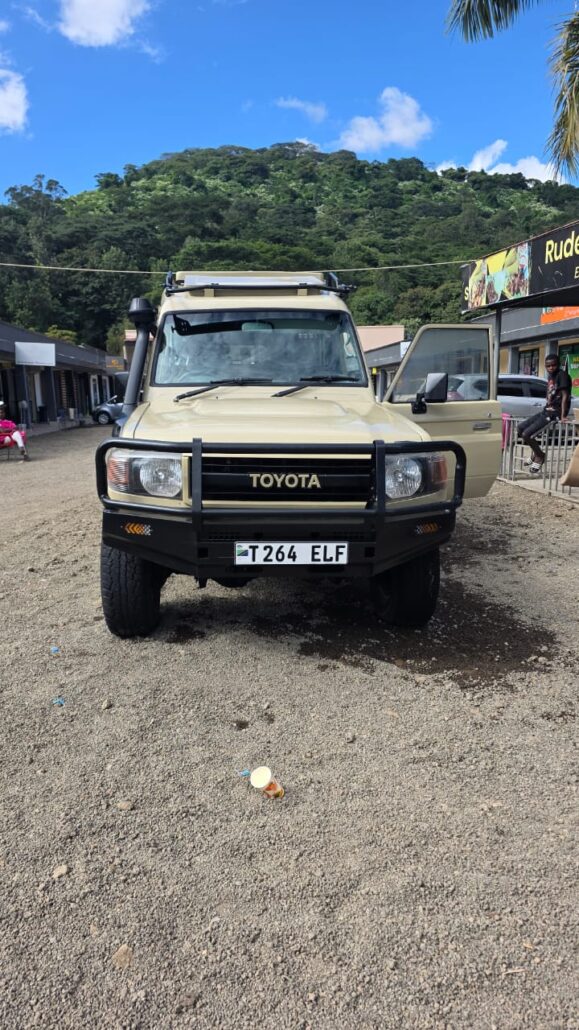
Tanzanian-registered, because the journey stays inside Tanzania. We use Tanzanian-registered vehicles for one-way rentals within Tanzania and its national parks and Uganda-registered vehicles for multi-country one-way rentals to Kenya, Rwanda, and Uganda.
Can I use a Kenyan-registered vehicle for this trip?
We do not recommend it. Kenyan-registered vehicles are completely prohibited from Tanzania’s national parks, and we do not recommend hiring one from Tanzania to Kenya or from Kenya to Tanzania.
Can a Kenyan driver-guide work in Tanzanian national parks?
No. Just as Kenyan-registered vehicles are completely prohibited from Tanzania’s national parks, Kenyan driver guides are not allowed to guide there. Tanzanian safari vehicles and their drivers are likewise not allowed to operate in Kenya.
How much does it cost?
The cost depends on the vehicle, the number of days, the add-ons you choose, and the one-way fee for the route. The fee is from $50 up to $600 on Tanzanian routes and is shown in writing before you book.
Why is there a one-way fee?
Because someone must bring the vehicle back. The fee covers fuel, the driver’s allowance, and the driver’s accommodation before and after the pick-up.
Do fuel prices and distance change the price?
Yes. When fuel prices rise, the cost of repositioning the vehicle rises with them. The farther the drop-off is from where the vehicle was picked up, the more it costs to return it.
Can I add a rooftop tent?
Yes. A rooftop tent is charged per day, and we can also supply a ground tent and a fridge.
Can I add a driver guide?
Yes, from $40 per day. He drives, handles the road and checks, and stays with the vehicle for the whole journey.
Can I collect at Kilimanjaro Airport?
Yes, by arrangement.
Can I drop the vehicle at the airport in Dar es Salaam?
Yes, by arrangement. Tell us your flight time so we can plan around the traffic.
Can I take the vehicle on the Zanzibar ferry?
No. Vehicles may not be driven onto the ferry, so you return the vehicle in Dar es Salaam before you cross.
Can I add a safari or a detour on the way?
Yes. Tell us which parks or side routes you want. We plan them with you and include the park vehicle fees in the quotation.
Can I drive at night?
No. Our vehicles are on the road only between 6:00 am and 7:00 pm.